
Occupational Qualification · W6
Discretionary Grant · UpcomingWater and Sanitation Coordinator
- NQF Level
- NQF Level 6
- Credits
- 225
- Duration
- —
- SAQA ID
- 121025
Official QCTO Registry Profile
Source: SAQA / QCTO registry- SAQA ID
- 121025
- Min Credits
- 225
- Registered
- 2023-07-04
- Re-registration
- 2028-07-04
- Field
- Field 06 - Manufacturing, Engineering and Technology
- Sub-field
- Engineering and Related Design
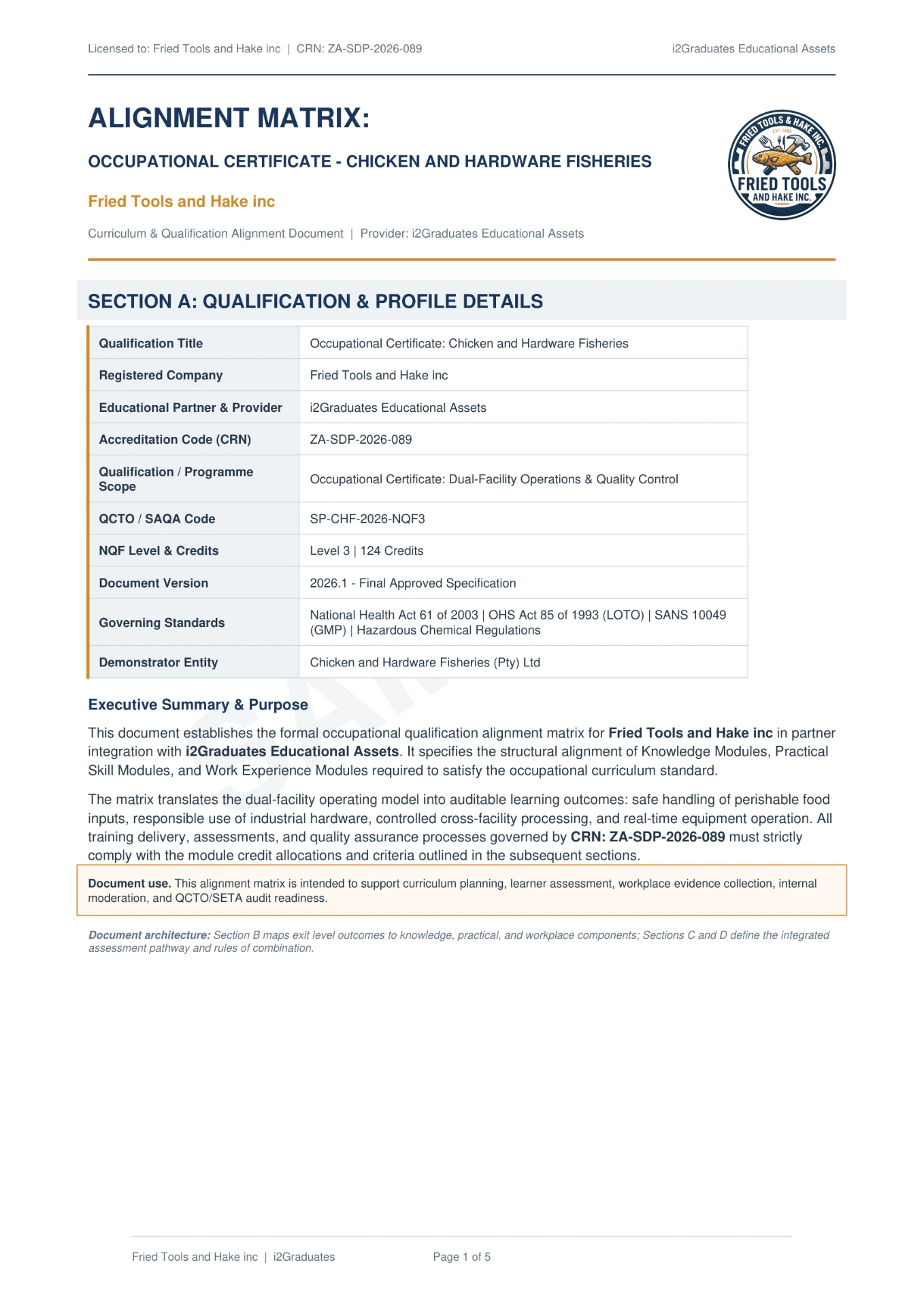
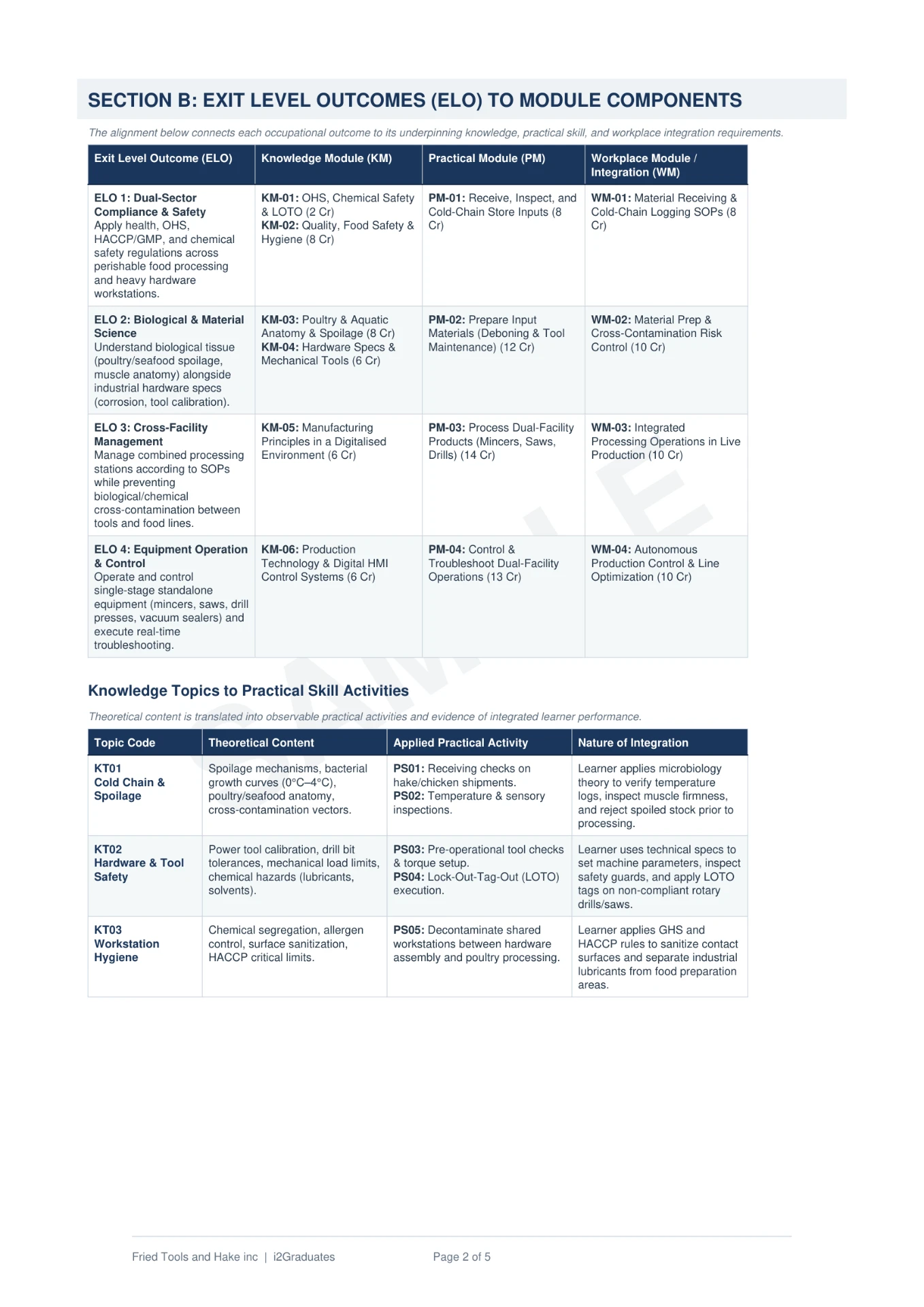
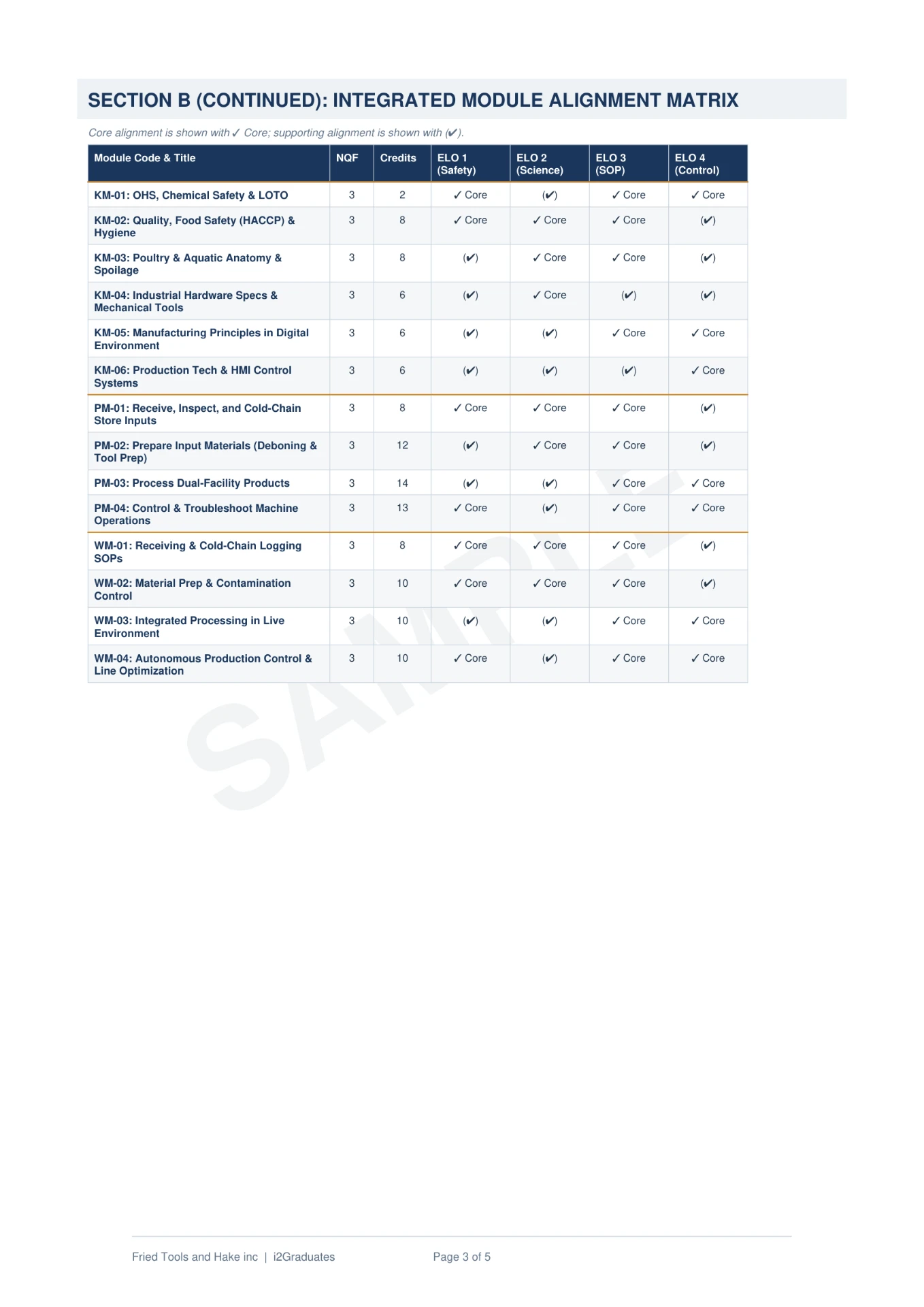
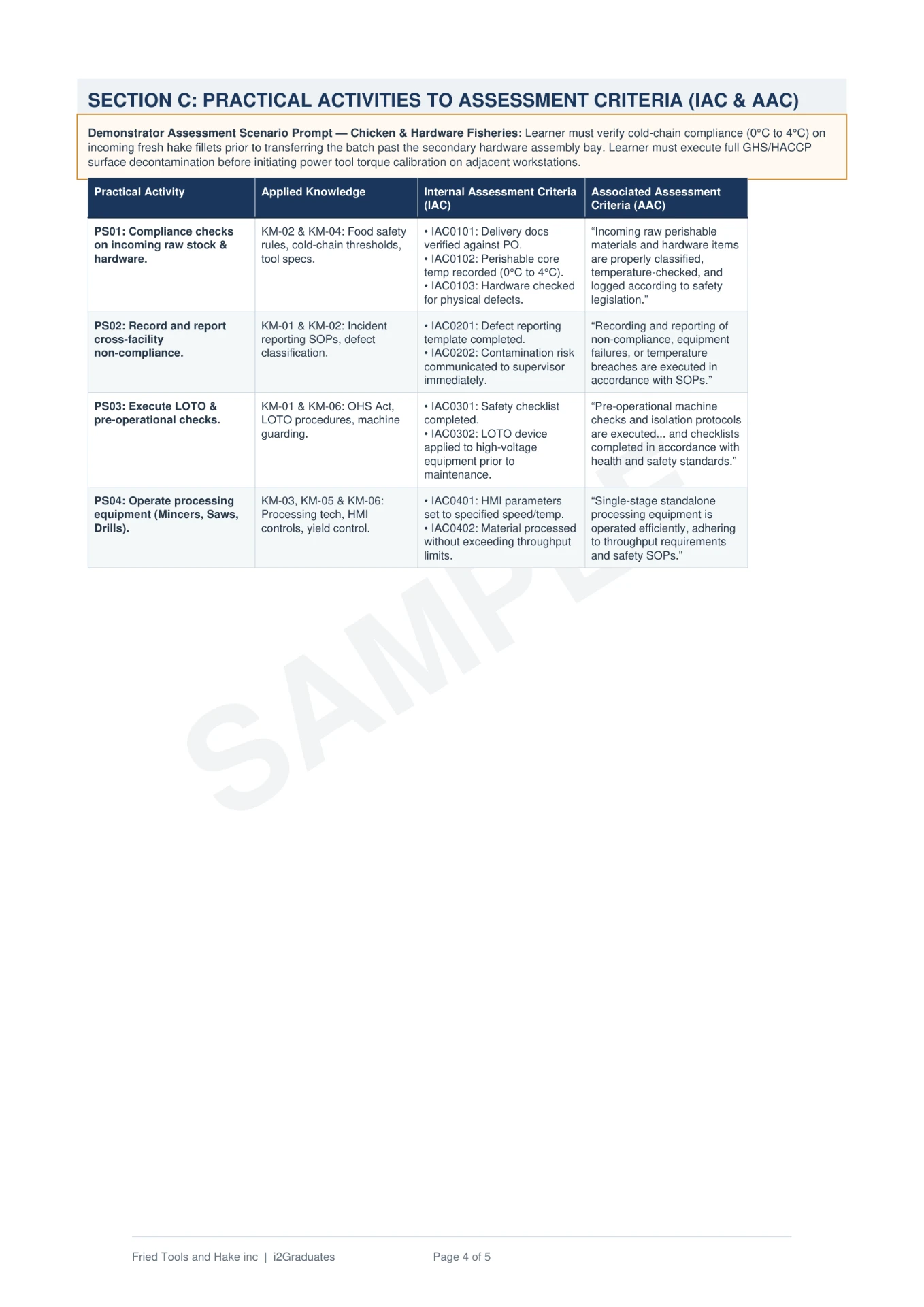
Sample Asset Preview
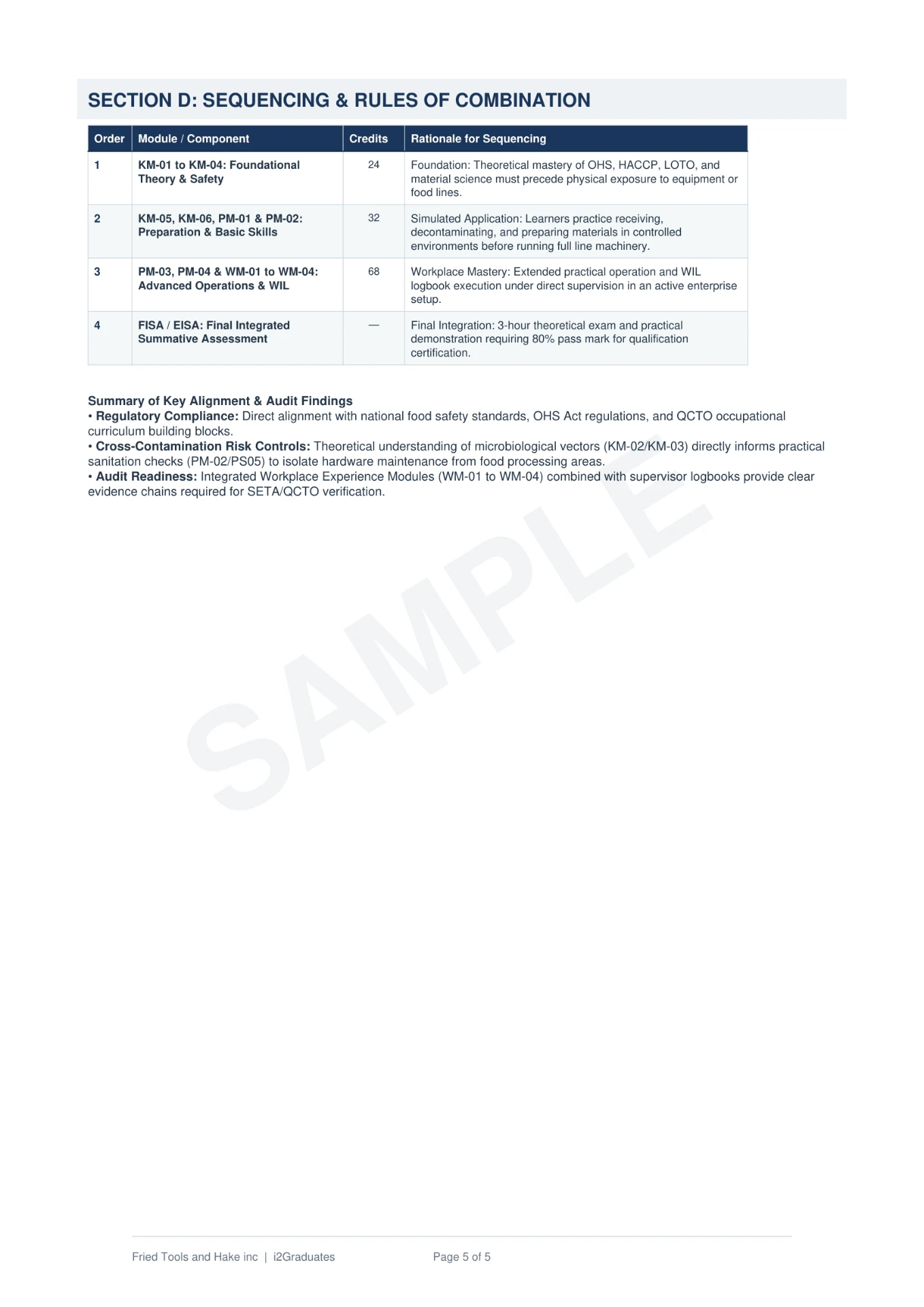
Overview & Scope
Programme Profile
- Target Designation
- Certified Water and Sanitation Coordinator Practitioner
- Competency Focus
- Master specialised practical applications, safety criteria, and regulatory mandates required of a qualified Water and Sanitation Coordinator.
- Academic Weight
- Full national recognition at NQF Level 6 yielding 225 credits upon successful PoE verification.
- Work Opportunities
- Deployment across As a qualified water and sanitation coordinator, you can find employment opportunities in Local Government, Municipal Services. Your skills will be in demand across both public and private sectors, and you may also choose to work as an independent contractor or start your own business in this field. operations under LGSETA scope.
- Audit Objective
- Bridges operational skills deficits under the governing LGSETA quality matrix.
- Value Proposition
- Measurable, legally compliant skills that optimise productivity, satisfy Workplace Skills Plans (WSP), and unlock B-BBEE scorecard weight.
Introduction▾
The Water and Sanitation Coordinator (NQF Level 6, 225 credits) is a comprehensive Occupational Certificate that blends foundational theory with intensive practical application. Throughout your learning journey, you will develop the competencies required to operate effectively, safely, and ethically within your industry. Employers value this qualification because it signals that you are job-ready from day one.
Purpose▾
The purpose of this qualification is to prepare a learner to operate as a Water and Sanitation Coordinator. A Water and Sanitation Coordinator plans, organises, directs, controls, promotes, facilitates, and coordinates the implementation of water, sanitation, health and hygiene programmes and projects to meet social and technical requirements. A qualified learner will be able to: • Investigate community needs in relation to sanitation and water-related services and practices. • Develop community engagement structures for planning and implementation of Sanitation, Hygiene and Water (SHAW) programmes and projects. • Plan and coordinate the implementation of SHAW programmes and projects at a community level. • Promote the implementation of SHAW programmes and projects. • Review or develop SHAW programme guidelines. The qualification will and create career opportunities for water and sanitation practitioners allowing career pathing to qualifying learners to water and sanitation related occupations such as Water and Sanitation Programme Manager, Water Sanitation and Hygiene (WASH) Advisor or Environmental Specialist.
Entry Requirements▾
Recognition of Prior Learning (RPL): • Learners will gain access to the qualification through RPL for Access as provided for in the QCTO RPL Policy. RPL for access is conducted by accredited education institution, skills development provider or workplace accredited to offer that specific qualification/part qualification. • Learners who have acquired competencies of the modules of a qualification or part qualification will be exempted from modules through RPL. • Learners will be awarded credits for or towards the qualification or part qualification through RPL as provided in the QCTO RPL Policy. RPL for credits provides for the formal award of credits for, or towards a qualification or part-qualification registered on the NQF. • RPL for access to the external integrated summative assessment: Accredited providers and approved workplaces must apply the internal assessment criteria specified in the related curriculum document to establish and confirm prior learning. Accredited providers and workplaces must confirm prior learning by issuing a statement of result or certifying a work experience record. Entry Requirements: • NQF Level 4 with Communication and Mathematics.
SAQA Rationale▾
Water borne diseases are major killers in society and effective intervention can reduce the spread of disease, alleviate suffering, and ultimately save lives. Preventing public health problems by coordinating pre-emptive measures adds value to government initiatives and enhances inter-governmental cooperation to address socio-economic problems relating to water and sanitation. The qualification reflects the needs expressed by the sector and has been developed to enhance the quality of education and training in water and sanitation field. There are many people in South Africa who lack access to clean, drinkable water. Good hygiene practices are an essential part of daily life, and this qualification will benefit the society especially in low-income settings such as rural and semi-rural areas as well as those living in urban areas facing water and sanitation challenges in informal settlements. It will provide the intended learners with competencies to oversee the implementation of community water, health and sanitation programmes and projects to address massive backlogs, especially in rural and remote communities by coordinating, facilitating and promoting good hygiene in the communities and educating them in ways to protect themselves and their families from ill-health. The provision of water supply, sanitation and wastewater services will generate substantial benefits for public health, the economy, and the environment. The qualification will benefit this country's economy as developed countries including World Health Organisation and the United Nations Children's Fund (UNICEF) will be encouraged to make substantial investments to improve access to water reducing water-borne diseases, sanitation and hygiene in South Africa. The education and training of communities by Water and Sanitation Coordinators will promote the people's health enabling them to be productive and contribute to the economy of the country adding value to the Gross Domestic Product (GDP). The qualification will also benefit the South African economy as the provision of safe, clean water, sanitation and good health practices will prevent diseases, illnesses and saving lives of the South African communities due to poor health and hygiene thus reducing unnecessary costs for healthcare. Qualifying learners will be able to coordinate, plan and implement programmes and oversee water, sanitation, and hygiene programmes through all stages of the project management and empower people to gain access to safe,clean water, sanitation and hygiene practices to improve the sustainability of community and environmental health, health and hygiene. Currently there is/are no similar qualification(s) registered on the National Qualifications Framework (NQF). In addition, there is no licensing or registration with a professional/regulatory body required for graduates to practice in the occupation at the time of development of this qualification.
Learning Assumed to be in Place & RPL▾
Recognition of Prior Learning (RPL): • Learners will gain access to the qualification through RPL for Access as provided for in the QCTO RPL Policy. RPL for access is conducted by accredited education institution, skills development provider or workplace accredited to offer that specific qualification/part qualification. • Learners who have acquired competencies of the modules of a qualification or part qualification will be exempted from modules through RPL. • Learners will be awarded credits for or towards the qualification or part qualification through RPL as provided in the QCTO RPL Policy. RPL for credits provides for the formal award of credits for, or towards a qualification or part-qualification registered on the NQF. • RPL for access to the external integrated summative assessment: Accredited providers and approved workplaces must apply the internal assessment criteria specified in the related curriculum document to establish and confirm prior learning. Accredited providers and workplaces must confirm prior learning by issuing a statement of result or certifying a work experience record. Entry Requirements: • NQF Level 4 with Communication and Mathematics.
Exit Level Outcomes▾
- Analyse and apply current sanitation and water strategies and plans regarding water services and resources protection (15%).
- Conduct community-based research on sanitation and waste management services and practice, (15%).
- Plan and coordinate the implementation of SHAW programmes and projects (30%).
- Establish community engagement structures for the promotion, facilitation, and coordination of the implementation of SHAW programmes and projects (15%).
- Monitor and evaluate the progress and performance of SHAW programmes and project implementation for specific community setting (25%).
Learning Material Included
- Learner Guide (Theory and Knowledge Modules)
- Facilitator Guide
- Workplace Logbook
- Formative and Summative Assessment
- Assessor Guide & Marking Memorandum
- SETA / QCTO Alignment Matrix
- Administrative & Onboarding Pack
- Implementation Plan
Moderator-Ready Curriculum Breakdown
10 modules · 157 creditsTheory, regulatory and safety knowledge. Each row carries the registered module code, NQF level and credit weight used for formative assessment rubric mapping.
- 121905-001-00-00-KM-0310 cr
Water and Sanitation Legislation, Regulations and Policies
NQF Level 5
Qualification 121025 · Curriculum Architecture
Occupational Certificate: Water and Sanitation Coordinator · NQF Level 6 (225 Credits)
Three Curriculum Pillars
Knowledge Modules
Classroom & E-Learning
- Facilitated lectures & self-study
- Written question banks
- Formative comprehension checks
Practical Skill Modules
Simulated Line Tasks
- Simulated line tasks
- Observation rubrics
- Structured task sheets
Work Experience Modules
On-the-Job Production
- On-the-job rotation
- Mentor logbooks
- Workplace sign-offs
Evidence & Audit Pipeline
Learner Portfolio of Evidence (PoE)Owner · Candidate▾
Admin & Registration
ID, learner contract, induction pack, POPIA consent.
Knowledge Evidence
Written assessments & question banks — KM-01 to KM-07.
Practical Evidence
Task sheets, observation rubrics, assessor photos.
Workplace Evidence
Logbooks, mentor sign-offs, supervisor letters.
Assessor Master FileOwner · Registered Assessor▾
Assessment Reports
Judgements, learner feedback, remediation agreements, appeals log.
Internal Moderation & Quality FileOwner · Moderator / SDP▾
Moderation Evidence
10% sampling matrix, HACCP/LOTO compliance sheets, SDP sign-off.
Final Accreditation Gateway
Issued by the accredited Skills Development Provider once internal moderation is signed off.
Provider submits declaration + PoE to the Assessment Quality Partner (AQP).
QCTO awards the SAQA-registered certificate on successful EISA outcome.
Audit & Compliance
Evidence & Audit Pipeline
From portfolio assembly to external sign-off — the exact route your evidence travels.
- Step 1
PoE Assembly
Learner evidence, formative records and logbook entries filed against the alignment matrix.
- Step 2
Internal Assessment
Registered assessor judges each KM/PM/WM outcome using the supplied instruments.
- Step 3
Internal Moderation
Sampling and verification of assessor decisions, with remediation loop before submission.
- Step 4
External Moderation
SETA/QCTO desktop audit and certification upload against registered credits.
Broken Standard vs i2Graduates Standard
The measurable delta between improvised material and an audit-ready suite.
Broken Standard
i2Graduates Standard
Curriculum Mapping
Photocopied guides with mismatched outcomes
1 KM + 5 PM + 4 WM modules mapped to NQF Level 6
Assessment Bank
Missing formative and summative assessments
Pre-validated assessment bank per module
Alignment Evidence
No alignment matrix — audit fails
LGSETA alignment matrix included
Facilitation
Facilitators improvise Water and Sanitation Coordinator delivery
Facilitator scripts + learner activities per credit
Portfolio of Evidence
PoE gaps flagged in moderation
PoE templates that survive external moderation
Pricing & Delivery Tiers
Base licence from R71 250
Digital Master Suite
Editable master files, licensed to your SDP
- Learner Guide, Facilitator Guide & Assessment Suite
- Workplace logbook + alignment matrix (editable)
- Instant digital delivery under institutional licence
- Free minor corrections for 12 months
Turnkey Print & Bound Package
Printed, bound and couriered per learner
- Everything in the Digital Master Suite
- Full-colour print, wire-bound learner packs
- Per-learner PoE folders and dividers
- Nationwide courier with tracked delivery
Full Enterprise Accreditation Bundle
Assets plus accreditation support end-to-end
- Everything in the Print & Bound Package
- Bespoke QMS build mapped to your scope
- Moderation dry-run + written remediation report
- Brand & metadata integration across the suite
Complementary Services
Optional add-ons that harden your accreditation scope before an external audit.
Bespoke QMS Build
We author your Quality Management System — policies, procedures, records, matrices — mapped to your accreditation scope. From R18,500.
Request QuoteModeration Consultation
External moderation dry-run on your PoE + delivery pack. Written report with fixes before your real audit. From R4,900.
Book Moderation SessionThe i2Graduates Quality Guarantee
Every page of this bundle is checked for sequence and structural accuracy — no missing pages, no shortcuts. You get pre-validated assessment instruments ready to survive rigorous compliance moderation, wrapped in a curriculum your facilitators will enjoy teaching.