
Occupational Qualification · W5
Discretionary Grant · UpcomingWaste Electrical and Electronic Equipment Small Business Operator
- NQF Level
- NQF Level 3
- Credits
- 154
- Duration
- —
- SAQA ID
- 121158
Official QCTO Registry Profile
Source: SAQA / QCTO registry- SAQA ID
- 121158
- Min Credits
- 154
- Registered
- 2023-11-14
- Re-registration
- 2028-11-14
- Field
- Field 03 - Business, Commerce and Management Studies
- Sub-field
- Marketing
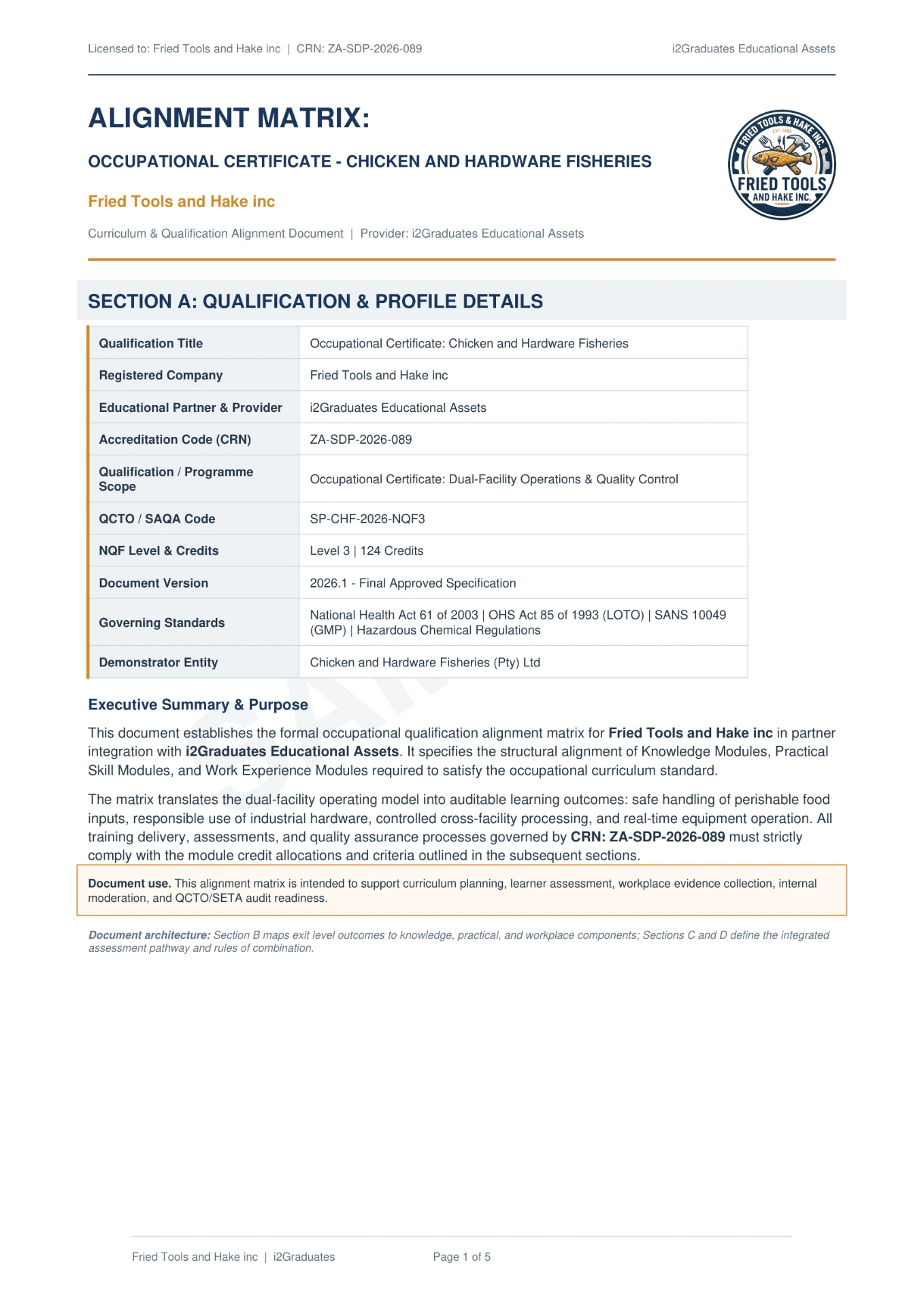
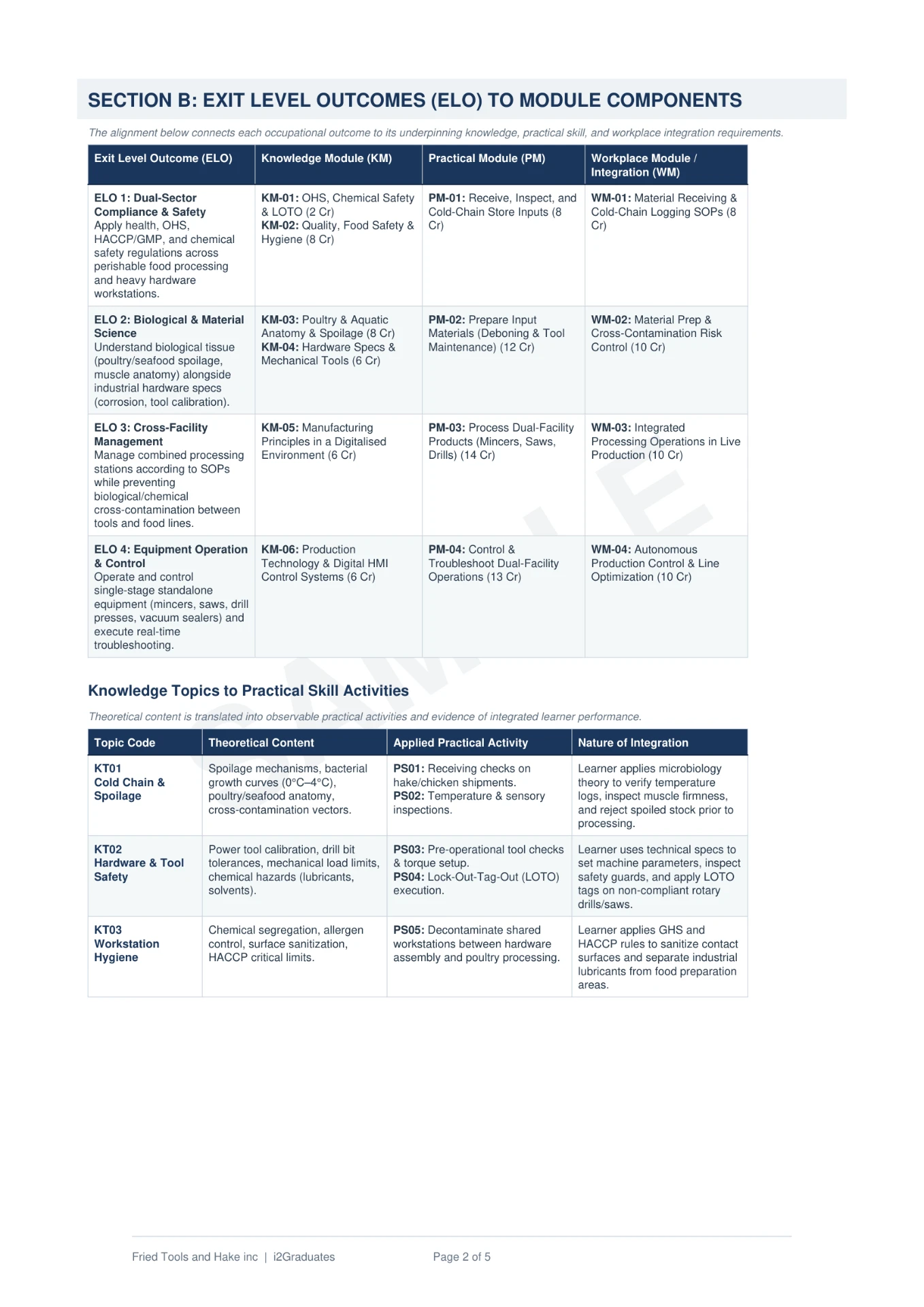
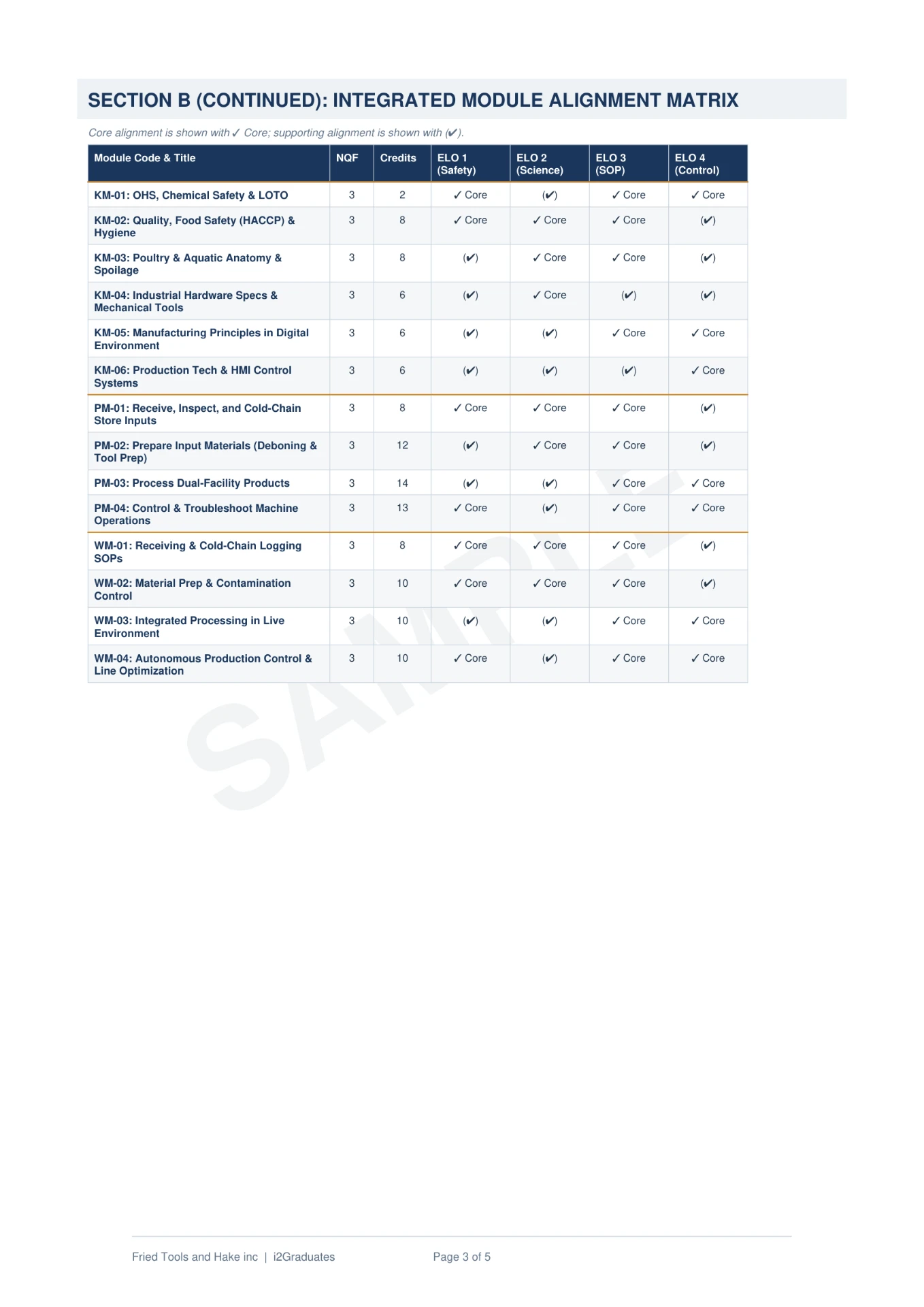
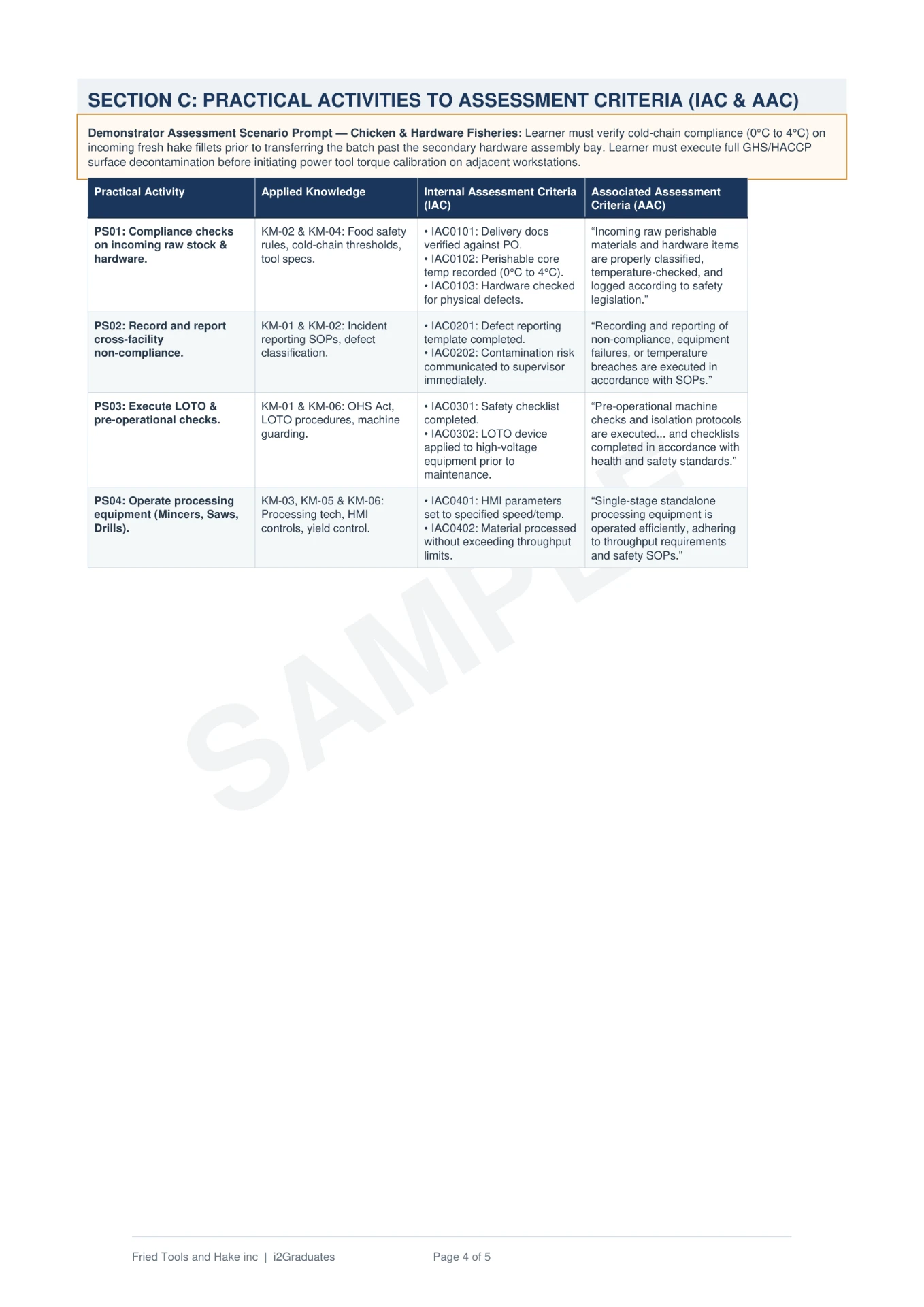
Sample Asset Preview
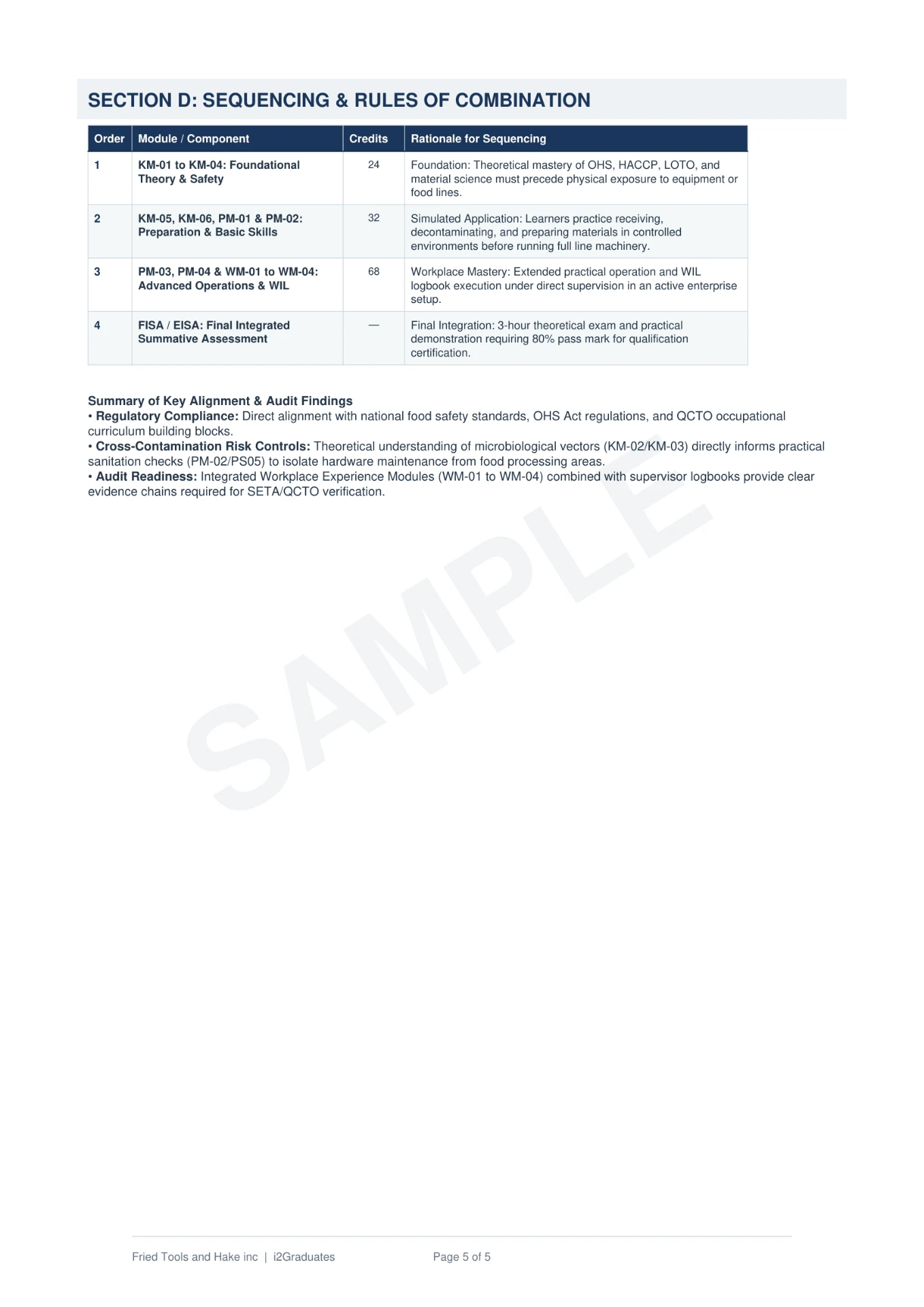
Overview & Scope
Programme Profile
- Target Designation
- Certified Waste Electrical and Electronic Equipment Small Business Operator Practitioner
- Competency Focus
- Master specialised practical applications, safety criteria, and regulatory mandates required of a qualified Waste Electrical and Electronic Equipment Small Business Operator.
- Academic Weight
- Full national recognition at NQF Level 3 yielding 154 credits upon successful PoE verification.
- Work Opportunities
- Deployment across As a qualified waste electrical and electronic equipment small business operator, you can find employment opportunities in Electrical Engineering, Construction, Utilities including construction firms, utilities, manufacturing plants, and maintenance service providers. Your skills will be in demand across both public and private sectors, and you may also choose to work as an independent contractor or start your own business in this field. operations under EWSETA scope.
- Audit Objective
- Bridges operational skills deficits under the governing EWSETA quality matrix.
- Value Proposition
- Measurable, legally compliant skills that optimise productivity, satisfy Workplace Skills Plans (WSP), and unlock B-BBEE scorecard weight.
Introduction▾
The Waste Electrical and Electronic Equipment Small Business Operator (NQF Level 3, 154 credits) is a comprehensive Intermediate Occupational Certificate that blends foundational theory with intensive practical application. Throughout your learning journey, you will develop the competencies required to operate effectively, safely, and ethically within your industry. Employers value this qualification because it signals that you are job-ready from day one.
Purpose▾
The purpose of this qualification is to prepare a learner to function as a Waste Electrical and Electronic Equipment Small Business Operator. A WEEE Entrepreneur starts-up and/or operates a small WEEE sector-related business. They collect, sort, containerise, store and prepare WEEE for transport. They also assess the WEEE, dismantle it and sell value fractions of WEEE to properly registered and compliant downstream WEEE facilities for final treatment and processing while paying them for the uptake of any depolluted components that require special final treatment such as incineration or land disposal. A WEEE Entrepreneur also direct hazardous waste to an appropriate and authorised downstream facility or service provider. A qualified learner will be able to: • Collect, record, assess, sort, containerise, store, and prepare WEEE for transport. • Test, assess, dismantle, and depollute ICT equipment to determine whether it can be reused, repaired, or refurbished or must be reclassified as WEEE. • Test, assess, dismantle, and depollute large and small household appliances (excluding temperature exchange equipment), and entertainment and consumer electronic equipment to determine whether they can be reused, repaired, or refurbished or must be reclassified as WEEE. • Operate a small WEEE sector-related business. Typical graduate attributes include proficiency, efficiency, and effectiveness in running a WEEE sector-related business or enterprise. Another significant attribute would be an appreciation of the significant level of responsibility involved in collecting, sorting, assessing, and dismantling and depolluting WEEE and determining whether it can be recycled or needs to be disposed of. The massive challenges posed by the accumulation of WEEE and the level of pollution of the environment require people who, through their chosen occupation, will alleviate such problems experienced by society.
Entry Requirements▾
The Waste Electrical and Electronic Equipment Small Business Operator is intended for entry-level workers, school leavers, or career changers who want to gain foundational skills. If you have a passion for this field and want to turn that passion into a profession, this programme will give you the tools and credentials to succeed. It is also suitable for employers who wish to upskill their workforce to meet industry standards.
SAQA Rationale▾
Waste Electrical and Electronic Equipment (WEEE) which is listed by the South African government into eight (8) distinct categories and classified as hazardous (unless depolluted) comprises of, inter alia, computers, monitors, printers, white appliances (washing machines, dishwashers, electric stoves etc.) cell phones, televisions, video machines, microwave machines, toasters etc. Recent estimates suggest that at least 415,000 tons of WEEE are generated per annum in South Africa. However, of that, only about 35,000 tons of WEEE finds its way to formally registered recyclers where it is recycled in a legally compliant manner. Research confirmed that a large portion of WEEE generated in South Africa is stored and stockpiled in national and provincial government departments, business entities and households and asset disposal release strategies are currently developed by government to unlock some of these volumes safely now. Disposing of used or non-functioning WEEE has potentially a large negative impact especially if simply landfilled (which has been largely the case in South Africa) because while some types of WEEE are benign certain materials contained within components are toxic and hazardous and can be harmful to human health and the environment if not treated or managed in a compliant manner. It is for that reason that as of 23 August 2021 all disposal of WEEE to landfill has been banned entirely, creating even more pressure to build capacity and skills related to the alternative treatment options for WEEE. On the other hand, with global pressure rising to secure future resources required for Electrical and Electronic Equipment (EEE) manufacturing it is crucial that South Africa builds capacity to facilitate the optimal value extraction from WEEE. Finally, with the introduction of regulation in October 2021 that promotes the Extended Producer Responsibility principle, parties grouped under 'producer' are now obligated to finance the management and take back of WEEE and ensure that funds are used to also facilitate job creation in the informal waste sector integration. The solution lies in recycling and recovery of WEEE for the purpose of refurbishment or materials recycling rather than any disposal. This involves collecting and sorting WEEE, preparing it for transport it to recycling facilities where it can be tested for functionality, dismantled, depolluted, and prepared either for further downstream recovery of materials or any other required form of final treatment including disposal (but only of the WEEE recycling residuals). It is against this background that, the proposed qualification scope will create the possibility of WEEE Entrepreneurs emerging as Small, Medium, and Micro-sized Enterprises (SMME). These SMMEs will promote a culture of WEEE recovery and recycling and significantly enhance job creation. While WEEE entrepreneurship - at this level - in the rapidly-growing WEEE space has started, the training needs of WEEE entrepreneurs will have to be addressed in a formal qualification. WEEE entrepreneurs will have to be trained to recover and recycle the ever-growing amount of WEEE generated in South Africa and beyond safely and efficiently. To be successful and adequately skilled WEEE entrepreneurs require the requisite theoretical understanding of WEEE and the practical skills to start their own small business and to create efficiency in the safe, compliant, and financially feasible collection, transportation, testing, dismantling and recycling and authorisation for disposal of WEEE recycling residues. There are four registered qualifications in the waste recycling space - the Occupational Certificate: Collaborative Recycler at NQF Level 2, the Occupational Certificate: Materials Recycler (Paper and Packaging Collector) at NQF Level 3, the Occupational Certificate: Self-employed Re-cycling Materials Collector at NQF Level 1 and the Occupational Certificate: Small Re-cycling Business Owner at NQF Level 3. However, the focus of the four registered qualifications is solely on the paper and packaging sector and not on WEEE, in which equipment such as a PC can contain as much as ten different material types and whose metals can be comprised of up to 37 different elements. The Occupational Certificate: E-Waste Operations Controller at Level 4 has a significant relationship with this qualification and presents an opportunity for vertical articulation. There is also a Higher Certificate in Resource and Waste Management offered by the Tshwane University of Technology (TUT). While it addresses waste and resource management, it does not mention WEEE per se nor does it address WEEE entrepreneurship. In essence, considering the size of WEEE generated annually in the country, the critical need for trained WEEE entrepreneurs, collectors and dismantlers created a huge demand for this qualification. And as the WEEE sector grows, the economy will grow and so will the need for skilled employees - the economic and social impact of the WEEE sector will be substantial. Typical learners include school leavers, those collecting and dismantling WEEE but in an informal and untrained manner, and those currently in employment without formal recognition of their competencies. WEEE Entrepreneurs can be employed as WEEE Collectors and Sorters, WEEE Manual Dismantlers and can become self-employed.
Exit Level Outcomes▾
- Collect, assess, sort, containerise, store, and prepare WEEE for transport.
- Test, assess, dismantle, and depollute ICT equipment to determine whether it can be reused, repaired, or refurbished or must be reclassified as WEEE.
- Test, assess, dismantle, and depollute large and small household appliances (excluding temperature exchange equipment), and consumer electronics and entertainment equipment to determine whether they can be reused, repaired, or refurbished or must be reclassified as WEEE.
- Operate a WEEE sector-related business.
Learning Material Included
- Learner Guide (Theory and Knowledge Modules)
- Facilitator Guide
- Workplace Logbook
- Formative and Summative Assessment
- Assessor Guide & Marking Memorandum
- SETA / QCTO Alignment Matrix
- Administrative & Onboarding Pack
- Implementation Plan
Moderator-Ready Curriculum Breakdown
15 modules · 154 creditsTheory, regulatory and safety knowledge. Each row carries the registered module code, NQF level and credit weight used for formative assessment rubric mapping.
- 524901-001-00-KM-017 cr
Waste Electrical and Electronic Equipment (WEEE) collection, assessment, sorting, containerising, storage, and preparation of WEEE for transport
NQF Level 2
- 524901-001-00-KM-024 cr
Electrical and electronic theory
NQF Level 3
- 524901-001-00-KM-0310 cr
Assessment, dismantling, and depollution of office and information communication technology (ICT) equipment, and data sanitisation
NQF Level 3
- 524901-001-00-KM-0410 cr
Assessment, dismantling and depollution of large and small household appliances (excluding temperature exchange appliances), and entertainment and consumer electronic equipment
NQF Level 3
- 524901-001-00-KM-056 cr
Operation of a WEEE sector-related business
NQF Level 3
- 524901-001-00-KM-064 cr
Customer management in a WEEE sector-related business
NQF Level 3
Qualification 121158 · Curriculum Architecture
Intermediate Occupational Certificate: Waste Electrical and Electronic Equipment Small Business Operator · NQF Level 3 (154 Credits)
Three Curriculum Pillars
Knowledge Modules
Classroom & E-Learning
- Facilitated lectures & self-study
- Written question banks
- Formative comprehension checks
Practical Skill Modules
Simulated Line Tasks
- Simulated line tasks
- Observation rubrics
- Structured task sheets
Work Experience Modules
On-the-Job Production
- On-the-job rotation
- Mentor logbooks
- Workplace sign-offs
Evidence & Audit Pipeline
Learner Portfolio of Evidence (PoE)Owner · Candidate▾
Admin & Registration
ID, learner contract, induction pack, POPIA consent.
Knowledge Evidence
Written assessments & question banks — KM-01 to KM-07.
Practical Evidence
Task sheets, observation rubrics, assessor photos.
Workplace Evidence
Logbooks, mentor sign-offs, supervisor letters.
Assessor Master FileOwner · Registered Assessor▾
Assessment Reports
Judgements, learner feedback, remediation agreements, appeals log.
Internal Moderation & Quality FileOwner · Moderator / SDP▾
Moderation Evidence
10% sampling matrix, HACCP/LOTO compliance sheets, SDP sign-off.
Final Accreditation Gateway
Issued by the accredited Skills Development Provider once internal moderation is signed off.
Provider submits declaration + PoE to the Assessment Quality Partner (AQP).
QCTO awards the SAQA-registered certificate on successful EISA outcome.
Audit & Compliance
Evidence & Audit Pipeline
From portfolio assembly to external sign-off — the exact route your evidence travels.
- Step 1
PoE Assembly
Learner evidence, formative records and logbook entries filed against the alignment matrix.
- Step 2
Internal Assessment
Registered assessor judges each KM/PM/WM outcome using the supplied instruments.
- Step 3
Internal Moderation
Sampling and verification of assessor decisions, with remediation loop before submission.
- Step 4
External Moderation
SETA/QCTO desktop audit and certification upload against registered credits.
Broken Standard vs i2Graduates Standard
The measurable delta between improvised material and an audit-ready suite.
Broken Standard
i2Graduates Standard
Curriculum Mapping
Photocopied guides with mismatched outcomes
6 KM + 5 PM + 4 WM modules mapped to NQF Level 3
Assessment Bank
Missing formative and summative assessments
Pre-validated assessment bank per module
Alignment Evidence
No alignment matrix — audit fails
EWSETA alignment matrix included
Facilitation
Facilitators improvise Waste Electrical and Electronic Equipment Small Business Operator delivery
Facilitator scripts + learner activities per credit
Portfolio of Evidence
PoE gaps flagged in moderation
PoE templates that survive external moderation
Pricing & Delivery Tiers
Base licence from R52 700
Digital Master Suite
Editable master files, licensed to your SDP
- Learner Guide, Facilitator Guide & Assessment Suite
- Workplace logbook + alignment matrix (editable)
- Instant digital delivery under institutional licence
- Free minor corrections for 12 months
Turnkey Print & Bound Package
Printed, bound and couriered per learner
- Everything in the Digital Master Suite
- Full-colour print, wire-bound learner packs
- Per-learner PoE folders and dividers
- Nationwide courier with tracked delivery
Full Enterprise Accreditation Bundle
Assets plus accreditation support end-to-end
- Everything in the Print & Bound Package
- Bespoke QMS build mapped to your scope
- Moderation dry-run + written remediation report
- Brand & metadata integration across the suite
Complementary Services
Optional add-ons that harden your accreditation scope before an external audit.
Bespoke QMS Build
We author your Quality Management System — policies, procedures, records, matrices — mapped to your accreditation scope. From R18,500.
Request QuoteModeration Consultation
External moderation dry-run on your PoE + delivery pack. Written report with fixes before your real audit. From R4,900.
Book Moderation SessionThe i2Graduates Quality Guarantee
Every page of this bundle is checked for sequence and structural accuracy — no missing pages, no shortcuts. You get pre-validated assessment instruments ready to survive rigorous compliance moderation, wrapped in a curriculum your facilitators will enjoy teaching.