
Occupational Qualification · T39
Discretionary Grant · UpcomingTraffic Officer
- NQF Level
- NQF Level 6
- Credits
- 371
- Duration
- —
- SAQA ID
- 121688
Official QCTO Registry Profile
Source: SAQA / QCTO registry- SAQA ID
- 121688
- Min Credits
- 371
- Registered
- 2024-01-30
- Re-registration
- 2029-01-30
- Field
- Field 08 - Law, Military Science and Security
- Sub-field
- Safety in Society
Sample Asset Preview
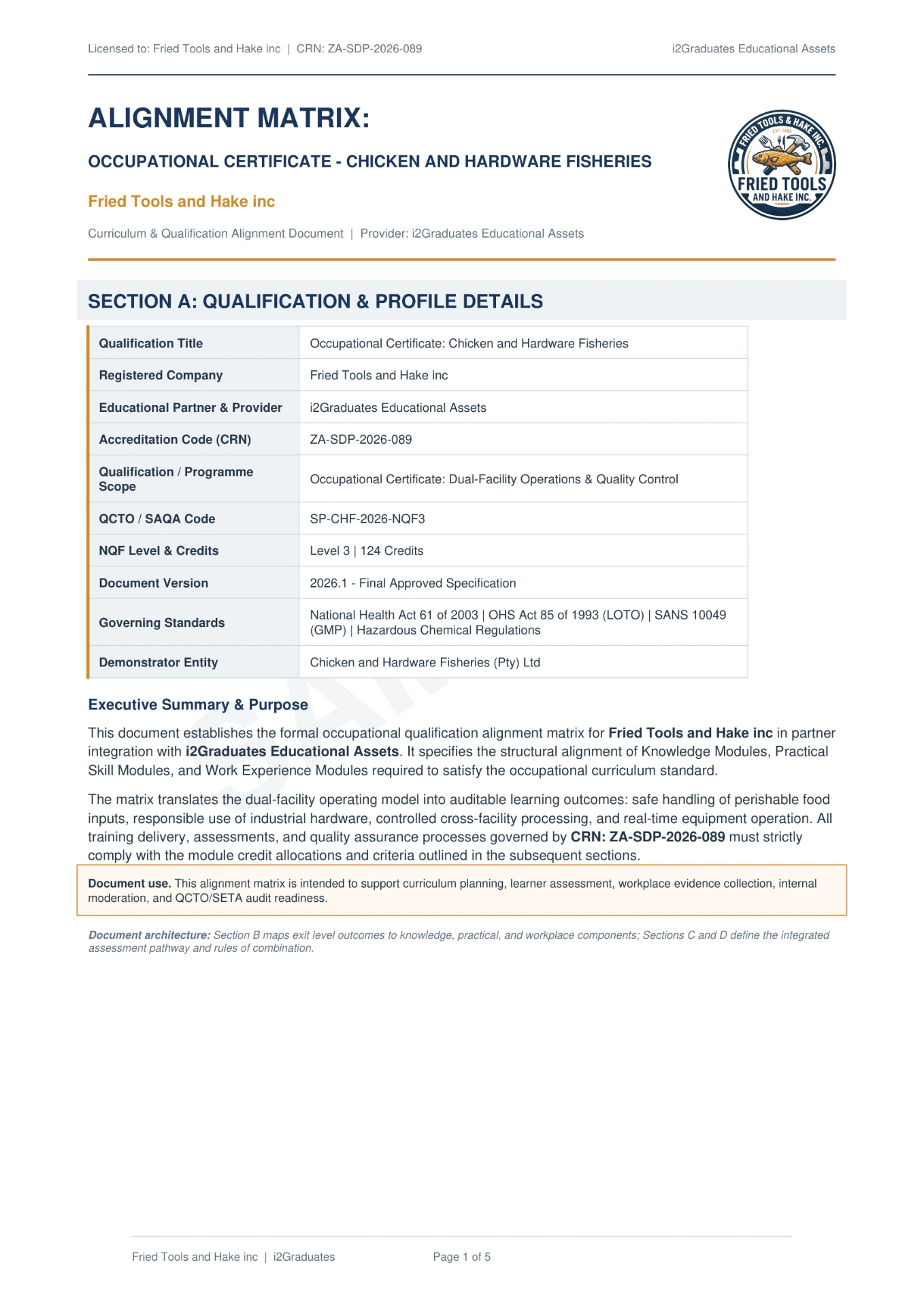
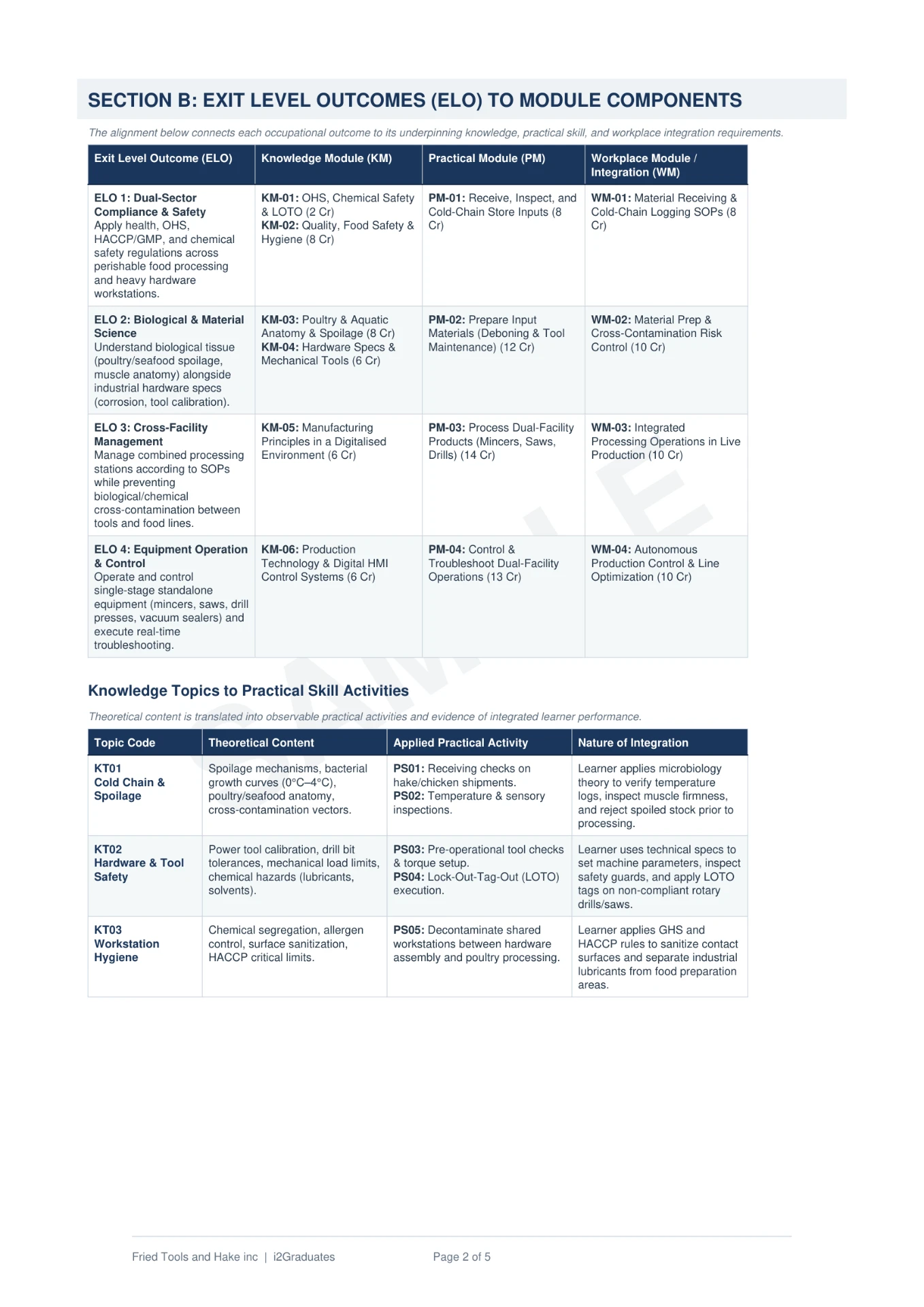
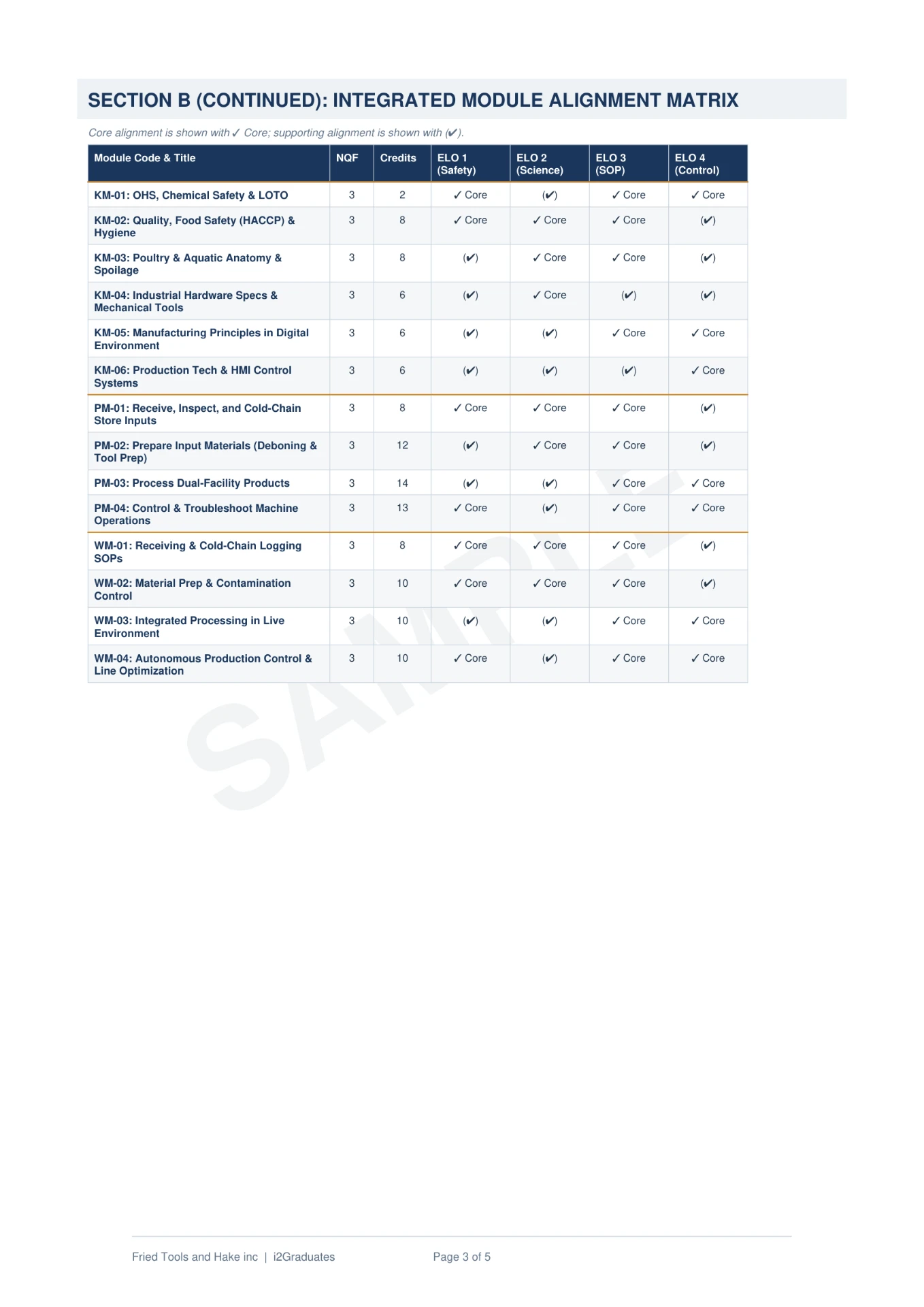
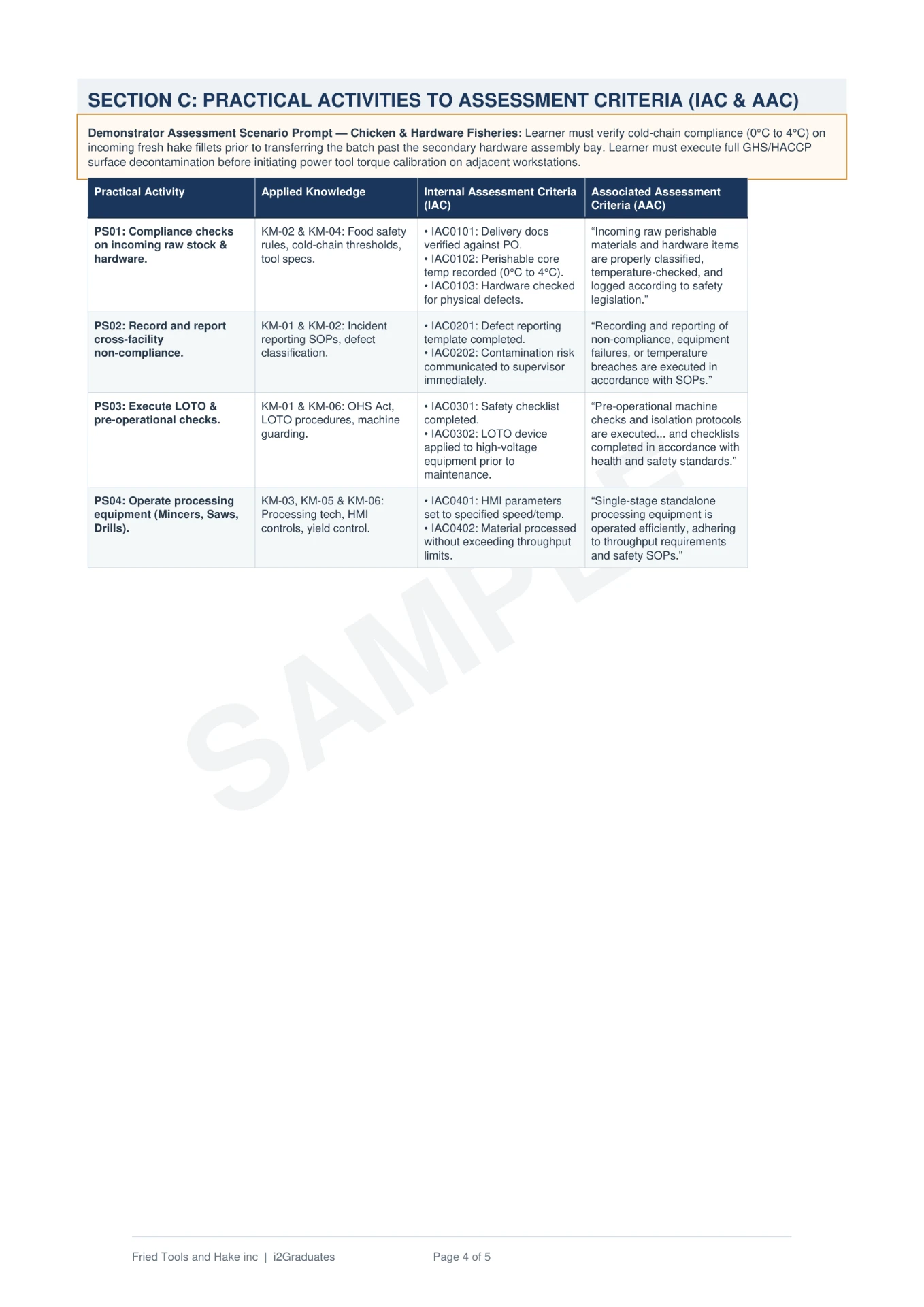
Overview & Scope
Programme Profile
- Target Designation
- Certified Traffic Officer Practitioner
- Competency Focus
- Master specialised practical applications, safety criteria, and regulatory mandates required of a qualified Traffic Officer.
- Academic Weight
- Full national recognition at NQF Level 6 yielding 371 credits upon successful PoE verification.
- Work Opportunities
- Deployment across As a qualified traffic officer, you can find employment opportunities in Security, Policing, Justice, Corrections. Your skills will be in demand across both public and private sectors, and you may also choose to work as an independent contractor or start your own business in this field. operations under SASSETA scope.
- Audit Objective
- Bridges operational skills deficits under the governing SASSETA quality matrix.
- Value Proposition
- Measurable, legally compliant skills that optimise productivity, satisfy Workplace Skills Plans (WSP), and unlock B-BBEE scorecard weight.
Introduction▾
The Traffic Officer (NQF Level 6, 371 credits) is a comprehensive Occupational Certificate that blends foundational theory with intensive practical application. Throughout your learning journey, you will develop the competencies required to operate effectively, safely, and ethically within your industry. Employers value this qualification because it signals that you are job-ready from day one.
Purpose▾
The purpose of this qualification is to prepare a learner to operate as a Traffic Officer. A traffic officer directs, controls and coordinates traffic operations in pursuit of safety on public roads. They provide effective law enforcement through planning and co-ordination of road traffic matters to ensure safe, secure, and responsible use of roads in the republic. A qualified traffic officer will be able to: • Evaluate and interpret traffic flow and traffic crash patterns by applying standard methods and techniques in the context of road traffic legislation, road safety audits, statistical analysis, and relevant standard operating procedures. • Select, investigate, and apply appropriate methods, procedures, and techniques to ensure that vehicles comply with prescribed minimum standards of roadworthiness. • Implement and manage driver licencing testing centres' processes by assessing and certifying driver's licence applicants in accordance with prescribed legislation and procedures. • Collect, evaluate, and synthesize information derived from various data sources to prepare a case within the context of crime and crash prevention models. • Respond to crash and crime scenes, incidents as well dangerous goods events and manage a plan that encompasses various other role players to mitigate secondary risks effectively and efficiently in the preliminary investigations as a first responder. • Evaluate potentially dangerous situations and select an appropriate tactical response in accordance with the minimum force regulations, apply restraining techniques and use a firearm, when necessary, to protect oneself and members of society.
Entry Requirements▾
This qualification is ideal for experienced practitioners, supervisors, or managers seeking professional recognition and deeper expertise. It is specifically designed for anyone who aspires to become a traffic officer and wants a structured, nationally recognised learning pathway. Whether you are currently working in the field or just starting out, this programme will meet you where you are and take you to the next level.
SAQA Rationale▾
As at the end of June 2021, the registered vehicles population as per the National Traffic Information Management System (NATIS) reflected a total 12 913 175 vehicles. With every second person who enters the world of work wanting to own and drive a car, coupled with South Africa becoming a sought-after tourist destination the demand for an essential service of the traffic law enforcement is envisaged to grow exponentially. The need for this qualification stems from the necessity to revise the existing similar qualifications, namely, the Occupational Certificate: Traffic Officer with SAQA ID: 97639. Eventually the Occupational Certificate: Traffic Officer, SAQA ID: 97639 and the legacy qualification, FETC: Road Traffic Law Enforcement, SAQA ID: 62289 will be replaced by the revised occupational qualification. Amongst others, the significance of the revised qualification is the inclusion of crime prevention modules, and the basic firer fighting and basic first aid modules as well as the splitting of the previously burdened modules in the current qualification that reflected disproportion of credits to workload during implementation by the skills development providers. This qualification is geared to repositioning the training norms and standards of traffic officers in line with the envisaged development of a 21st Century Cadre of traffic personnel for South Africa. The development of this qualification did not only earn acknowledgement of achievement in South Africa, but also sparked interest from several members of Southern African Development Community (SADC). This qualification is ringfenced and can only be offered by Traffic Training Centres that have been approved in terms of the National Road Traffic Act, 93 of 1996. According to Section 3D (1) (a) of the National Road Traffic Act, 1996, (Act No. 93 of 1996), the minimum requirements for registration as a traffic officer, shall be that the applicant has obtained his/her qualification at a Traffic Training Centre approved as prescribed by Regulation 2B of the National Road Traffic Regulations, 2000, and the Policy Document of Traffic Training Centres as published in the Government Gazette no. 34292 of 2011. The above is reinforced by Section 18 of the Road Traffic Management Act, 20 of 1999 wherein the Shareholders Committee must accordingly, as part of the organisational structuring of the Road Traffic Management Corporation, establish a unit responsible for the training of traffic personnel amongst many other functional units to ensure effective management of the road traffic fraternity. Furthermore, it should also be noted that the legacy qualification, FETC, Road Traffic Law Enforcement, FETC, SAQA ID: 62289 and the Occupational Certificate: Traffic Officer, SAQA ID: 97639 were ringfenced as per the above-mentioned reasons, but have now reached their registration end date. The benefit to the traffic law enforcement fraternity from the revised qualification will be a pool of properly trained and competent "Responsible, Accountable, Relevant and Ethical" (RARE) traffic law enforcement officers. The economy will benefit as more ethical and legally compliant traffic law enforcement officers will be deployed to curb the unacceptably high levels of road carnage on our public roads. Consequently, millions of Rands claimed from the Road Accident Fund (RAF) due to road accidents will be saved as road crash rates reduce as is the orphaned children who relies on the social grants from the Department of Social Development The society will also benefit from safer roads since motorists/drivers are likely to obey rules of the road as more qualified traffic officers will be deployed and visible on the public roads. The typical learners are the new entrants selected by the different spheres of government responsible for road traffic law enforcement in terms of the National Road Traffic Act, 1996 (Act 93 of 1996), as well as currently practising traffic officers who would access this qualification through recognition of prior learning (RPL). Learners who successfully complete this qualification will be eligible to operate as Traffic and Metro Police Officers, Examiners of Vehicles and Examiners for Driving Licences. Currently, no registration with a professional body is required for practicing traffic officers. However, after successfully completing this qualification, the qualified traffic officers will be required to register with the relevant enforcement authority in terms of the National Road Traffic Act (NRTA). This enforcement authority will issue them with an appointment certificate and an infrastructure number that will enable and allow them to execute their traffic law enforcement duties as authorised officers. Broader consultations were conducted with institutions of higher learning, department of transport, police and traffic training institutions and other transport agencies during the review of this occupational qualification.
Exit Level Outcomes▾
- Apply standard methods and techniques in the context of road traffic legislation, road safety audits, statistical analysis, and relevant standard operating procedures to evaluate and interpret traffic flow and traffic crash patterns.
- Demonstrate the ability to select and apply appropriate methods, procedures, and techniques to ensure that vehicles comply with prescribed minimum standards of roadworthiness.
- Demonstrate the ability to implement and manage driver licencing testing centres' processes by assessing and certifying driver's licence applicants in accordance with prescribed legislation and procedures.
- Demonstrate the ability to collect, evaluate, and synthesize information derived from various data sources to prepare a case within the context of crime and crash prevention models.
- Demonstrate the ability to evaluate potentially dangerous situations and select an appropriate tactical response in accordance with the minimum force regulations, apply restraining techniques and use a firearm when necessary to protect oneself and members of society.
- Demonstrate the ability to respond to crash and crime scenes, incidents as well as dangerous goods events and manage a plan that encompasses various other role players to mitigate secondary risks effectively and efficiently in the preliminary investigations as a first responder.
Learning Material Included
- Learner Guide (Theory and Knowledge Modules)
- Facilitator Guide
- Workplace Logbook
- Formative and Summative Assessment
- Assessor Guide & Marking Memorandum
- SETA / QCTO Alignment Matrix
- Administrative & Onboarding Pack
- Implementation Plan
Moderator-Ready Curriculum Breakdown
33 modules · 350 creditsTheory, regulatory and safety knowledge. Each row carries the registered module code, NQF level and credit weight used for formative assessment rubric mapping.
- 541201-000-00-01-KM-013 cr
Orientation
NQF Level 04
- 541201-000-00-01-KM-0212 cr
Communication Skills
NQF Level 05
- 541201-000-00-01-KM-037 cr
Professionalism and Practice
NQF Level 06
- 541201-000-00-01-KM-0412 cr
Road Traffic Law Enforcement Legislation
NQF Level 05
- 541201-000-00-01-KM-0520 cr
Additional Road Traffic Law Enforcement Legislation
NQF Level 06
- 541201-000-00-01-KM-067 cr
Administrative Adjudication of Road Traffic Offences Act
NQF Level 06
- 541201-000-00-01-KM-0712 cr
Legal framework for road traffic law enforcement
NQF Level 5
- 541201-000-00-01-KM-0816 cr
Criminal Procedure
NQF Level 07
- 541201-000-00-01-KM-097 cr
Introduction to Traffic Criminology
NQF Level 06
- 541201-000-00-01-KM-1010 cr
Road Safety Education and Road Safety Systems
NQF Level 06
- 541201-000-00-01-KM-114 cr
Tactical Techniques and Procedures
NQF Level 5
- 541201-000-00-01-KM-124 cr
Theory and Use of Firearm
NQF Level 05
- 541201-000-00-01-KM-135 cr
Corruption and Anti-Corruption Strategies
NQF Level 06
- 541201-000-00-01-KM-148 cr
Client Service Centre (CSC) Operational Principles
NQF Level 5
- 541201-000-00-01-KM-152 cr
Mental Wellbeing
NQF Level 06
- 541201-000-00-01-KM-1610 cr
Examine and Test Motor Vehicles for Roadworthiness
NQF Level 06
- 541201-000-00-01-KM-173 cr
Basic Personal Financial Management Skills
NQF Level 4
- 541201-000-00-01-KM-184 cr
Introduction to Basic Crash Investigation
NQF Level 5
- 541201-000-00-01-KM-193 cr
Carry-out Basic First Aid
NQF Level 4
- 541201-000-00-01-KM-204 cr
Carry-out Basic Firefighting
NQF Level 4
- 541201-000-00-01-KM-2116 cr
Criminal Law
NQF Level 07
- 541201-000-00-01-KM-226 cr
Crime Prevention
NQF Level 05
Qualification 121688 · Curriculum Architecture
Occupational Certificate: Traffic Officer · NQF Level 6 (371 Credits)
Three Curriculum Pillars
Knowledge Modules
Classroom & E-Learning
- Facilitated lectures & self-study
- Written question banks
- Formative comprehension checks
Practical Skill Modules
Simulated Line Tasks
- Simulated line tasks
- Observation rubrics
- Structured task sheets
Work Experience Modules
On-the-Job Production
- On-the-job rotation
- Mentor logbooks
- Workplace sign-offs
Evidence & Audit Pipeline
Learner Portfolio of Evidence (PoE)Owner · Candidate▾
Admin & Registration
ID, learner contract, induction pack, POPIA consent.
Knowledge Evidence
Written assessments & question banks — KM-01 to KM-07.
Practical Evidence
Task sheets, observation rubrics, assessor photos.
Workplace Evidence
Logbooks, mentor sign-offs, supervisor letters.
Assessor Master FileOwner · Registered Assessor▾
Assessment Reports
Judgements, learner feedback, remediation agreements, appeals log.
Internal Moderation & Quality FileOwner · Moderator / SDP▾
Moderation Evidence
10% sampling matrix, HACCP/LOTO compliance sheets, SDP sign-off.
Final Accreditation Gateway
Issued by the accredited Skills Development Provider once internal moderation is signed off.
Provider submits declaration + PoE to the Assessment Quality Partner (AQP).
QCTO awards the SAQA-registered certificate on successful EISA outcome.
Audit & Compliance
Evidence & Audit Pipeline
From portfolio assembly to external sign-off — the exact route your evidence travels.
- Step 1
PoE Assembly
Learner evidence, formative records and logbook entries filed against the alignment matrix.
- Step 2
Internal Assessment
Registered assessor judges each KM/PM/WM outcome using the supplied instruments.
- Step 3
Internal Moderation
Sampling and verification of assessor decisions, with remediation loop before submission.
- Step 4
External Moderation
SETA/QCTO desktop audit and certification upload against registered credits.
Broken Standard vs i2Graduates Standard
The measurable delta between improvised material and an audit-ready suite.
Broken Standard
i2Graduates Standard
Curriculum Mapping
Photocopied guides with mismatched outcomes
22 KM + 7 PM + 4 WM modules mapped to NQF Level 6
Assessment Bank
Missing formative and summative assessments
Pre-validated assessment bank per module
Alignment Evidence
No alignment matrix — audit fails
SASSETA alignment matrix included
Facilitation
Facilitators improvise Traffic Officer delivery
Facilitator scripts + learner activities per credit
Portfolio of Evidence
PoE gaps flagged in moderation
PoE templates that survive external moderation
Pricing & Delivery Tiers
Base licence from R78 550
Digital Master Suite
Editable master files, licensed to your SDP
- Learner Guide, Facilitator Guide & Assessment Suite
- Workplace logbook + alignment matrix (editable)
- Instant digital delivery under institutional licence
- Free minor corrections for 12 months
Turnkey Print & Bound Package
Printed, bound and couriered per learner
- Everything in the Digital Master Suite
- Full-colour print, wire-bound learner packs
- Per-learner PoE folders and dividers
- Nationwide courier with tracked delivery
Full Enterprise Accreditation Bundle
Assets plus accreditation support end-to-end
- Everything in the Print & Bound Package
- Bespoke QMS build mapped to your scope
- Moderation dry-run + written remediation report
- Brand & metadata integration across the suite
Complementary Services
Optional add-ons that harden your accreditation scope before an external audit.
Bespoke QMS Build
We author your Quality Management System — policies, procedures, records, matrices — mapped to your accreditation scope. From R18,500.
Request QuoteModeration Consultation
External moderation dry-run on your PoE + delivery pack. Written report with fixes before your real audit. From R4,900.
Book Moderation SessionThe i2Graduates Quality Guarantee
Every page of this bundle is checked for sequence and structural accuracy — no missing pages, no shortcuts. You get pre-validated assessment instruments ready to survive rigorous compliance moderation, wrapped in a curriculum your facilitators will enjoy teaching.