
Occupational Qualification · S52
Steelpan Maker and Tuner
- NQF Level
- NQF Level 4
- Credits
- 85
- Duration
- —
- SAQA ID
- 119362
Official QCTO Registry Profile
Source: SAQA / QCTO registry- SAQA ID
- 119362
- Min Credits
- 85
- Registered
- 2022-06-21
- Re-registration
- 2025-12-31
- Field
- Field 02 - Culture and Arts
- Sub-field
- Music
Sample Asset Preview
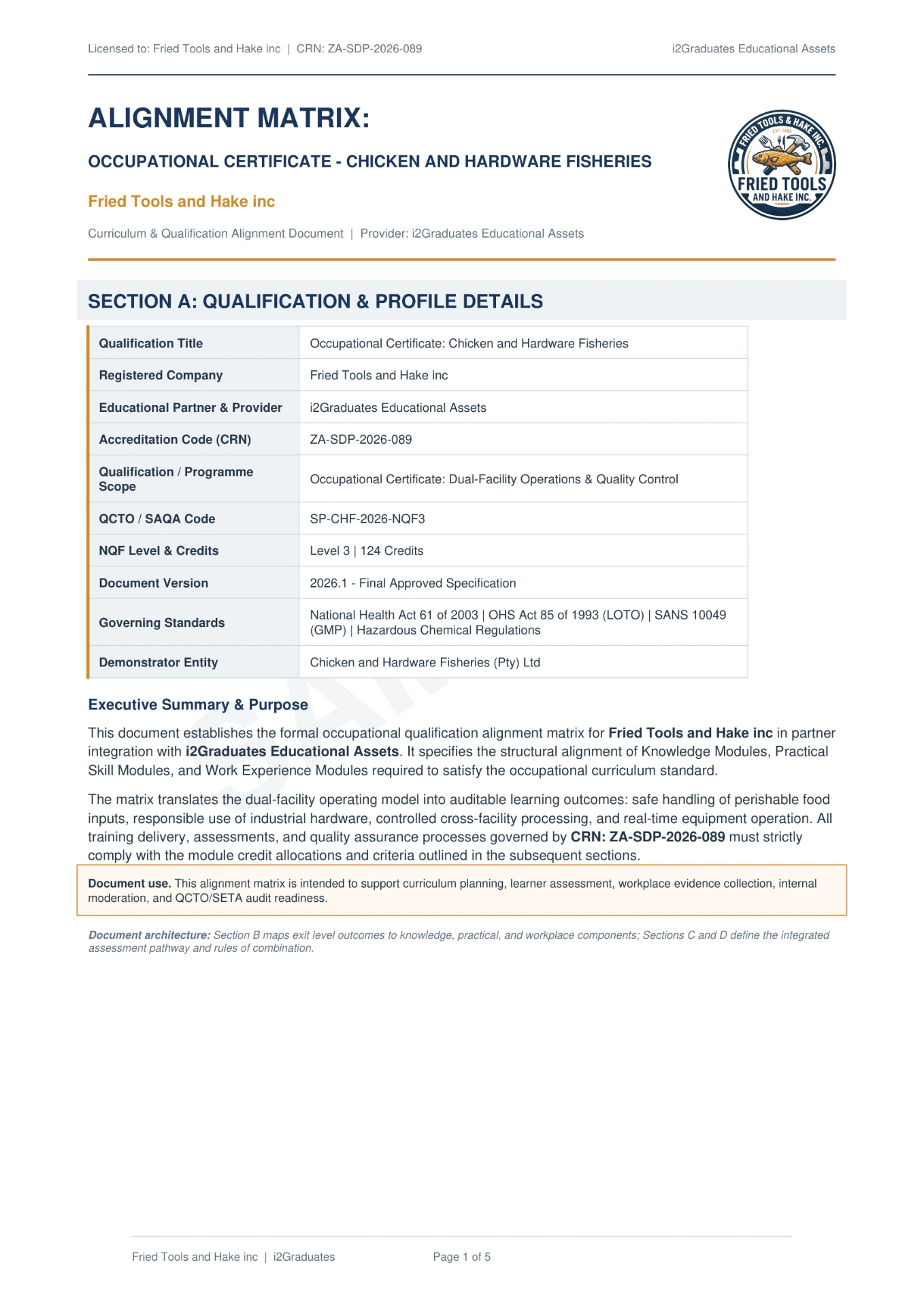
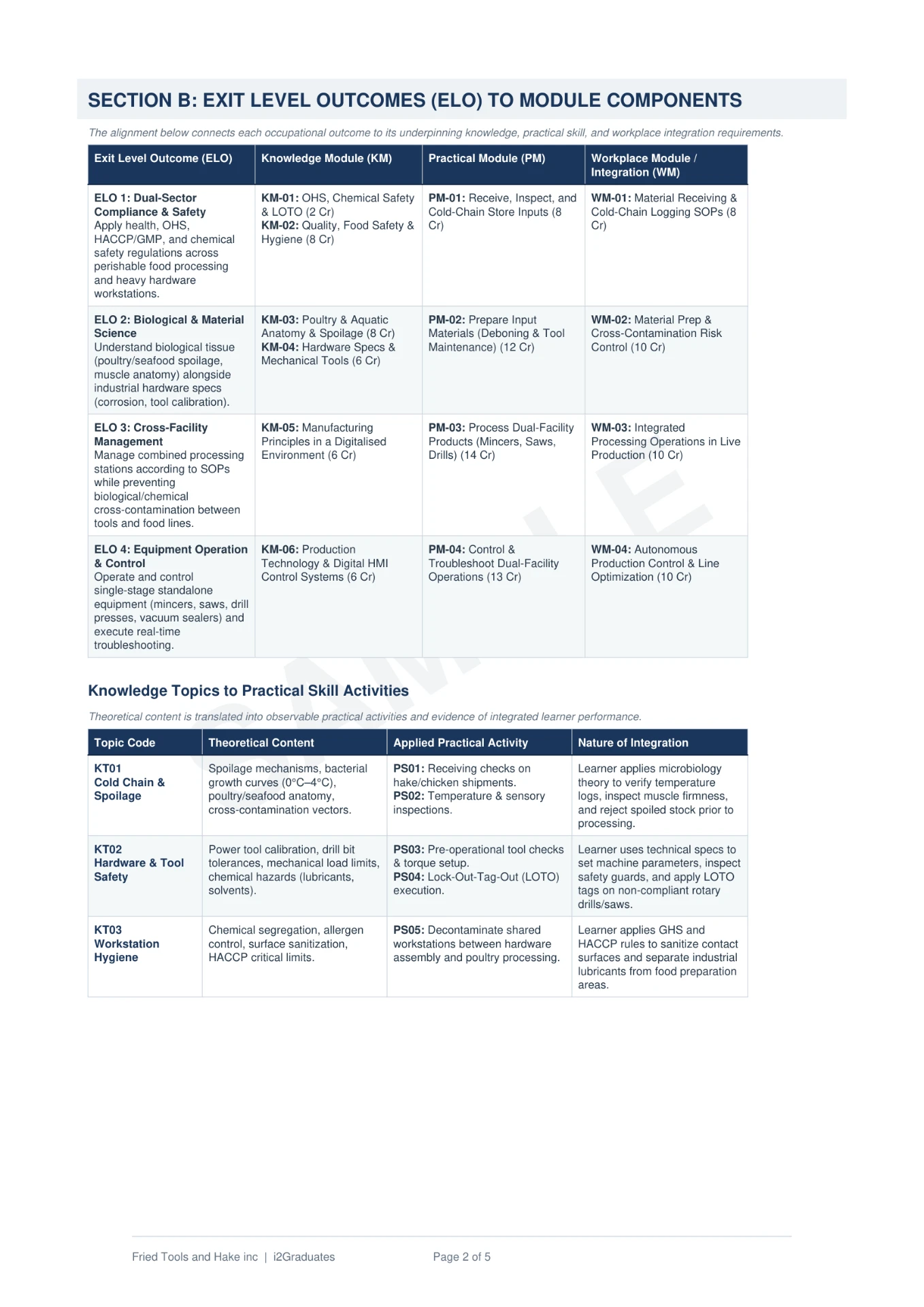
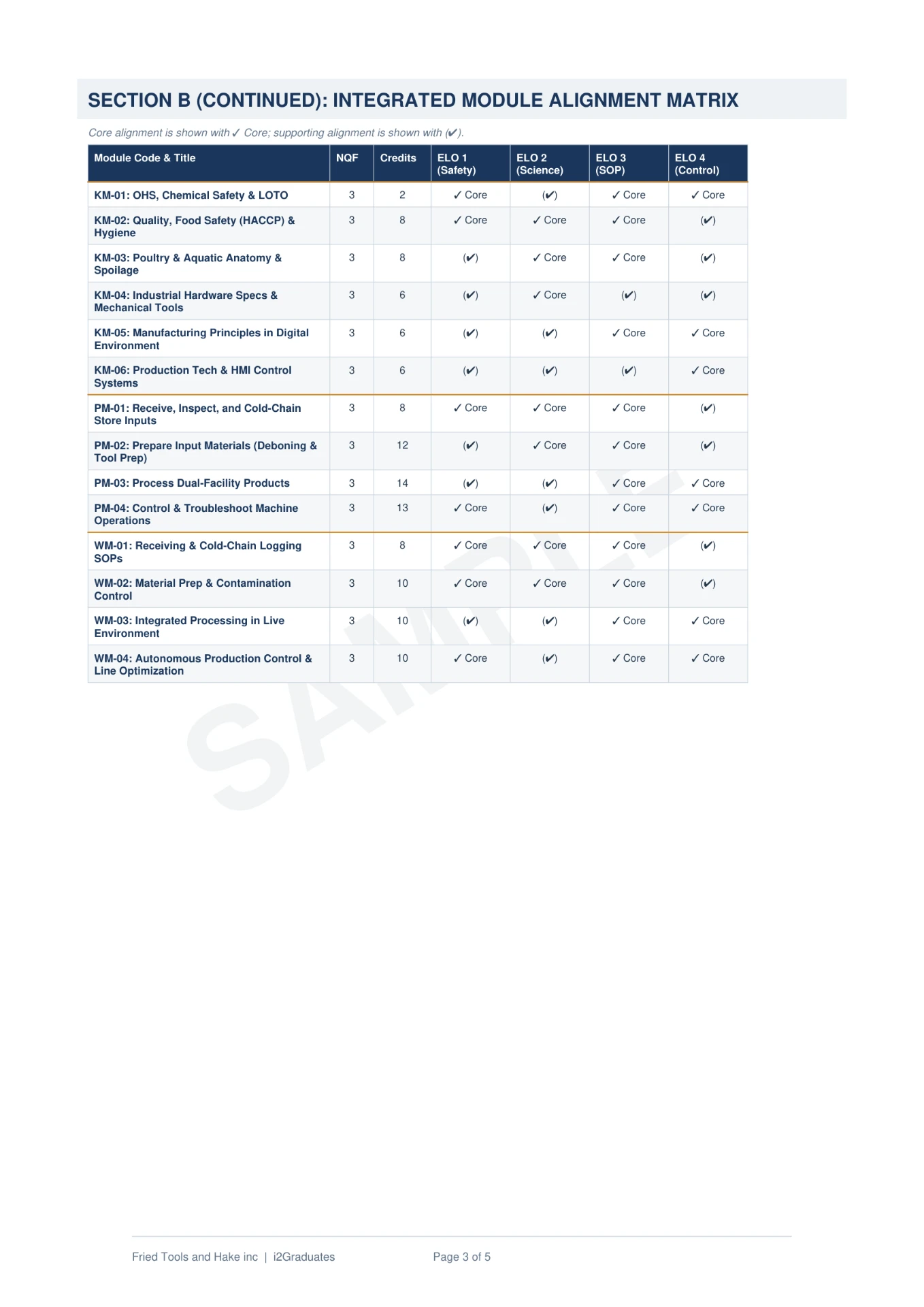
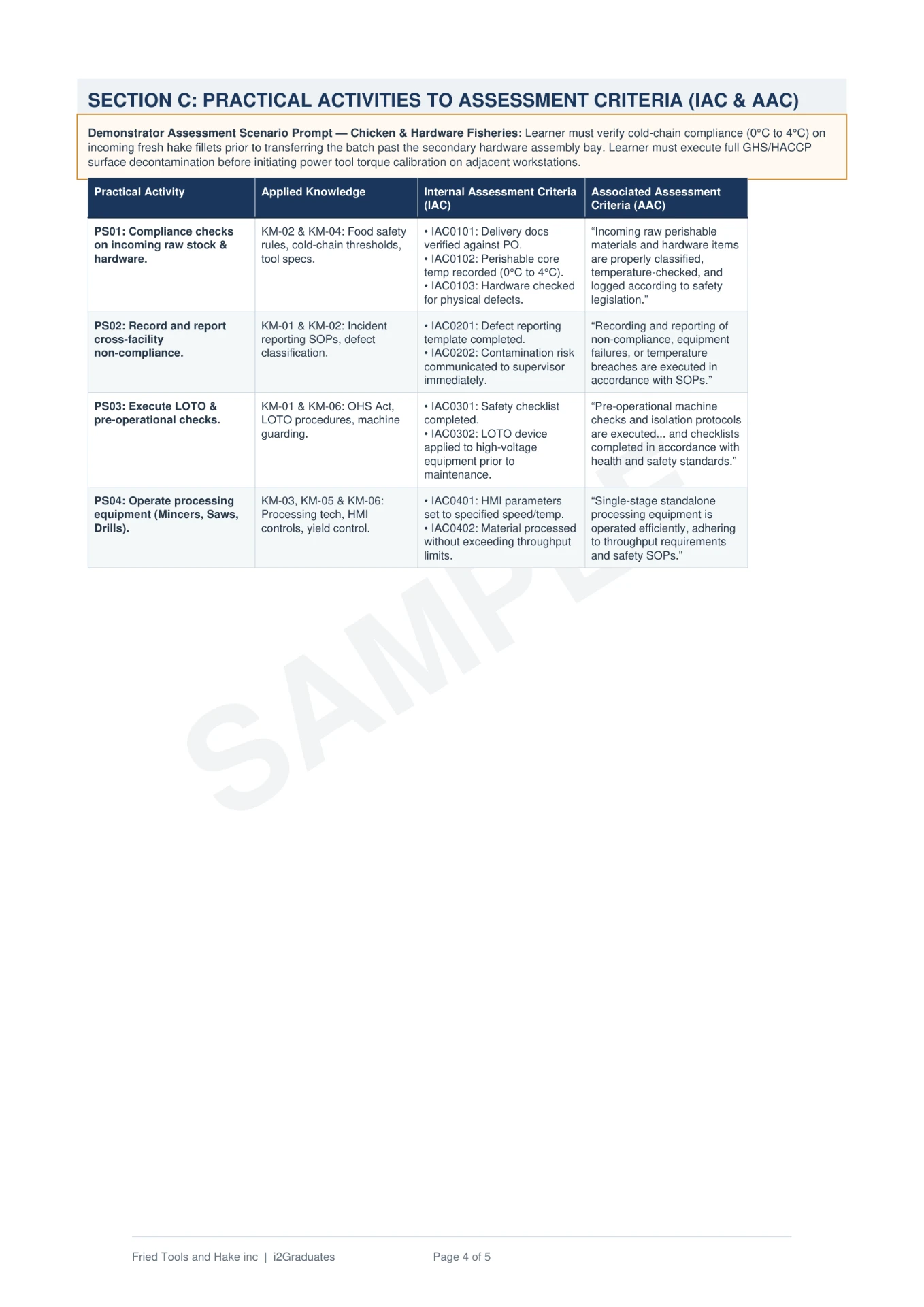
Overview & Scope
Programme Profile
- Target Designation
- Certified Steelpan Maker and Tuner Practitioner
- Competency Focus
- Master specialised practical applications, safety criteria, and regulatory mandates required of a qualified Steelpan Maker and Tuner.
- Academic Weight
- Full national recognition at NQF Level 4 yielding 85 credits upon successful PoE verification.
- Work Opportunities
- Deployment across As a qualified steelpan maker and tuner, you can find employment opportunities in Various (Quality Council for Trades and Occupations). Your skills will be in demand across both public and private sectors, and you may also choose to work as an independent contractor or start your own business in this field. operations under QCTO scope.
- Audit Objective
- Bridges operational skills deficits under the governing QCTO quality matrix.
- Value Proposition
- Measurable, legally compliant skills that optimise productivity, satisfy Workplace Skills Plans (WSP), and unlock B-BBEE scorecard weight.
Introduction▾
The Steelpan Maker and Tuner is a Occupational Certificate set at NQF Level 4, comprising 85 credits. This qualification has been carefully developed to provide you with the essential knowledge, practical skills, and workplace experience needed to excel in your chosen field. Whether you are starting your career or looking to formalise your existing expertise, this programme offers a structured pathway to competence and recognition.
Purpose▾
The purpose of this part-qualification is to prepare a learner to function as a Steelpan Maker and Tuner. A Steelpan Maker and Tuner maintains, services, tunes and makes steelpans. Typical graduate attributes of a qualified learner are to promote professionalism and apply a strong, positive work ethic. They apply a unique combination of metalwork handicraft competences for the making of the instruments with a musical and acoustic background and the art of tuning a steelpan. A qualified learner will be able to: • Tune fundamental and overtones of tuned steelpans according to the requirements of the musical scale of the instrument. • Make and repair steelpans applying metalwork skills.
Entry Requirements▾
The Steelpan Maker and Tuner is intended for individuals with some work experience or prior learning who wish to formalise their skills and advance their careers. If you have a passion for this field and want to turn that passion into a profession, this programme will give you the tools and credentials to succeed. It is also suitable for employers who wish to upskill their workforce to meet industry standards.
SAQA Rationale▾
Music is a basic human function and plays a significant role in everyday life within a society, from advertising campaigns to live performances to the individual taking pleasure in it. In the African culture, music is a form of communication; it accompanies all human activities and gatherings, from marriage, birth, rites of passage and political activities. It expresses life through the medium of sound. African music includes a wide range of musical instruments. There is a growing interest in percussion instruments, especially in the marimba and steelpan. Participation in the annual International Marimba & Steelpan Festival (hosted in South Africa) is increasing and the demand for instruments is growing likewise. The demand for instruments such as marimbas and steelpans is unfortunately exceeding the supply, resulting in a waiting period of six months and more for instruments to be delivered. An increase in the availability of the marimbas and steelpans will create increased availability, particularly in the more rural and remote schools and communities in South Africa, providing an opportunity to youth to participate in bands and express themselves through music. The socio-economic benefits of competent Steelpan Maker and Tuner are far-reaching. This part-qualification aims to develop learners and promote professionalism and a strong, positive work ethic within the marimba and steelpan industry, while at the same time bringing it into line with international standards related to the production of these instruments. It provides learners with knowledge and skills to make, tune and care for tuned percussion musical instruments. Qualified Steelpan Maker and Tuner will produce music instruments locally thereby supplying the demand and reducing the dependence on imported instruments. This will increase availability of musical instruments to musicians, the public and educational institutions. These two instruments embrace and expand the African rhythm and culture and making these instruments available in rural communities will support the strengthening of social cohesion through communities coming together. It will also enable learners to receive a formal qualification in marimba and steelpan making and tuning where previously no formal recognition of this unique expertise and competence existed. Liaison with international practitioners from Trinidad and Tobago, which is the origin of the steelpan, highlighted that this is the first qualification of this nature. This qualification focusses on various aspects, including woodwork and metal work handicraft as competences for the making of the instruments as well as on the musical and acoustic background and art of tuning the instruments. Learners achieving this qualification can find employment with Non-Governmental Organisations (NGOs) that are providing outreaches to schools and remote communities, or other Non-Profit Organisations (NPO) promoting music and arts in schools for tuning, repairing and maintaining marimbas and steelpans. They can also find employment at current manufacturing workshops or establish their own small businesses. However, with the additional skills in woodwork and steelwork, successful learners can enter the craft market as being self-employed, manufacturing steel and wooden craft products. No similar qualifications were noted on the National Qualifications Framework (NQF) because the Occupational Certificate: Steelpan Maker and Tuner has its own unique nature and content. No professional registration is needed for Steelpan Makers and Tuners to operate within the industry. Typical learners include qualified learners from learning institutions and persons currently employed in the industry without formal recognition. The Occupational Certificate: Steelpan Maker and Tuner is one of three part-qualifications of the Occupational Certificate: Tuned Percussion Instrument Maker. It provides appropriate exit points for competence related to making, repairing and tuning of steelpans offering learners an opportunity to achieve knowledge and skills for operating in the music industry as a Steelpan Maker and Tuner. Hereafter Steelpan Makers and Tuners may enrol for the Occupational Certificate: Tuned Percussion Instrument Maker whereby furthering a career in Steelpan and Marimba making, repairing, and tuning.
Exit Level Outcomes▾
1. Tune fundamental and overtones of tuned steelpans according to the requirements of the musical scale of the instrument. 2. Measure, cut and assemble and repair steelpans to comply with the requirements of the musical scale, design and/or technical drawing. 3. Apply knowledge of the influence of the mallet on the performance of the instrument when making mallets for use with various percussion instruments. ASSOCIATED ASSESSMENT CRITERIA Associated Assessment Criteria for Exit Level Outcome 1: • Apply the knowledge and understanding of acoustic and music notation principles when tuning the percussion instruments. • Demonstrate the knowledge and understanding of the importance of accuracy and precision when tuning the instrument. • Tune the tones and overtones of a steelpan according to the requirements of the musical scale of the instrument design. • Adjust the pitches and the timbre, the "colour" of the sound, and independently solve related problemsy during the tuning process and. • Control both the fundamental, constituting the playing pitch, and the upper partials (harmonics), to ensure a harmonic sound. • Solve harmonic relationships related to notes sounding harsh and metal-like. • Understand the theory on tone generation and a discussion of partials. • Use metalwork equipment to shape the tones of the steelpan. • Use an electronic tuning device and auditory sense to tune the musical instrument. Associated Assessment Criteria for Exit Level Outcome 2: • Inspect and selecta drum for good quality and thickness of material for a steelpan to ensure appropriate resonance. • Prepare the drums for the steelpan making processes using metal work tools and equipment skilfully and in compliance with safety procedures. • Sink a drum is precisely to the required depth to ensure an even concave shape to serve as a basis for the tones. • Cut and prepare the skirt of the steelpan to ensure metal is more pliable for tuning. • Apply a layer of protective finish to the exposed steel to prevent corrosion. • Cut and weld a stand for the steelpan ensuring stability when played. • Care for and maintain A steelpan to ensure the original character and voice are preserved. • Repair a steelpan to original state to ensure that character and voices are achieved. Associated Assessment Criteria for Exit Level Outcome 3: • Identify the purposes and specific musical instrument, for which the mallet is intended. • Demonstrate the knowledge of the use of mallets as integral melodic and harmonic part of the music. • Demonstrate the knowledge of the many factors such as size and shape of the mallet head, the material used, the density of the material, the flexibility or non-flexibility of the mallet shafts, that influence the performance of the musical instrument. • Demonstrate knowledge of the effect of various types of materials on the resulting hardness/softness of the mallet head. • Select suitable raw material for mallet components based on the intended purpose and performance of musical instrument. • Produce a set of mallets that create the correct sound and enhances the performance of the specific musical instrument. • Resolve problems related to the flexibility of the shaft, hardness/softness and shape of the head to produce the desired sound.
Learning Material Included
- Learner Guide (Theory and Knowledge Modules)
- Facilitator Guide
- Workplace Logbook
- Formative and Summative Assessment
- Assessor Guide & Marking Memorandum
- SETA / QCTO Alignment Matrix
- Administrative & Onboarding Pack
- Implementation Plan
Moderator-Ready Curriculum Breakdown
12 modules · 83 creditsTheory, regulatory and safety knowledge. Each row carries the registered module code, NQF level and credit weight used for formative assessment rubric mapping.
- 661201-001-00-KM-018 cr
Basic Music Notation for both Steelpan and Marimba Making
NQF Level 2
- 661201-001-00-KM-022 cr
History of Percussion Instruments
NQF Level 3
- 661201-001-00-KM-032 cr
Safety, Health, Environment and Risks
NQF Level 2
- 661201-001-00-KM-041 cr
Materials for and Construction of Mallets
NQF Level 1
- 661201-001-00-KM-102 cr
Materials Used for Steelpan Making
NQF Level 3
- 661201-001-00-KM-114 cr
Design and Components of the Steelpan
NQF Level 4
Qualification 119362 · Curriculum Architecture
Occupational Certificate: Steelpan Maker and Tuner · NQF Level 4 (85 Credits)
Three Curriculum Pillars
Knowledge Modules
Classroom & E-Learning
- Facilitated lectures & self-study
- Written question banks
- Formative comprehension checks
Practical Skill Modules
Simulated Line Tasks
- Simulated line tasks
- Observation rubrics
- Structured task sheets
Work Experience Modules
On-the-Job Production
- On-the-job rotation
- Mentor logbooks
- Workplace sign-offs
Evidence & Audit Pipeline
Learner Portfolio of Evidence (PoE)Owner · Candidate▾
Admin & Registration
ID, learner contract, induction pack, POPIA consent.
Knowledge Evidence
Written assessments & question banks — KM-01 to KM-07.
Practical Evidence
Task sheets, observation rubrics, assessor photos.
Workplace Evidence
Logbooks, mentor sign-offs, supervisor letters.
Assessor Master FileOwner · Registered Assessor▾
Assessment Reports
Judgements, learner feedback, remediation agreements, appeals log.
Internal Moderation & Quality FileOwner · Moderator / SDP▾
Moderation Evidence
10% sampling matrix, HACCP/LOTO compliance sheets, SDP sign-off.
Final Accreditation Gateway
Issued by the accredited Skills Development Provider once internal moderation is signed off.
Provider submits declaration + PoE to the Assessment Quality Partner (AQP).
QCTO awards the SAQA-registered certificate on successful EISA outcome.
Audit & Compliance
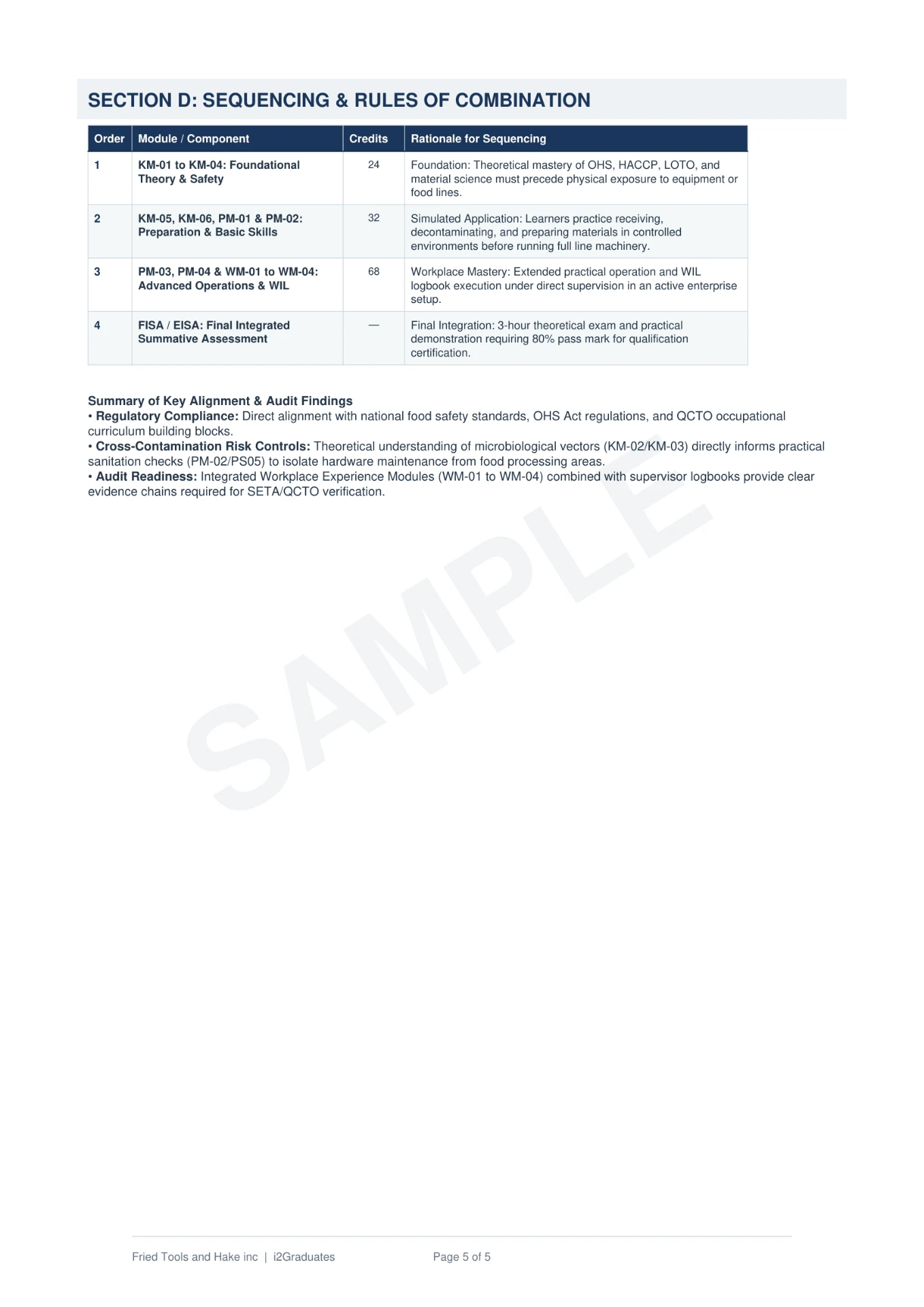
Evidence & Audit Pipeline
From portfolio assembly to external sign-off — the exact route your evidence travels.
- Step 1
PoE Assembly
Learner evidence, formative records and logbook entries filed against the alignment matrix.
- Step 2
Internal Assessment
Registered assessor judges each KM/PM/WM outcome using the supplied instruments.
- Step 3
Internal Moderation
Sampling and verification of assessor decisions, with remediation loop before submission.
- Step 4
External Moderation
SETA/QCTO desktop audit and certification upload against registered credits.
Broken Standard vs i2Graduates Standard
The measurable delta between improvised material and an audit-ready suite.
Broken Standard
i2Graduates Standard
Curriculum Mapping
Photocopied guides with mismatched outcomes
6 KM + 4 PM + 2 WM modules mapped to NQF Level 4
Assessment Bank
Missing formative and summative assessments
Pre-validated assessment bank per module
Alignment Evidence
No alignment matrix — audit fails
QCTO alignment matrix included
Facilitation
Facilitators improvise Steelpan Maker and Tuner delivery
Facilitator scripts + learner activities per credit
Portfolio of Evidence
PoE gaps flagged in moderation
PoE templates that survive external moderation
Pricing & Delivery Tiers
Base licence from R54 250
Digital Master Suite
Editable master files, licensed to your SDP
- Learner Guide, Facilitator Guide & Assessment Suite
- Workplace logbook + alignment matrix (editable)
- Instant digital delivery under institutional licence
- Free minor corrections for 12 months
Turnkey Print & Bound Package
Printed, bound and couriered per learner
- Everything in the Digital Master Suite
- Full-colour print, wire-bound learner packs
- Per-learner PoE folders and dividers
- Nationwide courier with tracked delivery
Full Enterprise Accreditation Bundle
Assets plus accreditation support end-to-end
- Everything in the Print & Bound Package
- Bespoke QMS build mapped to your scope
- Moderation dry-run + written remediation report
- Brand & metadata integration across the suite
Complementary Services
Optional add-ons that harden your accreditation scope before an external audit.
Bespoke QMS Build
We author your Quality Management System — policies, procedures, records, matrices — mapped to your accreditation scope. From R18,500.
Request QuoteModeration Consultation
External moderation dry-run on your PoE + delivery pack. Written report with fixes before your real audit. From R4,900.
Book Moderation SessionThe i2Graduates Quality Guarantee
Every page of this bundle is checked for sequence and structural accuracy — no missing pages, no shortcuts. You get pre-validated assessment instruments ready to survive rigorous compliance moderation, wrapped in a curriculum your facilitators will enjoy teaching.