
Occupational Qualification · S3
Discretionary Grant · RollingSafety Inspector (Forestry and Related Industries Safety Health and Environment Officer)
- NQF Level
- NQF Level 4
- Credits
- 278
- Duration
- —
- SAQA ID
- 99712
Official QCTO Registry Profile
Source: SAQA / QCTO registry- SAQA ID
- 99712
- Min Credits
- 278
- Registered
- 2018-07-01
- Re-registration
- 2025-12-30
- Field
- Field 01 - Agriculture and Nature Conservation
- Sub-field
- Forestry and Wood Technology
Sample Asset Preview
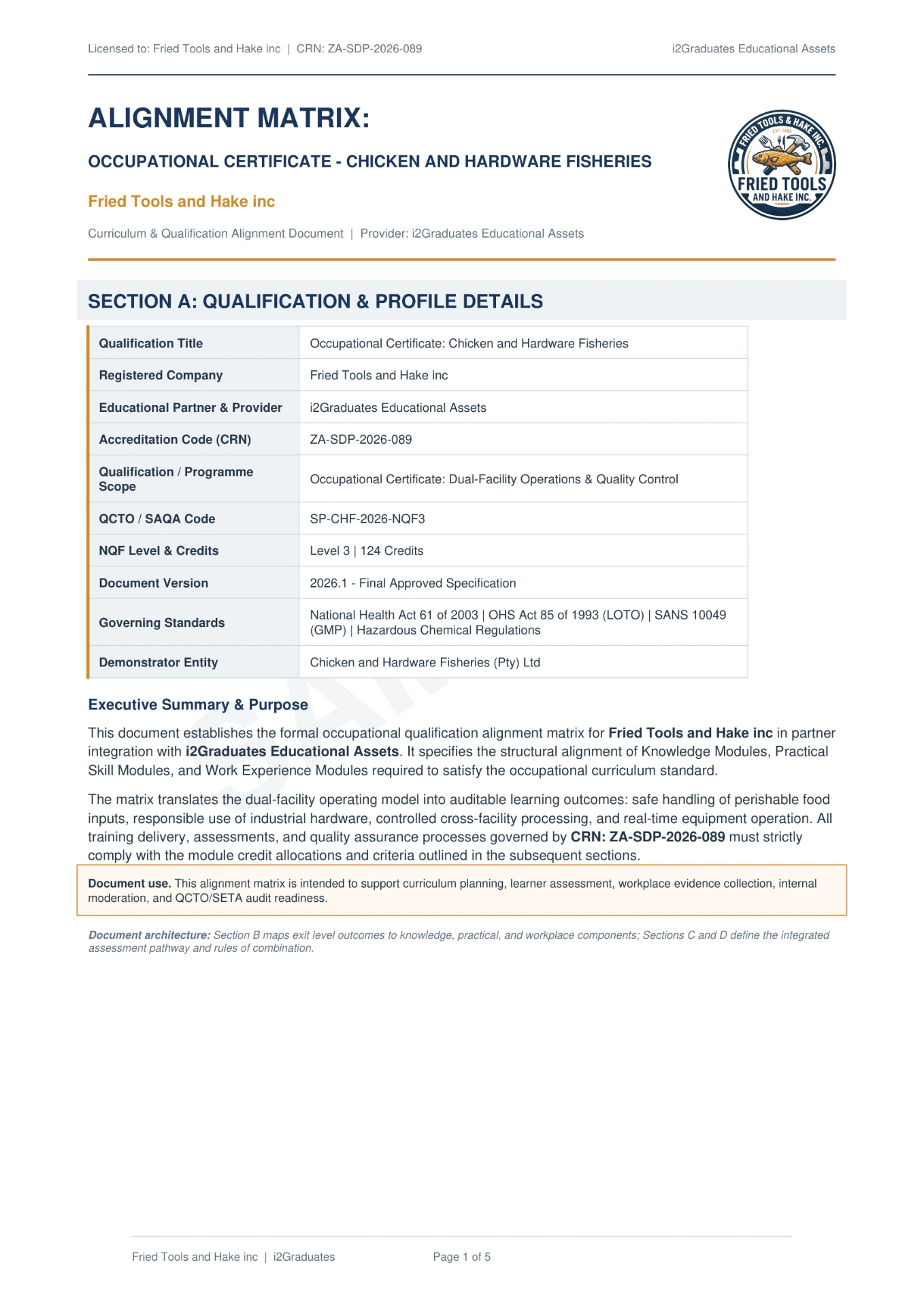
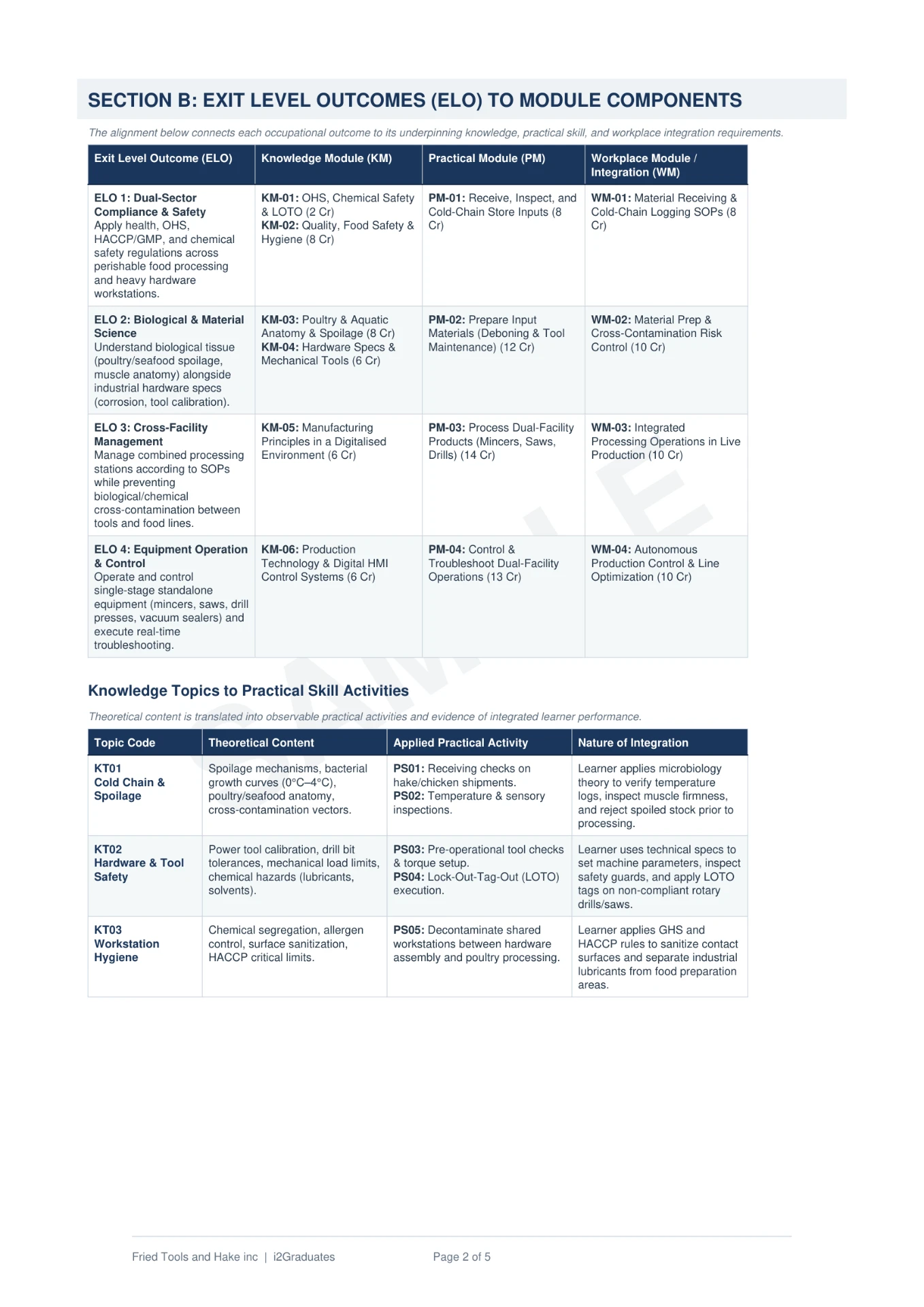
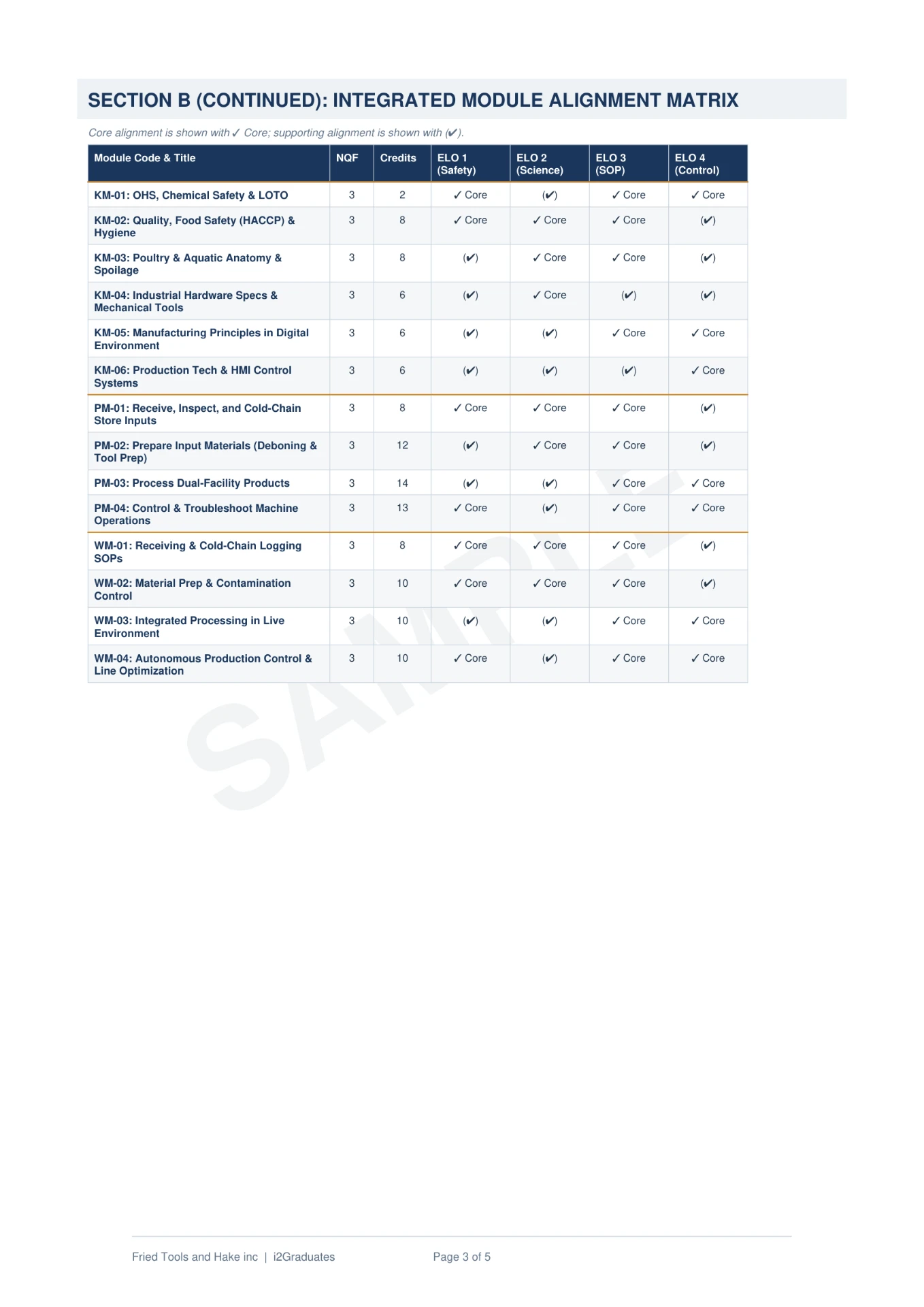
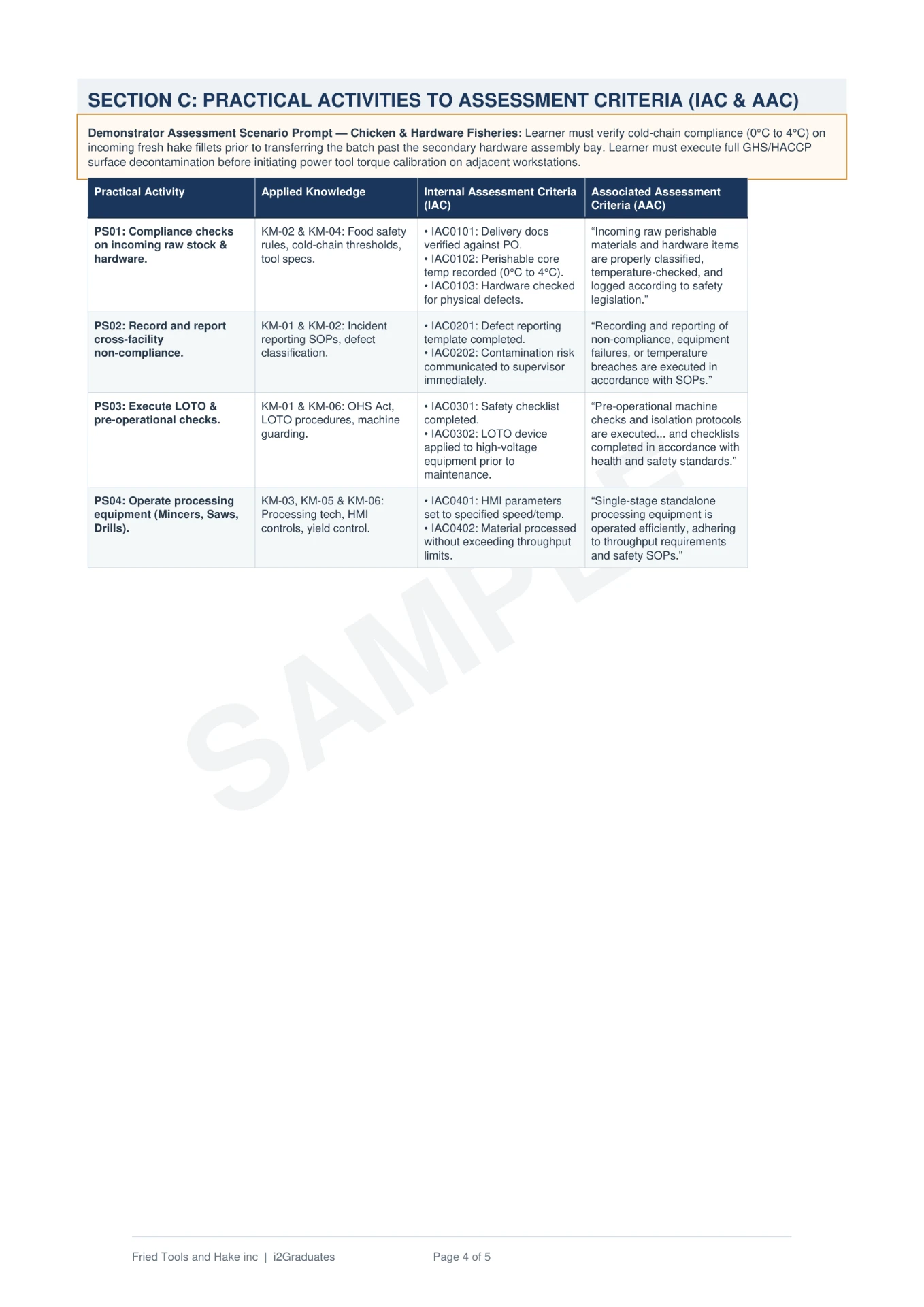
Overview & Scope
Programme Profile
- Target Designation
- Certified Safety Inspector (Forestry and Related Industries Safety Health and Environment Officer) Practitioner
- Competency Focus
- Master specialised practical applications, safety criteria, and regulatory mandates required of a qualified Safety Inspector (Forestry and Related Industries Safety Health and Environment Officer).
- Academic Weight
- Full national recognition at NQF Level 4 yielding 278 credits upon successful PoE verification.
- Work Opportunities
- Deployment across As a qualified safety inspector (forestry and related industries safety health and environment officer), you can find employment opportunities in Furniture, Paper, Printing, Packaging, Forestry including hospitals, clinics, home care agencies, NGOs, and community health centres. Your skills will be in demand across both public and private sectors, and you may also choose to work as an independent contractor or start your own business in this field. operations under FP&M SETA scope.
- Audit Objective
- Bridges operational skills deficits under the governing FP&M SETA quality matrix.
- Value Proposition
- Measurable, legally compliant skills that optimise productivity, satisfy Workplace Skills Plans (WSP), and unlock B-BBEE scorecard weight.
Introduction▾
The Safety Inspector (Forestry and Related Industries Safety Health and Environment Officer) is a Occupational Certificate set at NQF Level 4, comprising 278 credits. This qualification has been carefully developed to provide you with the essential knowledge, practical skills, and workplace experience needed to excel in your chosen field. Whether you are starting your career or looking to formalise your existing expertise, this programme offers a structured pathway to competence and recognition.
Purpose▾
The purpose of this qualification is to prepare a learner to operate as a Forestry and Related Industries Safety, Health and Environment Officer. A Forestry and Related Industries Safety, Health and Environment Officer ensures forestry and related industry companies adhere to the legal requirements in terms of Occupational Health and Safety Legislation, in line with industry systems and standards in order to direct and support management in achieving its safety, health and environmental goals and objectives. A qualified learner will be able to: • Implement, maintain and review the specific elements of the forestry and related industry company safety systems to promote a safe and healthy work environment free of hazards and risks. • Identify, monitor and mitigate hazards and risks in the forestry and related industry workplace to minimise and control potential for injury and loss. • Manage incident scenes, coordinate emergency responses and take part/assist in incident investigations to identify and determine compliance with safety, health and environmental rules and regulations and implement preventative measures. • Enforce statutory (legal) and forestry and related industry company compliance requirements through inspections, first party audits and structured meetings. • Conduct an appreciation of all operational, chemical and mechanical tasks and activities of a forestry and related industry company to determine compliance with legislation. • Conduct elementary Safety, Health and Environment (SHE) activities in a forestry and related industry workplace to promote a safe and healthy work environment.
Entry Requirements▾
Recognition of Prior Learning (RPL): RPL for access to the external integrated summative assessment: Accredited providers and approved workplaces must apply the internal assessment criteria specified in the related curriculum document to establish and confirm prior learning. Accredited providers and workplaces must confirm prior learning by issuing a statement of result or certifying a work experience record. RPL for access to the qualification: Accredited providers and approved workplaces may recognise prior learning against the relevant access requirements. Entry Requirements: • NQF Level 3 with Communication in English and Mathematical Literacy. Or • NQF Level 2 with Communication and Mathematical Literacy and 2 years' of Safety, Health and Environment workplace experience.
SAQA Rationale▾
The forest resources of South Africa cover over 40 million hectares (ha) of the land surface area of the country. The Forest sector employs around 165 900 workers and provides about 62 700 direct jobs and 30 000 indirect jobs. Forestry provides livelihood support to 652 000 people of the rural population of the country. The Pulp and Paper industry provides about 13 200 direct and 11 000 indirect employment opportunities. Some 20 000 workers are employed in Sawmilling and 6 000 in the Timber Board and 2 200 in the Mining Timber industries, while a further 11 000 workers are employed in miscellaneous jobs in Forestry. In terms of land use, the afforested area is about 1,27 million ha or about 1% of the total South African land area of 122,3 million ha. The forest sector (forestry and forest products) contributes about 1% to the Gross Domestic Product (GDP) of South Africa. In terms of regional GDP, forestry in KwaZulu-Natal contributes 4,4%; in Mpumalanga 3,7%; in the Eastern Cape 0,6% and in Limpopo about 0,6%. The Department of Agriculture, Forestry and Fisheries (DAFF) allocates money annually from the department's budget to Forestry and Natural Resources Management. The DAFF contributes to eradicating poverty through the Forestry Livelihoods Programme. Firewood, construction poles, medicinal plants and edible fruits are all critical to the livelihoods of the rural poor. The DAFF develops human resources through Forestry sector skills development initiatives and promotes employment through commercial forestry activities such as forestation and downstream activities. The integration of forestry programmes into provincial and municipal development plans will assist the "Plant a Million Trees" Campaign. The department is pursuing a target of 10 000 ha of nett new afforestation a year. Afforestation is taking place in rural areas where there are few other viable opportunities for job creation and economic activity. The development of these additional raw material resources will attract greater processing capacity in the form of sawmills, board mills, chipping plants and treatment plants, which will lead to broad economic growth. An additional R500 million a year could be generated from such plantations. There are many potential hazards involved in both forestry work practices and equipment. Safe harvesting of timber either mechanically or manually depends on hazard elimination or risk reduction actions to provide the highest level of protection for the worker. By law, employers are responsible for controlling all potential safety hazards in their workplaces. The function of the Safety, Health and Environment (SHE) Officer is crucial in the identification and mitigation of risks and in legal compliance. Where solutions are not obvious, the SHE Officers use a process to help them determine the most effective control measures for the risks they find in their workplace. An important role of the SHE Officer is to advise on the required processes and actions employers and employees must take in order to meet their legal obligations. This qualification will meet the need in the industry for qualified SHE Officers. Currently, Safety and Health Representatives are trained in the industry and through courses like SAMTRAC, NOSA and IRCA which are offered to existing Safety Officers. This qualification will take the Safety Officers to the required level of competence. Two important forestry industry training objectives, namely to reduce risks and increase safety are relevant to this qualification. The opportunity exists for Safety and Heath Representatives to complete this qualification and progress to Safety Officers in organisations. Learners will be equipped with practical skills and gain experience at the work place. Employers will be able to appoint qualified Safety Officers with the required skill level in their businesses. Safety working procedures will be followed, accidents and risks will be reduced and safety will be increased. Holders of a Level 3 qualification and who are literate in English and who are able to communicate (verbally and in writing) and who are numerate or learners that have completed grade 10 or a Level 2 qualification, who are literate in English who are able to communicate (verbally and in writing) and who are numerate and have 3 years' workplace experience are eligible to apply for admission to this qualification. Learners who have completed this qualification may be employed in the position of Safety Officer and can progress to careers in Management in the field of Safety, Health and Environment.
Learning Assumed to be in Place & RPL▾
Recognition of Prior Learning (RPL): RPL for access to the external integrated summative assessment: Accredited providers and approved workplaces must apply the internal assessment criteria specified in the related curriculum document to establish and confirm prior learning. Accredited providers and workplaces must confirm prior learning by issuing a statement of result or certifying a work experience record. RPL for access to the qualification: Accredited providers and approved workplaces may recognise prior learning against the relevant access requirements. Entry Requirements: • NQF Level 3 with Communication in English and Mathematical Literacy. Or • NQF Level 2 with Communication and Mathematical Literacy and 2 years' of Safety, Health and Environment workplace experience.
Exit Level Outcomes▾
- Conduct elementary safety, health and environment activities in the workplace to promote a safe and healthy work environment.
- Implement, maintain and review the specific elements of company safety systems.
- Interpret information and present findings and recommendations to ensure preventative and corrective measures are implemented.
- Identify, monitor and mitigate hazards and risks in the workplace to promote a safe and healthy work environment free of hazards and risks.
- Manage incident scenes and co-ordinate emergency responses.
- Take part/assist in incident investigations to identify and determine compliance with safety, health and environmental rules and regulations.
- Identify and prioritise preventative measures for non-conformance found.
- Enforce statutory (legal) and company compliance requirements through inspections, first party audits and structured meetings.
- Conduct a safety appreciation (machine, workplace and operations) to determine compliance with legislation.
Learning Material Included
- Learner Guide (Theory and Knowledge Modules)
- Facilitator Guide
- Workplace Logbook
- Formative and Summative Assessment
- Assessor Guide & Marking Memorandum
- SETA / QCTO Alignment Matrix
- Administrative & Onboarding Pack
- Implementation Plan
Moderator-Ready Curriculum Breakdown
13 modules · 116 creditsTheory, regulatory and safety knowledge. Each row carries the registered module code, NQF level and credit weight used for formative assessment rubric mapping.
- 325705001-KM-0122 cr
Safety systems in the Forestry and Related Industry workplace
NQF Level 4
- 325705001-KM-023 cr
Interpersonal skills for the Safety, Health and Environment Officer
NQF Level 4
- 325705001-KM-035 cr
Forestry and Related Industry Hazard Identification and Risk Assessment (HIRA)
NQF Level 4
- 325705001-KM-045 cr
Emergency response, incident investigation and root cause analysis in Forestry and Related Industries
NQF Level 4
- 325705001-KM-052 cr
Documentation needed for incident and investigation meetings
NQF Level 4
- 325705001-KM-066 cr
Safety, Health and Environmental Legislation and Regulations in the Forestry and Related Industry
NQF Level 4
- 325705001-KM-079 cr
Operational appreciation in the Forestry and Related Industry workplace
NQF Level 3
- 325705001-KM-084 cr
Forestry and Related Industry Safety, Health and Environment Theory for the SHE Representative
NQF Level 3
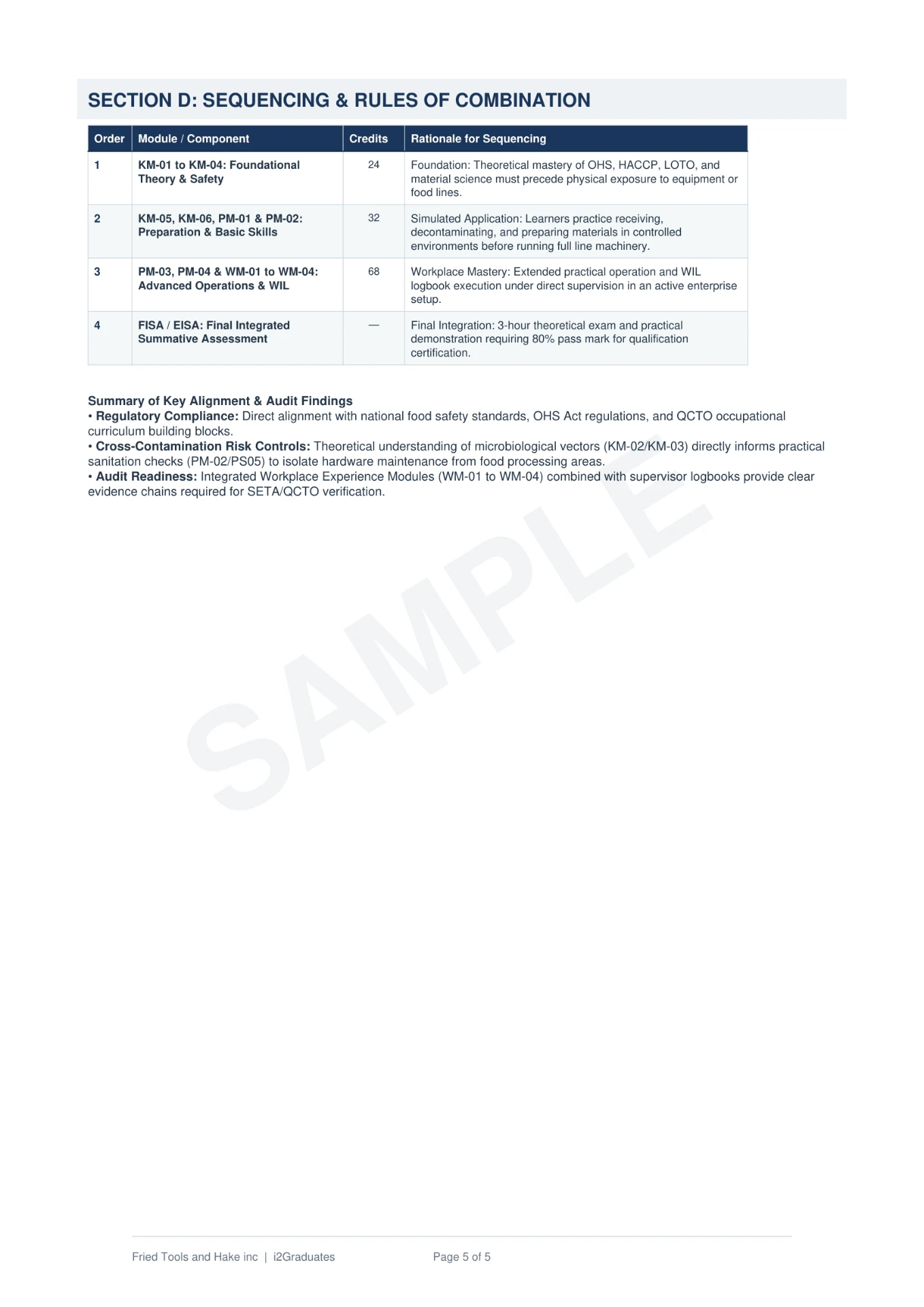
Qualification 99712 · Curriculum Architecture
Occupational Certificate: Safety Inspector (Forestry and Related Industries Safety Health and Environment Officer) · NQF Level 4 (278 Credits)
Three Curriculum Pillars
Knowledge Modules
Classroom & E-Learning
- Facilitated lectures & self-study
- Written question banks
- Formative comprehension checks
Practical Skill Modules
Simulated Line Tasks
- Simulated line tasks
- Observation rubrics
- Structured task sheets
Work Experience Modules
On-the-Job Production
- On-the-job rotation
- Mentor logbooks
- Workplace sign-offs
Evidence & Audit Pipeline
Learner Portfolio of Evidence (PoE)Owner · Candidate▾
Admin & Registration
ID, learner contract, induction pack, POPIA consent.
Knowledge Evidence
Written assessments & question banks — KM-01 to KM-07.
Practical Evidence
Task sheets, observation rubrics, assessor photos.
Workplace Evidence
Logbooks, mentor sign-offs, supervisor letters.
Assessor Master FileOwner · Registered Assessor▾
Assessment Reports
Judgements, learner feedback, remediation agreements, appeals log.
Internal Moderation & Quality FileOwner · Moderator / SDP▾
Moderation Evidence
10% sampling matrix, HACCP/LOTO compliance sheets, SDP sign-off.
Final Accreditation Gateway
Issued by the accredited Skills Development Provider once internal moderation is signed off.
Provider submits declaration + PoE to the Assessment Quality Partner (AQP).
QCTO awards the SAQA-registered certificate on successful EISA outcome.
Audit & Compliance
Evidence & Audit Pipeline
From portfolio assembly to external sign-off — the exact route your evidence travels.
- Step 1
PoE Assembly
Learner evidence, formative records and logbook entries filed against the alignment matrix.
- Step 2
Internal Assessment
Registered assessor judges each KM/PM/WM outcome using the supplied instruments.
- Step 3
Internal Moderation
Sampling and verification of assessor decisions, with remediation loop before submission.
- Step 4
External Moderation
SETA/QCTO desktop audit and certification upload against registered credits.
Broken Standard vs i2Graduates Standard
The measurable delta between improvised material and an audit-ready suite.
Broken Standard
i2Graduates Standard
Curriculum Mapping
Photocopied guides with mismatched outcomes
8 KM + 5 PM + 0 WM modules mapped to NQF Level 4
Assessment Bank
Missing formative and summative assessments
Pre-validated assessment bank per module
Alignment Evidence
No alignment matrix — audit fails
FP&M SETA alignment matrix included
Facilitation
Facilitators improvise Safety Inspector (Forestry and Related Industries Safety Health and Environment Officer) delivery
Facilitator scripts + learner activities per credit
Portfolio of Evidence
PoE gaps flagged in moderation
PoE templates that survive external moderation
Pricing & Delivery Tiers
Base licence from R63 900
Digital Master Suite
Editable master files, licensed to your SDP
- Learner Guide, Facilitator Guide & Assessment Suite
- Workplace logbook + alignment matrix (editable)
- Instant digital delivery under institutional licence
- Free minor corrections for 12 months
Turnkey Print & Bound Package
Printed, bound and couriered per learner
- Everything in the Digital Master Suite
- Full-colour print, wire-bound learner packs
- Per-learner PoE folders and dividers
- Nationwide courier with tracked delivery
Full Enterprise Accreditation Bundle
Assets plus accreditation support end-to-end
- Everything in the Print & Bound Package
- Bespoke QMS build mapped to your scope
- Moderation dry-run + written remediation report
- Brand & metadata integration across the suite
Complementary Services
Optional add-ons that harden your accreditation scope before an external audit.
Bespoke QMS Build
We author your Quality Management System — policies, procedures, records, matrices — mapped to your accreditation scope. From R18,500.
Request QuoteModeration Consultation
External moderation dry-run on your PoE + delivery pack. Written report with fixes before your real audit. From R4,900.
Book Moderation SessionThe i2Graduates Quality Guarantee
Every page of this bundle is checked for sequence and structural accuracy — no missing pages, no shortcuts. You get pre-validated assessment instruments ready to survive rigorous compliance moderation, wrapped in a curriculum your facilitators will enjoy teaching.