
Occupational Qualification · R47
Discretionary Grant · UpcomingRoad Crash Investigator
- NQF Level
- NQF Level 6
- Credits
- 376
- Duration
- —
- SAQA ID
- 121162
Official QCTO Registry Profile
Source: SAQA / QCTO registry- SAQA ID
- 121162
- Min Credits
- 376
- Registered
- 2023-11-14
- Re-registration
- 2028-11-14
- Field
- Field 08 - Law, Military Science and Security
- Sub-field
- Safety in Society
Sample Asset Preview
Overview & Scope
Programme Profile
- Target Designation
- Certified Road Crash Investigator Practitioner
- Competency Focus
- Master specialised practical applications, safety criteria, and regulatory mandates required of a qualified Road Crash Investigator.
- Academic Weight
- Full national recognition at NQF Level 6 yielding 376 credits upon successful PoE verification.
- Work Opportunities
- Deployment across As a qualified road crash investigator, you can find employment opportunities in Security, Policing, Justice, Corrections. Your skills will be in demand across both public and private sectors, and you may also choose to work as an independent contractor or start your own business in this field. operations under SASSETA scope.
- Audit Objective
- Bridges operational skills deficits under the governing SASSETA quality matrix.
- Value Proposition
- Measurable, legally compliant skills that optimise productivity, satisfy Workplace Skills Plans (WSP), and unlock B-BBEE scorecard weight.
Introduction▾
The Road Crash Investigator is a Occupational Diploma set at NQF Level 6, comprising 376 credits. This qualification has been carefully developed to provide you with the essential knowledge, practical skills, and workplace experience needed to excel in your chosen field. Whether you are starting your career or looking to formalise your existing expertise, this programme offers a structured pathway to competence and recognition.
Purpose▾
The purpose of this qualification is to prepare a learner to operate as a Road Crash Investigator. A road crash investigator adopts an analytical approach to plan, assess, interpret causes of road crashes through the establishment and co-ordinating of incident management teams and providing evidence to support the judicial process. A qualified learner will be able to: • Examine vehicles involved in a road crash for compliance and fitness pre-crash. • Reconstruct the road crash scene. • Analyse and interpret evidence obtained from the vehicle/s, road, and external factors as well as from interviewing occupants and witnesses. • Authenticate and verify photographic and/or videographic evidence, draft on field sketch plan/plan and key thereto, and complete Accident Report form and scene reports. • Present evidence for civil and/or criminal litigation.
Entry Requirements▾
RPL for Access to the Qualification • Learners will gain access to the qualification through RPL for Access as provided for in the QCTO RPL Policy. RPL for access is conducted by accredited education institution, skills development provider or is workplace accredited to offer that specific qualification/part qualification. • Learners who have acquired competencies of the modules of a qualification or part qualification will be credited for modules through RPL. RPL for access to the external integrated summative assessment: Accredited providers and approved workplaces must apply the internal assessment criteria specified in the related curriculum document to establish and confirm prior learning. Accredited providers and workplaces must confirm prior learning by issuing a statement of result. Entry Requirements: • An NQF Level 4 qualification.
SAQA Rationale▾
The need for this qualification stems from the necessity to standardise the training and work performed by the road crash investigators across the country. In terms of the state of road safety in the country, South Africa continues to experience one of the highest road death rates in the world by far. Given this context it is imperative that road crash investigators fully understand the complexity of road safety to be effective problem solvers in their field. On the contrary, there is a fragmented approach when it comes to road crash investigation across the country. The same road crashes are investigated by different stakeholders namely, (Municipal/Metro Police and Provincial Traffic Departments, South African Police Service (SAPS) and the Road Traffic Management Corporation (RTMC) as well as various private road crash investigators. The current crash investigators are at arguably varying skills with duplication of functions in various authorities across due to the absence of a formal qualification. This qualification will assist in standardizing the training and will increase capacity for road crash investigation across the country. Currently, due to capacity constraints only major road crashes wherein three or more fatalities are involved are being prioritised for investigation. Therefore, the introduction of an NQF registered qualification will provide a formal credit-bearing qualification that will ensure that trainees are trained following the same investigative principles and techniques. This will harmonise the processes of road crash investigation across the various government institutions and private sector through a common NQF registered curriculum. Consequently, this will allow evidence-based research, traffic engineering advancements, legislative amendments, enhanced law enforcement operations and road safety education programmes. The Road Traffic Management Corporation (RTMC) is mandated by the National Road Traffic Act, Act 93 of 1996 and the Road Traffic Management Corporation Act, Act 20 of 1999 to ensure road safety in South Africa. The RTMC, being the lead agency in road traffic, confirmed the need for the development of a qualification for Road Crash Investigators as an integral part of achieving the National Development Plan (NDP) and the Human Resource Development Strategy South Africa (HRDS SA). This qualification responds to the government priorities of reducing injury, accidents, and violence by 50% from the 2010 baseline and strengthen the justice system as well as ensuring a developmental and capable state. This qualification will equip current and prospective road crash investigators who wish to enter this field with the necessary skills knowledge and understanding to effectively understand the complexity of road crash investigation. The exit level outcomes of this qualification makes it a unique one with currently no similar qualification registered on the NQF to achieve the same outcomes. There is currently no formal registered qualification available for a Road Crash Investigator except the informal and non-credit training offered by the SAPS, RTMC and some private and independent road crash investigators. The Road Crash Investigators working in the field are forced to undergo local un-accredited short training courses focusing on specific areas of the Road Crash Investigation field for self-development. These short training courses are extremely limited which means that to further their skills in the field these practitioners are obliged to register for overseas short training courses in this field. The benefit to the road crash investigation fraternity will be a pool of highly trained and skilled road crash investigators in implementing road incident management system, road crash evidence collection and documentation from various perspectives, and presentation of evidence in the court of law. The economy will grow as more ethical and legally compliant road crash investigators will be deployed to investigate the unacceptably high levels of road carnage on our public roads. Detailed road crash investigation reports will provide road safety orientated recommendations to road engineers when constructing roads. This will in turn, contribute to minimising the road carnage caused by poorly constructed roads which costs the South African economy in the region of R300 billion per annum. It is envisaged that the detailed road crash investigation reports to be compiled by the road crash investigators trained from this qualification will also assist the Road Accident Fund (RAF) and the insurance companies in curbing the fraudulent claims and unjustifiable pay-outs. It will also provide valuable information to improve roads and road infrastructure which will in turn benefit the economy by providing employment to individuals. Society will also benefit from safer roads emanating from recommendations made in detailed reports to address problems identified in relation to road infrastructure, law enforcement and road safety initiatives. Detailed road crash investigation reports will also assist the judicial process in the successful adjudicating of criminal and civil litigation emanating from road crashes. Proper road crash investigation will ensure that the correct recommendations are made to the relevant stakeholder so that the losses to society caused by road crashes are prevented. The overall benefit to the society will be a reduction in trauma and suffering to road crash victims and their dependants since less road crashes might be experienced than it is currently the case. The typical learners are the new entrants with an interest in road crash investigation as well as currently practising road crash investigators with no formal qualification. Learners who successfully complete this qualification will be eligible to operate as Road Crash Investigators. No registration with any professional body is envisaged since there is currently no professional body approved and recognized by the South African Qualifications Authority (SAQA) currently in this field.
Learning Assumed to be in Place & RPL▾
RPL for Access to the Qualification • Learners will gain access to the qualification through RPL for Access as provided for in the QCTO RPL Policy. RPL for access is conducted by accredited education institution, skills development provider or is workplace accredited to offer that specific qualification/part qualification. • Learners who have acquired competencies of the modules of a qualification or part qualification will be credited for modules through RPL. RPL for access to the external integrated summative assessment: Accredited providers and approved workplaces must apply the internal assessment criteria specified in the related curriculum document to establish and confirm prior learning. Accredited providers and workplaces must confirm prior learning by issuing a statement of result. Entry Requirements: • An NQF Level 4 qualification.
Exit Level Outcomes▾
- Evaluate and interpret appropriate methods, procedures or techniques for compliance of vehicles involved in crash.
- Apply mathematical science and formulae to measure and calculate vehicle dynamics and damages.
- Process, manage and evaluate the road crash evidence from various perspectives.
- Produce Road crash evidence from various perspectives.
- Produce and communicate complex information reliably and coherently using appropriate formats and technologies for a given context.
Learning Material Included
- Learner Guide (Theory and Knowledge Modules)
- Facilitator Guide
- Workplace Logbook
- Formative and Summative Assessment
- Assessor Guide & Marking Memorandum
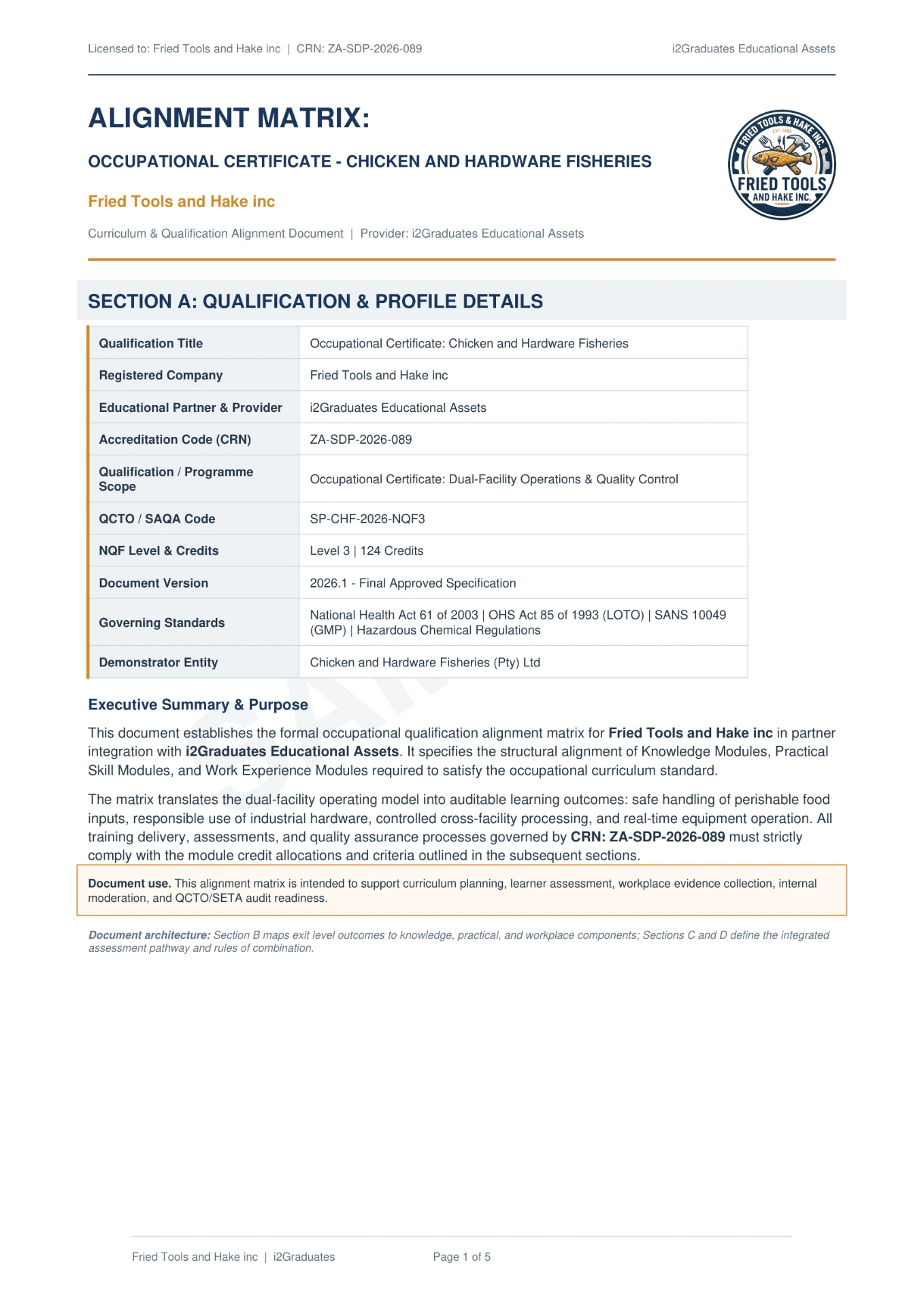
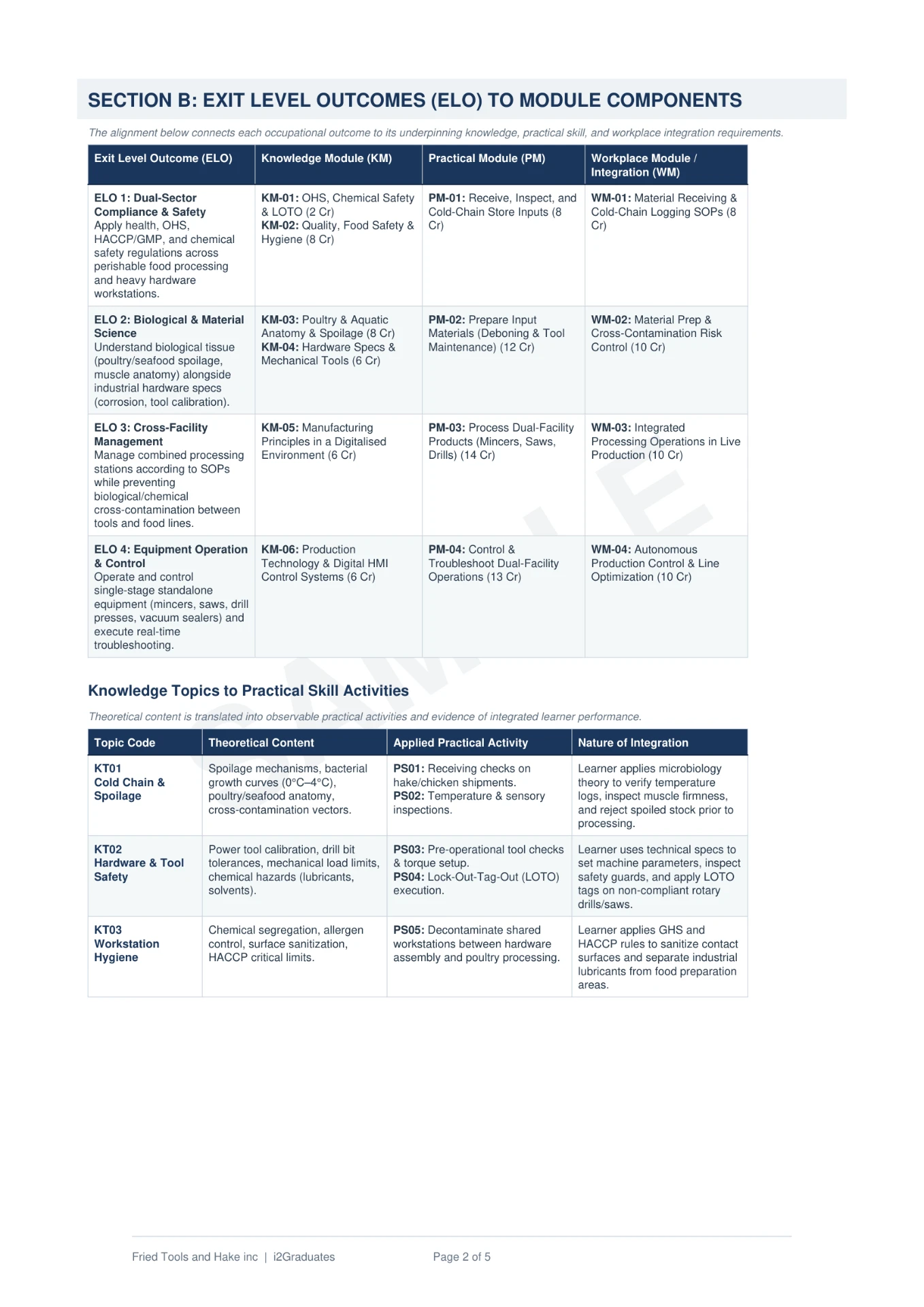
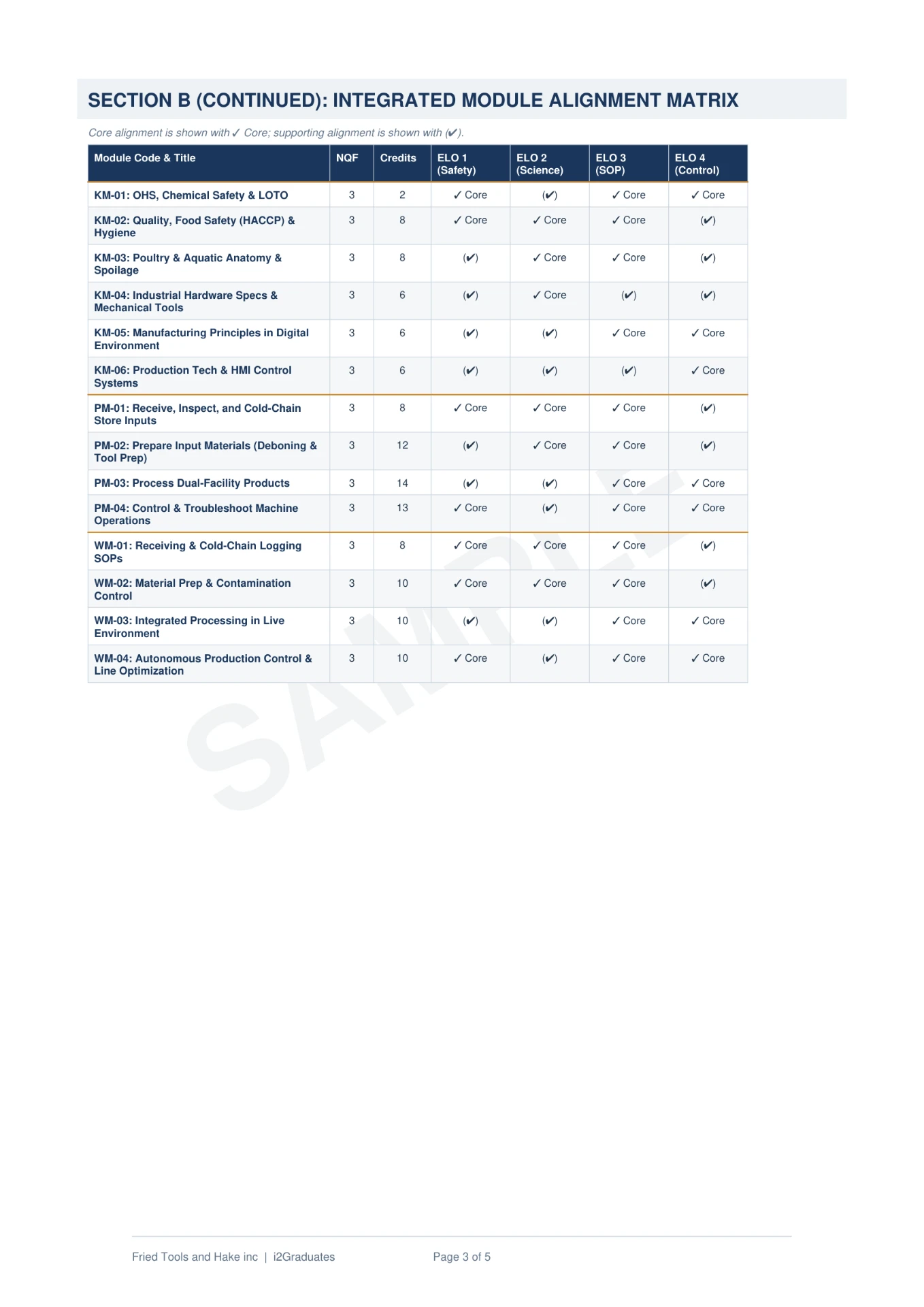
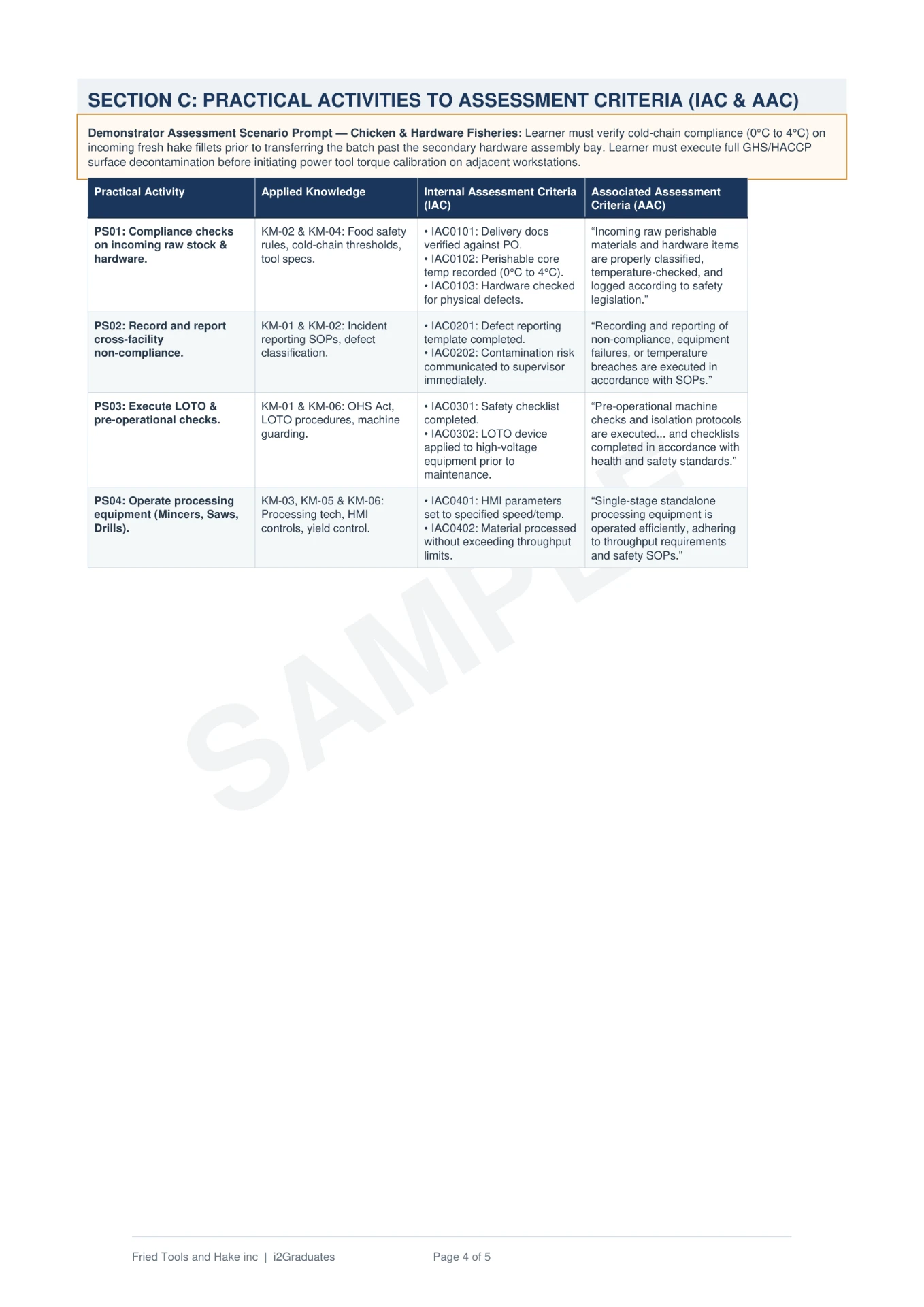
- SETA / QCTO Alignment Matrix
- Administrative & Onboarding Pack
- Implementation Plan
Moderator-Ready Curriculum Breakdown
25 modules · 376 creditsTheory, regulatory and safety knowledge. Each row carries the registered module code, NQF level and credit weight used for formative assessment rubric mapping.
- 335502-001-00-KM-014 cr
Road Crash Investigation
NQF Level 4
- 335502-001-00-KM-0216 cr
Road Incident Management System
NQF Level 5
- 335502-001-00-KM-035 cr
Legal Principles of Road Crash Investigation
NQF Level 5
- 335502-001-00-KM-0412 cr
Communication Skills
NQF Level 5
- 335502-001-00-KM-0514 cr
Evidence from and about People
NQF Level 6
- 335502-001-00-KM-0620 cr
Road Crash Scene Evidence
NQF Level 6
- 335502-001-00-KM-0712 cr
Vehicle Evidence
NQF Level 6
- 335502-001-00-KM-0816 cr
Theory of Road Crash Photography
NQF Level 6
- 335502-001-00-KM-0912 cr
Surveying and Drafting of the Road Crash Scene
NQF Level 6
- 335502-001-00-KM-1017 cr
Completion of relevant road crash documentation
NQF Level 6
- 335502-001-00-KM-1112 cr
Court Procedures and Testimony
NQF Level 6
- 335502-001-00-KM-128 cr
Principles of Mechanical Vehicle Examination
NQF Level 6
- 335502-001-00-KM-135 cr
Corruption and Anti-Corruption Strategies
NQF Level 6
- 335502-001-00-KM-145 cr
Road Safety Related Infrastructure Assessments
NQF Level 4
- 335502-001-00-KM-1514 cr
Principles of Road Crash Dynamics, and Reconstruction
NQF Level 6
Qualification 121162 · Curriculum Architecture
Occupational Diploma: Road Crash Investigator · NQF Level 6 (376 Credits)
Three Curriculum Pillars
Knowledge Modules
Classroom & E-Learning
- Facilitated lectures & self-study
- Written question banks
- Formative comprehension checks
Practical Skill Modules
Simulated Line Tasks
- Simulated line tasks
- Observation rubrics
- Structured task sheets
Work Experience Modules
On-the-Job Production
- On-the-job rotation
- Mentor logbooks
- Workplace sign-offs
Evidence & Audit Pipeline
Learner Portfolio of Evidence (PoE)Owner · Candidate▾
Admin & Registration
ID, learner contract, induction pack, POPIA consent.
Knowledge Evidence
Written assessments & question banks — KM-01 to KM-07.
Practical Evidence
Task sheets, observation rubrics, assessor photos.
Workplace Evidence
Logbooks, mentor sign-offs, supervisor letters.
Assessor Master FileOwner · Registered Assessor▾
Assessment Reports
Judgements, learner feedback, remediation agreements, appeals log.
Internal Moderation & Quality FileOwner · Moderator / SDP▾
Moderation Evidence
10% sampling matrix, HACCP/LOTO compliance sheets, SDP sign-off.
Final Accreditation Gateway
Issued by the accredited Skills Development Provider once internal moderation is signed off.
Provider submits declaration + PoE to the Assessment Quality Partner (AQP).
QCTO awards the SAQA-registered certificate on successful EISA outcome.
Audit & Compliance
Evidence & Audit Pipeline
From portfolio assembly to external sign-off — the exact route your evidence travels.
- Step 1
PoE Assembly
Learner evidence, formative records and logbook entries filed against the alignment matrix.
- Step 2
Internal Assessment
Registered assessor judges each KM/PM/WM outcome using the supplied instruments.
- Step 3
Internal Moderation
Sampling and verification of assessor decisions, with remediation loop before submission.
- Step 4
External Moderation
SETA/QCTO desktop audit and certification upload against registered credits.
Broken Standard vs i2Graduates Standard
The measurable delta between improvised material and an audit-ready suite.
Broken Standard
i2Graduates Standard
Curriculum Mapping
Photocopied guides with mismatched outcomes
15 KM + 8 PM + 2 WM modules mapped to NQF Level 6
Assessment Bank
Missing formative and summative assessments
Pre-validated assessment bank per module
Alignment Evidence
No alignment matrix — audit fails
SASSETA alignment matrix included
Facilitation
Facilitators improvise Road Crash Investigator delivery
Facilitator scripts + learner activities per credit
Portfolio of Evidence
PoE gaps flagged in moderation
PoE templates that survive external moderation
Pricing & Delivery Tiers
Base licence from R78 800
Digital Master Suite
Editable master files, licensed to your SDP
- Learner Guide, Facilitator Guide & Assessment Suite
- Workplace logbook + alignment matrix (editable)
- Instant digital delivery under institutional licence
- Free minor corrections for 12 months
Turnkey Print & Bound Package
Printed, bound and couriered per learner
- Everything in the Digital Master Suite
- Full-colour print, wire-bound learner packs
- Per-learner PoE folders and dividers
- Nationwide courier with tracked delivery
Full Enterprise Accreditation Bundle
Assets plus accreditation support end-to-end
- Everything in the Print & Bound Package
- Bespoke QMS build mapped to your scope
- Moderation dry-run + written remediation report
- Brand & metadata integration across the suite
Complementary Services
Optional add-ons that harden your accreditation scope before an external audit.
Bespoke QMS Build
We author your Quality Management System — policies, procedures, records, matrices — mapped to your accreditation scope. From R18,500.
Request QuoteModeration Consultation
External moderation dry-run on your PoE + delivery pack. Written report with fixes before your real audit. From R4,900.
Book Moderation SessionThe i2Graduates Quality Guarantee
Every page of this bundle is checked for sequence and structural accuracy — no missing pages, no shortcuts. You get pre-validated assessment instruments ready to survive rigorous compliance moderation, wrapped in a curriculum your facilitators will enjoy teaching.