
Occupational Qualification · Q6
Discretionary Grant · RollingQuantity Surveying Viability Planner
- NQF Level
- NQF Level 1
- Credits
- 53
- Duration
- —
- SAQA ID
- 124426
Official QCTO Registry Profile
Source: SAQA / QCTO registry- SAQA ID
- 124426
- Min Credits
- 53
- Registered
- 2025-06-03
- Re-registration
- 2030-06-03
- Field
- Field 12 - Physical Planning and Construction
- Sub-field
- Physical Planning, Design and Management
Sample Asset Preview
Overview & Scope
Programme Profile
- Target Designation
- Certified Quantity Surveying Viability Planner Practitioner
- Competency Focus
- Master specialised practical applications, safety criteria, and regulatory mandates required of a qualified Quantity Surveying Viability Planner.
- Academic Weight
- Full national recognition at NQF Level 1 yielding 53 credits upon successful PoE verification.
- Work Opportunities
- Deployment across As a qualified quantity surveying viability planner, you can find employment opportunities in Various sectors (depending on specialisation). Your skills will be in demand across both public and private sectors, and you may also choose to work as an independent contractor or start your own business in this field. operations under CETA scope.
- Audit Objective
- Bridges operational skills deficits under the governing CETA quality matrix.
- Value Proposition
- Measurable, legally compliant skills that optimise productivity, satisfy Workplace Skills Plans (WSP), and unlock B-BBEE scorecard weight.
Introduction▾
Designed as a Occupational Certificate at NQF Level 1 worth 0 credits, the Quantity Surveying Viability Planner equips you with both theoretical understanding and hands-on capabilities. You will learn to perform complex tasks, solve real-world problems, and adapt to the demands of a dynamic work environment. This qualification is your stepping stone to becoming a confident, capable professional.
Purpose▾
The purpose of this part qualification is to prepare a learner to be a Quantity Surveying Viability Planner. A qualified learner will be able to: • perform construction project cost estimation. • conduct a viability study on a construction project, and • produce a viability report. Achieving this Quantity Surveying Viability Planner part qualification will provide several benefits to the learner, including: • Carrying out a viability study will ensure the successful completion of construction projects and give learners the skills needed to inform their clients on information pertaining to their investment decisions. • Being able to analyse a number of factors that help in making the final determination regarding a construction project. • Undertaking calculations to determine total building costs, total capital outlay, operating costs and return on investment. • Performing cost estimates and producing viability study reports with respect to construction projects. • An understanding of property, real estate investments, the processes involved, and developing a framework for an investment strategy. • Expanding the horizons of a Quantity Surveying Viability Planner who will operate in a niche field within the Quantity Surveying Profession and then be able to pursue other qualifications. • Being accessible to learners from other fields like engineering, property development etc. Typical graduate attributes include proficiency, efficiency, and effectiveness in completing various viability studies-related tasks. A Quantity Surveying Viability Planner is a person of integrity and high ethical standards as they need to ensure that construction projects, which are inherently costly, are only undertaken if the viability study indicates or predicts their likely success, thus ensuring completion of projects without getting into budgetary difficulties.
Entry Requirements▾
RPL for Access to Training: Learners may use the RPL process to gain access to training opportunities for a programme of learning, qualification, part-qualification or skills programme if they do not meet the formal, minimum entry requirements for admission. RPL assessment provides an alternative access route into a programme of learning, qualification, part-qualification, or skills programme. Such an RPL assessment may be developed, moderated and conducted by the accredited Skills Development Provider which offers that specific qualification/part qualification/skills programme. Such an assessment must ensure that the learner is able to display the equivalent level of competencies required for access, based on the NQF level descriptors. RPL for Exemption of Modules: For exemption from modules through RPL, learners who have gained the stipulated competencies of the modules of a programme of learning, qualification, part-qualification or skills programme through any means of formal, informal or non-formal learning and/or work experience, may be awarded credits towards relevant modules, and gaps identified for training, which is then concluded. RPL for credits Learners who have gained the stipulated competencies of the modules of a programme of learning, qualification, part-qualification or skills programme through any means of formal, informal or non-formal learning and/or work experience, may be awarded credits towards relevant modules, and gaps identified for training, which is then concluded. RPL for Access to the External Integrated Summative Assessment (EISA): A valid Statement of Results is required for admission to the EISA in which confirmation of achievement is provided that all internal assessment criteria for all modules in the related curriculum document have been achieved. Upon successful completion of the EISA, RPL learners will be issued with the QCTO certificate for the qualification, part-qualification or skills programme. Quality partners are responsible for ensuring the RPL mechanism and process for qualifications and part-qualification are approved by the QCTO. Entry Requirements: An NQF Level 4 qualification, with mathematics and science.
SAQA Rationale▾
There is a significant need for this part qualification to exist. A viability study is a detailed look at how profitable a business idea might be. This type of study does not consider whether something can be done instead, it looks at whether or not it is worth doing. Because it helps uncover potential problems or dangers associated with a project before major financial resources are committed to it, a viability study is an important tool for all stakeholders in the Built Environment profession. A viability study increases success probability. These points emphasise the importance of the Occupational Certificate: Quantity Surveying Viability Planner. The Quantity Surveying Viability Planner operates in the broad construction sector, making a significant contribution to the South African economy. According to a report titled 'South Africa Construction Market Size, Trend Analysis by Sector, Competitive Landscape and Forecast to 2027' (December 2023), the South Africa construction market size was $25.5 billion in 2022. The market is projected to achieve an Average Annual Growth Rate (AAGR) of more than 3% during 2024-2027. This emphasises the potential role that can and will be played by the Quantity Surveying Viability Planner, as part of a very niche function within the Quantity Surveying profession. The Quantity Surveying Viability Planner part qualification is becoming increasingly sought after by those involved in the quantity surveying and construction sectors. Currently, there is neither a qualification nor a part-qualification on a viability or feasibility study registered on the NQF, and neither is there any skills programme on viability studies recorded at the QCTO. The Quantity Surveying sector and by extension the Built Environment sector will benefit substantially because the Quantity Surveying Viability Planner will assist project owners to determine whether a construction project is financially viable before any construction starts. It also allows the Quantity Surveying Viability Planner the opportunity to give project owners an informed indication of their expected return on investment, which would influence the owner's investment decision (i.e. whether to proceed with a project, make amendments to the project or discontinue the project altogether and look for a different investment alternative). This qualification will become an enabling mechanism and will ensure the increased success of projects whose owners have the wherewithal to start and complete projects. This qualification will also save prospective clients and property developers from starting on a project that is not financially viable and which could potentially place them in huge financial debt. Concept and viability planning encompass many areas of the built environment, including residential, commercial, industrial, civil construction and shopping centre developments. Successful feasibilities lead to the successful execution of many projects which, in turn, provide an impetus for job creation opportunities for many industry participants. This qualification would lead to skills enhancement and create and eco-system for employment. Increased employment brings about a concomitant beneficial impact on the economy because the construction/quantity surveying industry plays such a significant role in the economy. Typical learners will be school leavers and those already working in the quantity surveying, construction, and engineering sectors. This part qualification is also for people wanting to work in the built environment and construction sectors, with an interest in quantity surveying and who need core knowledge and skills required in the sector. In terms of the learning pathway, they could pursue the Quantity Surveying Assistant qualification once it is registered. At the current moment this is the only part qualification available which is the lead in this space, therefore the articulation possibilities are not viable at the current moment. There could be qualifications in future perhaps during the review where the articulation within and across will be possible. Various stakeholders participated in the development of this part qualification.
Learning Assumed to be in Place & RPL▾
RPL for Access to Training: Learners may use the RPL process to gain access to training opportunities for a programme of learning, qualification, part-qualification or skills programme if they do not meet the formal, minimum entry requirements for admission. RPL assessment provides an alternative access route into a programme of learning, qualification, part-qualification, or skills programme. Such an RPL assessment may be developed, moderated and conducted by the accredited Skills Development Provider which offers that specific qualification/part qualification/skills programme. Such an assessment must ensure that the learner is able to display the equivalent level of competencies required for access, based on the NQF level descriptors. RPL for Exemption of Modules: For exemption from modules through RPL, learners who have gained the stipulated competencies of the modules of a programme of learning, qualification, part-qualification or skills programme through any means of formal, informal or non-formal learning and/or work experience, may be awarded credits towards relevant modules, and gaps identified for training, which is then concluded. RPL for credits Learners who have gained the stipulated competencies of the modules of a programme of learning, qualification, part-qualification or skills programme through any means of formal, informal or non-formal learning and/or work experience, may be awarded credits towards relevant modules, and gaps identified for training, which is then concluded. RPL for Access to the External Integrated Summative Assessment (EISA): A valid Statement of Results is required for admission to the EISA in which confirmation of achievement is provided that all internal assessment criteria for all modules in the related curriculum document have been achieved. Upon successful completion of the EISA, RPL learners will be issued with the QCTO certificate for the qualification, part-qualification or skills programme. Quality partners are responsible for ensuring the RPL mechanism and process for qualifications and part-qualification are approved by the QCTO. Entry Requirements: An NQF Level 4 qualification, with mathematics and science.
Exit Level Outcomes▾
1. Perform project cost estimation, conduct a viability study and develop a viability report.
Learning Material Included
- Learner Guide (Theory and Knowledge Modules)
- Facilitator Guide
- Workplace Logbook
- Formative and Summative Assessment
- Assessor Guide & Marking Memorandum
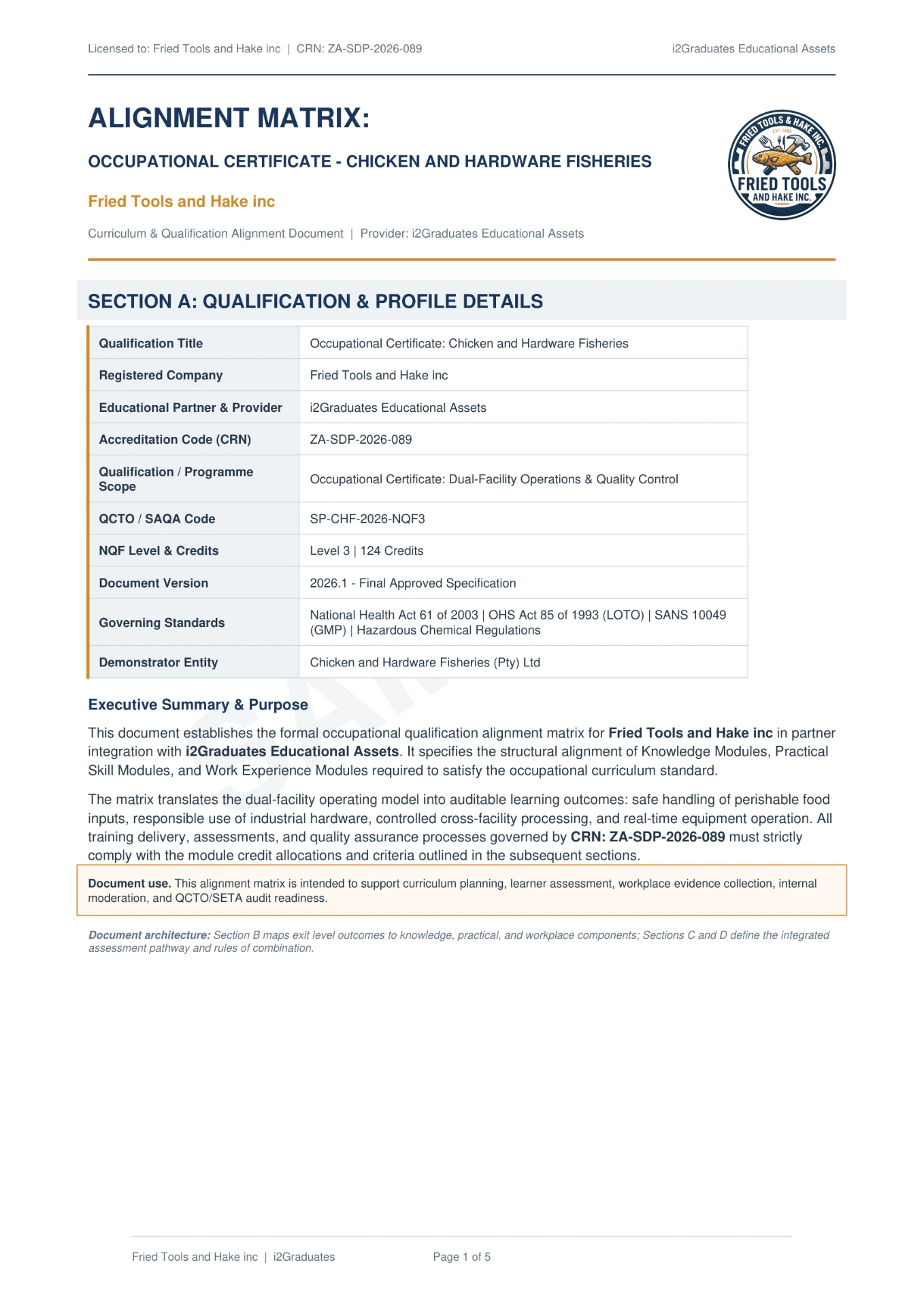
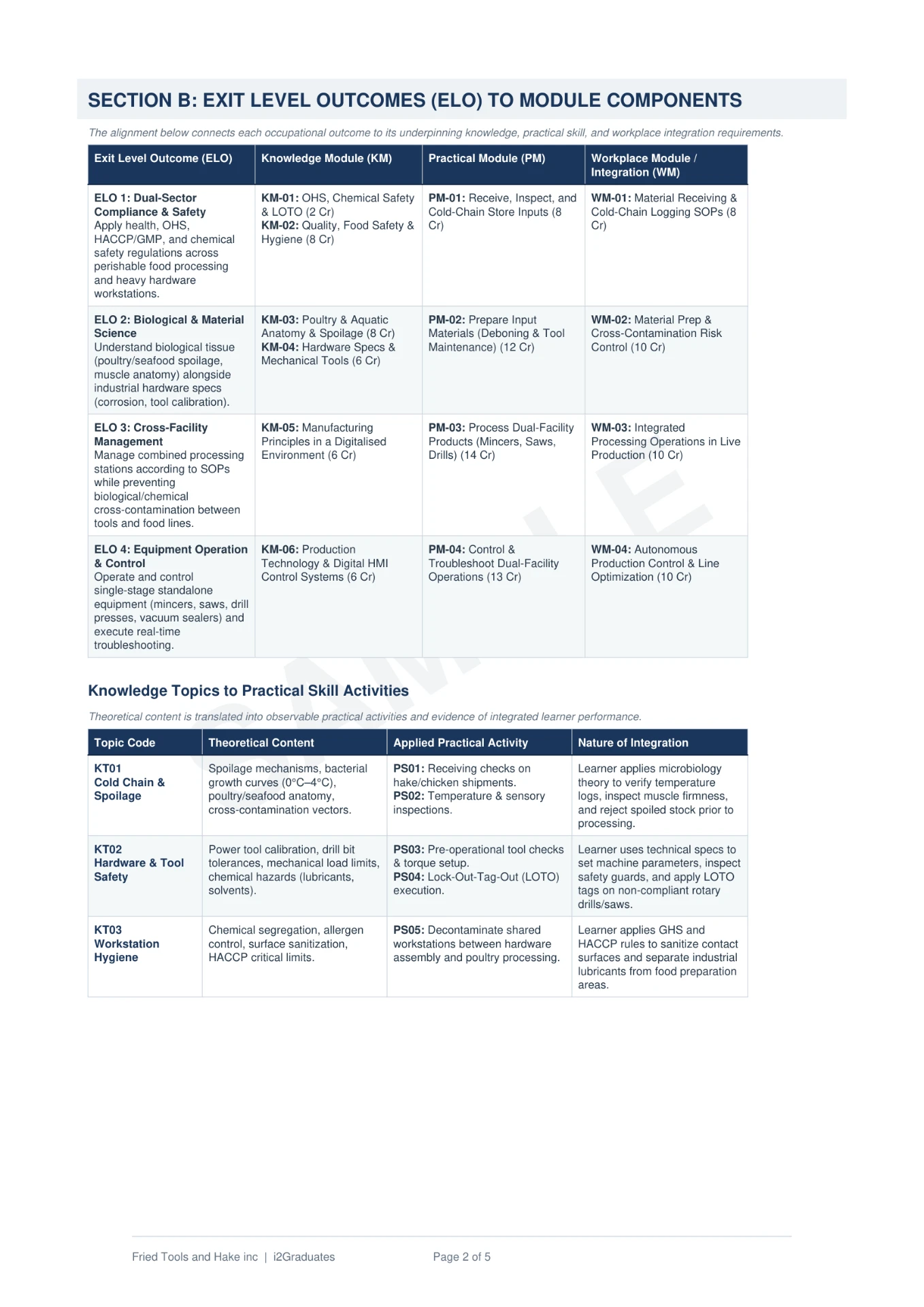
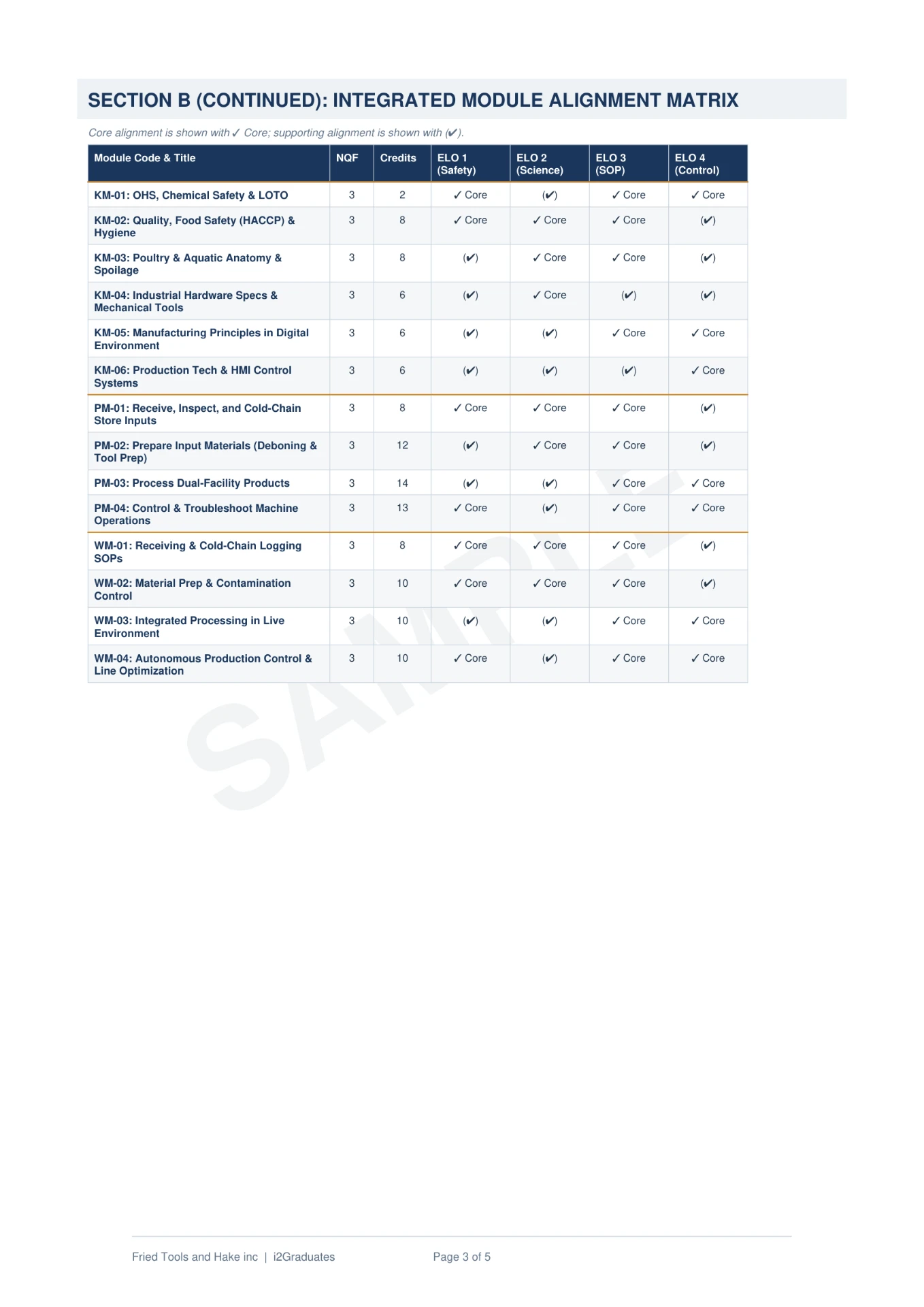
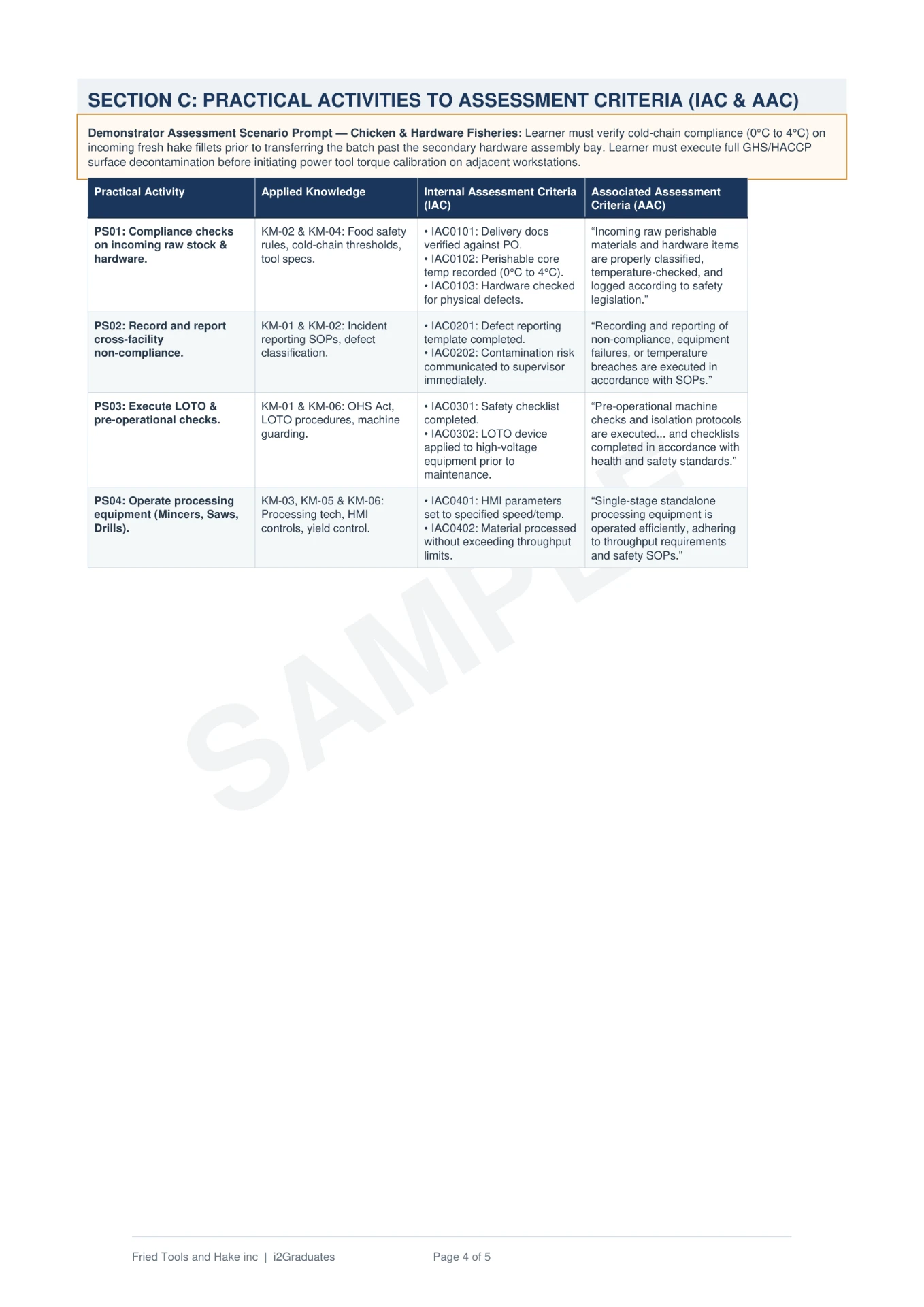
- SETA / QCTO Alignment Matrix
- Administrative & Onboarding Pack
- Implementation Plan
Moderator-Ready Curriculum Breakdown
7 modules · 53 creditsTheory, regulatory and safety knowledge. Each row carries the registered module code, NQF level and credit weight used for formative assessment rubric mapping.
- 214904-001-00-KM-015 cr
Project Scope
NQF Level 4
- 214904-001-00-KM-0411 cr
Project Cost Estimation and Financial Viability Planning and Reporting
NQF Level 5
Qualification 124426 · Curriculum Architecture
Occupational Certificate: Quantity Surveying Viability Planner · NQF Level 1 (53 Credits)
Three Curriculum Pillars
Knowledge Modules
Classroom & E-Learning
- Facilitated lectures & self-study
- Written question banks
- Formative comprehension checks
Practical Skill Modules
Simulated Line Tasks
- Simulated line tasks
- Observation rubrics
- Structured task sheets
Work Experience Modules
On-the-Job Production
- On-the-job rotation
- Mentor logbooks
- Workplace sign-offs
Evidence & Audit Pipeline
Learner Portfolio of Evidence (PoE)Owner · Candidate▾
Admin & Registration
ID, learner contract, induction pack, POPIA consent.
Knowledge Evidence
Written assessments & question banks — KM-01 to KM-07.
Practical Evidence
Task sheets, observation rubrics, assessor photos.
Workplace Evidence
Logbooks, mentor sign-offs, supervisor letters.
Assessor Master FileOwner · Registered Assessor▾
Assessment Reports
Judgements, learner feedback, remediation agreements, appeals log.
Internal Moderation & Quality FileOwner · Moderator / SDP▾
Moderation Evidence
10% sampling matrix, HACCP/LOTO compliance sheets, SDP sign-off.
Final Accreditation Gateway
Issued by the accredited Skills Development Provider once internal moderation is signed off.
Provider submits declaration + PoE to the Assessment Quality Partner (AQP).
QCTO awards the SAQA-registered certificate on successful EISA outcome.
Audit & Compliance
Evidence & Audit Pipeline
From portfolio assembly to external sign-off — the exact route your evidence travels.
- Step 1
PoE Assembly
Learner evidence, formative records and logbook entries filed against the alignment matrix.
- Step 2
Internal Assessment
Registered assessor judges each KM/PM/WM outcome using the supplied instruments.
- Step 3
Internal Moderation
Sampling and verification of assessor decisions, with remediation loop before submission.
- Step 4
External Moderation
SETA/QCTO desktop audit and certification upload against registered credits.
Broken Standard vs i2Graduates Standard
The measurable delta between improvised material and an audit-ready suite.
Broken Standard
i2Graduates Standard
Curriculum Mapping
Photocopied guides with mismatched outcomes
2 KM + 3 PM + 2 WM modules mapped to NQF Level 1
Assessment Bank
Missing formative and summative assessments
Pre-validated assessment bank per module
Alignment Evidence
No alignment matrix — audit fails
CETA alignment matrix included
Facilitation
Facilitators improvise Quantity Surveying Viability Planner delivery
Facilitator scripts + learner activities per credit
Portfolio of Evidence
PoE gaps flagged in moderation
PoE templates that survive external moderation
Pricing & Delivery Tiers
Base licence from R35 000
Digital Master Suite
Editable master files, licensed to your SDP
- Learner Guide, Facilitator Guide & Assessment Suite
- Workplace logbook + alignment matrix (editable)
- Instant digital delivery under institutional licence
- Free minor corrections for 12 months
Turnkey Print & Bound Package
Printed, bound and couriered per learner
- Everything in the Digital Master Suite
- Full-colour print, wire-bound learner packs
- Per-learner PoE folders and dividers
- Nationwide courier with tracked delivery
Full Enterprise Accreditation Bundle
Assets plus accreditation support end-to-end
- Everything in the Print & Bound Package
- Bespoke QMS build mapped to your scope
- Moderation dry-run + written remediation report
- Brand & metadata integration across the suite
Complementary Services
Optional add-ons that harden your accreditation scope before an external audit.
Bespoke QMS Build
We author your Quality Management System — policies, procedures, records, matrices — mapped to your accreditation scope. From R18,500.
Request QuoteModeration Consultation
External moderation dry-run on your PoE + delivery pack. Written report with fixes before your real audit. From R4,900.
Book Moderation SessionThe i2Graduates Quality Guarantee
Every page of this bundle is checked for sequence and structural accuracy — no missing pages, no shortcuts. You get pre-validated assessment instruments ready to survive rigorous compliance moderation, wrapped in a curriculum your facilitators will enjoy teaching.