
Occupational Qualification · P1
Packaging Operator
- NQF Level
- NQF Level 2
- Credits
- 40
- Duration
- —
- SAQA ID
- 88895
Official QCTO Registry Profile
Source: SAQA / QCTO registry- SAQA ID
- 88895
- Min Credits
- 40
- Registered
- 2018-07-01
- Re-registration
- 2023-06-30
- Field
- Field 05 - Education, Training and Development
- Sub-field
- Adult Learning
Sample Asset Preview
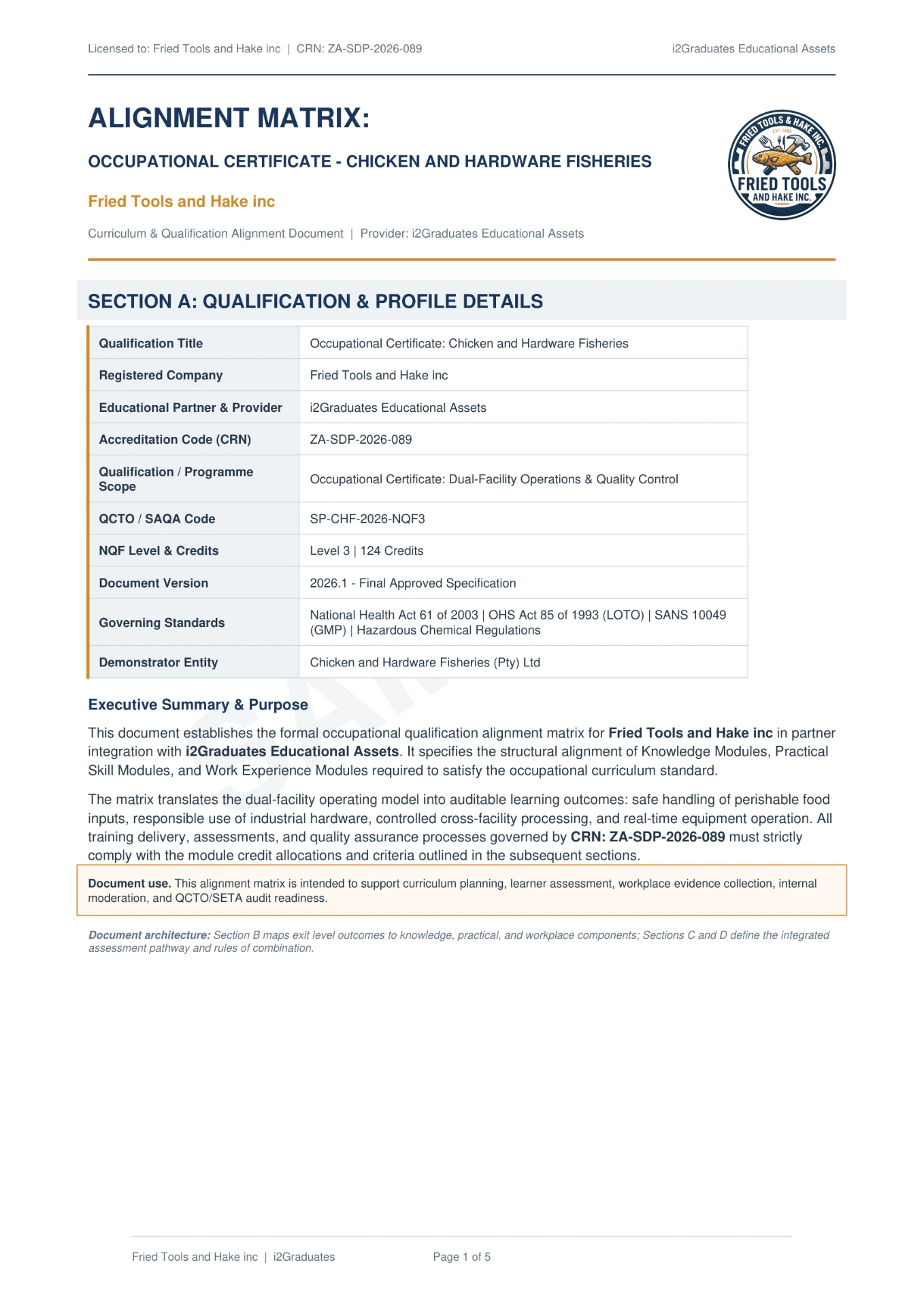
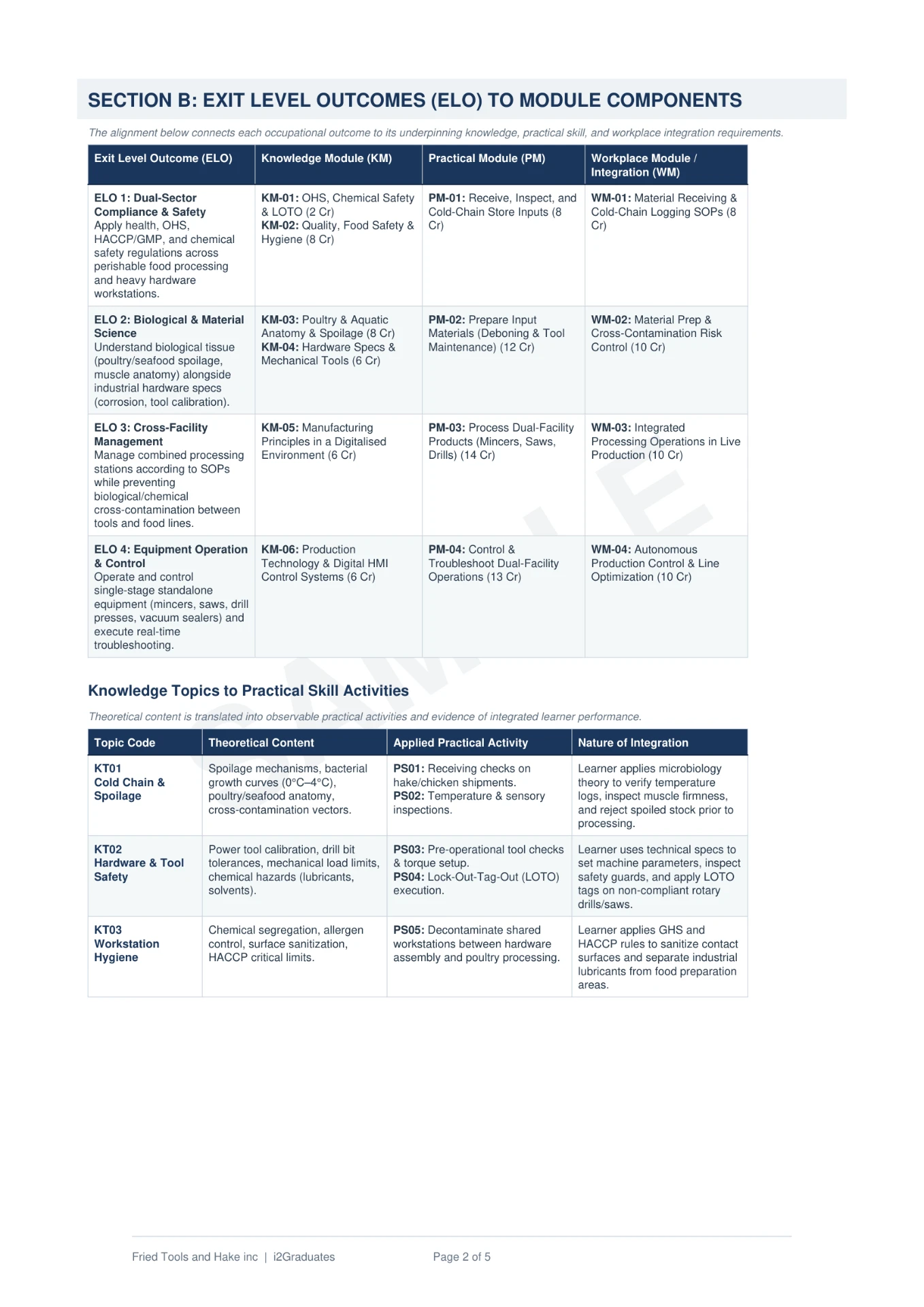
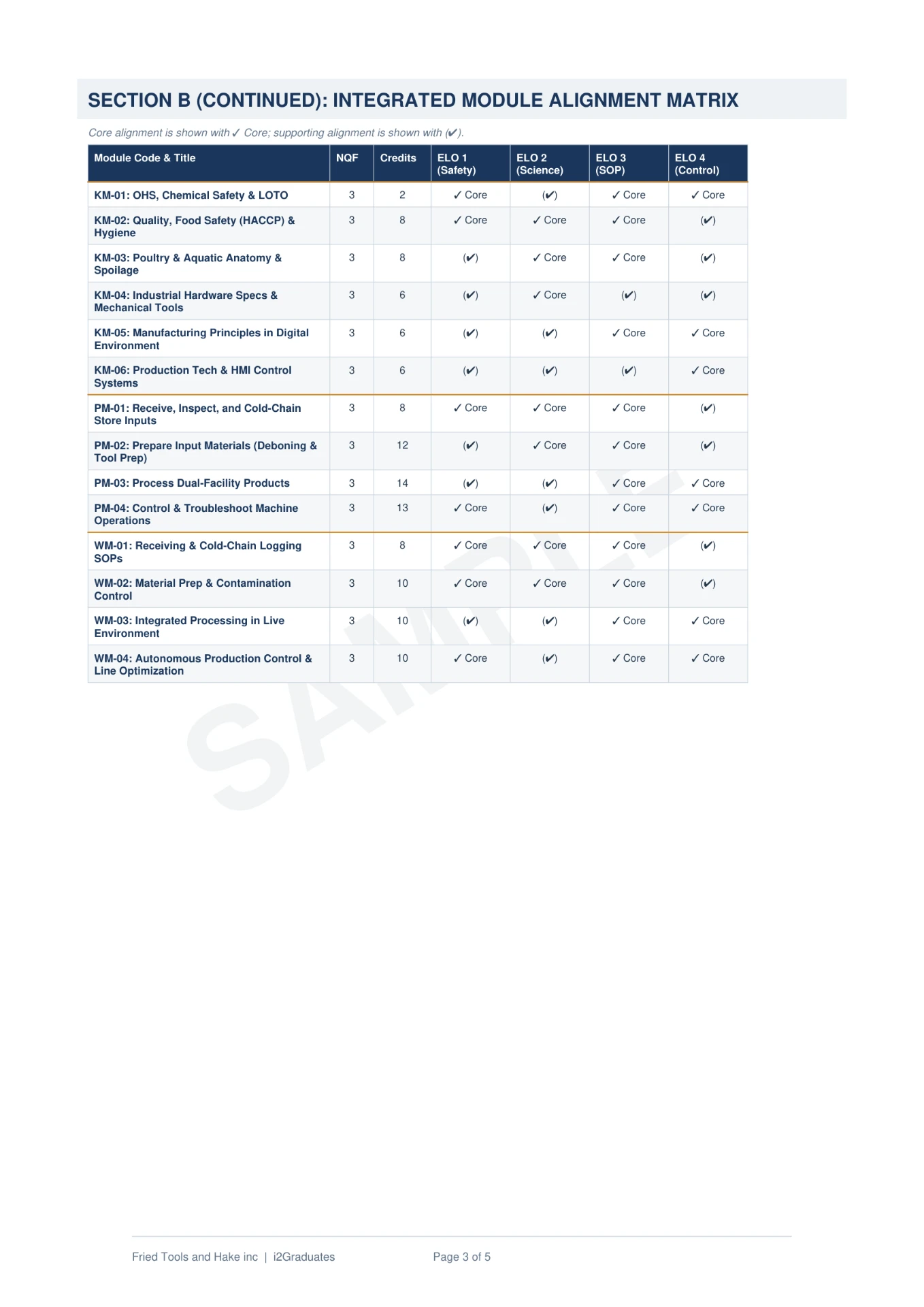
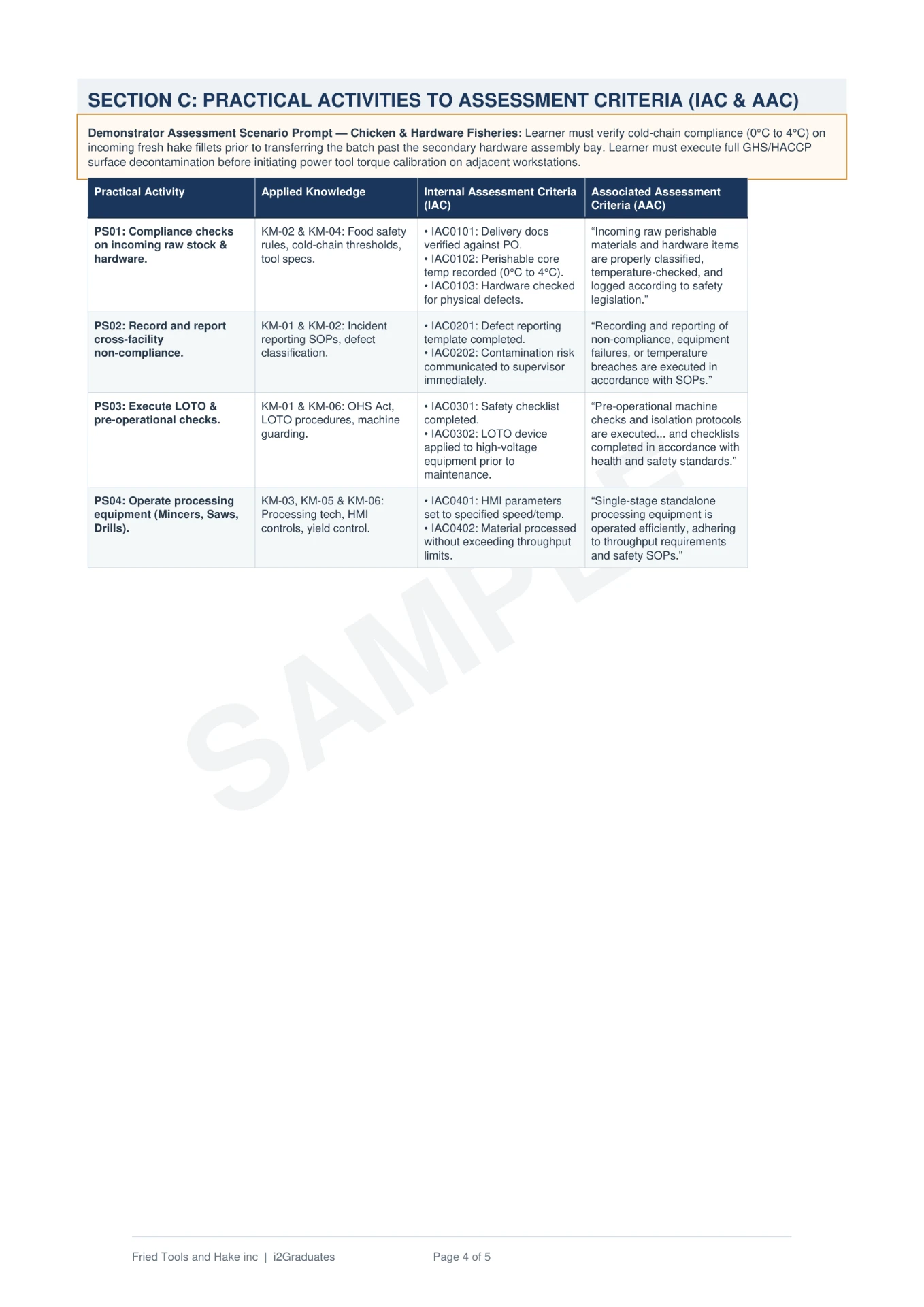
Overview & Scope
Programme Profile
- Target Designation
- Certified Packaging Operator Practitioner
- Competency Focus
- Master specialised practical applications, safety criteria, and regulatory mandates required of a qualified Packaging Operator.
- Academic Weight
- Full national recognition at NQF Level 2 yielding 40 credits upon successful PoE verification.
- Work Opportunities
- Deployment across As a qualified packaging operator, you can find employment opportunities in Various sectors (depending on specialisation). Your skills will be in demand across both public and private sectors, and you may also choose to work as an independent contractor or start your own business in this field. operations under IEB scope.
- Audit Objective
- Bridges operational skills deficits under the governing IEB quality matrix.
- Value Proposition
- Measurable, legally compliant skills that optimise productivity, satisfy Workplace Skills Plans (WSP), and unlock B-BBEE scorecard weight.
Introduction▾
Designed as a Foundational Learning Certificate at NQF Level 2 worth 40 credits, the Packaging Operator equips you with both theoretical understanding and hands-on capabilities. You will learn to perform complex tasks, solve real-world problems, and adapt to the demands of a dynamic work environment. This qualification is your stepping stone to becoming a confident, capable professional.
Purpose▾
Foundational Learning refers to the competence needed in the two key areas of Communication and Mathematical Literacy in order to deal successfully with occupational learning at NQF Levels 2-4. Its key purpose is to remove barriers to learning and progress in occupational pathways and skills development. The part qualification component 'Foundational Communication' describes the language skills, processes, knowledge and practices needed in the language of instruction for occupational training and in the language of formal usage in the workplace. The purpose of this component is to enable individuals to deal confidently and successfully with the Language of Learning and Teaching (LOLT) of formal occupational training, in relation to oral skills, print-based learning and the language of external assessments such as trade tests. People who achieve the part qualification will be able to speak, listen, read and write meaningfully and effectively in the language of instruction, so that they can progress further in their chosen occupational pathways and workplace contexts. The part qualification component 'Foundational Mathematical Literacy' is the minimum, generic mathematical literacy that will provide learners with the necessary foundation to cope with the mathematical demands of occupational training and to engage meaningfully in real-life situations involving mathematics. Foundational Mathematical Literacy will also serve as the foundation for further development of an individual in mathematical literacy contexts and mathematical concepts that may be specific to an occupation or trade. Individuals who have met all the requirements of Foundational Mathematical Literacy are able to make sense of and solve problems in real contexts by responding to information about mathematical ideas that are presented in a variety of ways. Individuals will solve problems by defining their goals, analysing and making sense of problem situations, planning how to solve problems, executing their plans, interpreting and evaluating the results, and justifying the method and solution. Individuals will respond by means of identifying or locating, ordering, sorting, comparing, counting, estimating, computing, measuring, modelling, interpreting and communicating. The mathematical ideas will revolve around number and quantity, space and shape, patterns and relationships, data and chance and measurements.
Entry Requirements▾
It is assumed that learners are competent in: • Communication at Adult Based Education and Training (ABET) Level 3 or equivalent. • Mathematical Literacy at ABET Level 3 or equivalent. Recognition of Prior Learning (RPL): This part qualification may be obtained through the Recognition of Prior Learning. For the purpose of recognising prior learning, learners will be required to undertake a formal assessment according to the designated Assessment Quality Partner's (AQP) assessment mechanisms. The notion of Recognition of Prior Learning is primary to the purpose and rationale of the FLC Part Qualification. The qualification model allows for candidates to present themselves for the National External Assessment without first going through a foundational learning programme, thus creating a model for Recognition of Prior Learning (RPL) that has been lacking in the areas of language and mathematical literacy. However, candidates following this route should take cognisance of the Learning Assumed to be in Place as stipulated in the qualification. Minimum programme-based requirements are specified in each of the Foundational Learning subject area curriculum frameworks registered by the QCTO. Recognition of Prior Learning candidates successful in the National External Assessment for the FLC Part Qualification who do not undertake a learning programme are condoned for programme-based internal assessment requirements. Access to Qualification Open. However, it should be noted that individuals who do not have firmly established Mathematical Literacy skills or literacy skills in the language of the National External Assessment are unlikely to be successful.
SAQA Rationale▾
The Foundational Learning Competence (FLC) Part Qualification comprises two components, Mathematical Literacy and Communication, as these two areas have been identified as platform skills for occupational progress and skills development. The FLC Part Qualification defines itself in the context of the occupational qualifications framework. It was developed to address the following needs: • Many South Africans are denied qualifications in occupations and trades at NQF Levels 2, 3 and 4 because they are unable to achieve the compulsory fundamental requirements at all four levels in the FET band for mathematical literacy and language. Foundational Learning provides an alternative qualification model to enable progress in occupational qualifications pathways. • Many South Africans are unable to cope with the learning demands of qualifications at NQF Levels 2, 3 and 4 due to historical educational backlogs which resulted in a gap in their understanding of and ability to apply mathematics literacy and language. Foundational Learning supports learners in the skills development context. • Additional language or Mathematical Literacy requirements specific to sector and occupational domains are addressed in the design process of occupational qualifications in the FET band, building on the competence levels of the FLC Part Qualification. The FLC Part Qualification is linked to an assessment model that is designed to streamline the process of identifying those who need upskilling in the two foundational areas, while at the same time serving as Recognition for Prior Learning for those who already have the minimum competence in place. It therefore enables access and removes barriers to occupational progression. This part qualification must be read together with the Curriculum Framework for each learning area. These are registered with the Quality Council for Trades and Occupation (QCTO), and provide detailed specifications of knowledge, content, applied skills, range statements and assessment requirements. Programme development must be done in relation to these frameworks; compliance with the Curriculum Frameworks is an indicator in the provider accreditation process for this part qualification.
Learning Assumed to be in Place & RPL▾
It is assumed that learners are competent in: • Communication at Adult Based Education and Training (ABET) Level 3 or equivalent. • Mathematical Literacy at ABET Level 3 or equivalent. Recognition of Prior Learning (RPL): This part qualification may be obtained through the Recognition of Prior Learning. For the purpose of recognising prior learning, learners will be required to undertake a formal assessment according to the designated Assessment Quality Partner's (AQP) assessment mechanisms. The notion of Recognition of Prior Learning is primary to the purpose and rationale of the FLC Part Qualification. The qualification model allows for candidates to present themselves for the National External Assessment without first going through a foundational learning programme, thus creating a model for Recognition of Prior Learning (RPL) that has been lacking in the areas of language and mathematical literacy. However, candidates following this route should take cognisance of the Learning Assumed to be in Place as stipulated in the qualification. Minimum programme-based requirements are specified in each of the Foundational Learning subject area curriculum frameworks registered by the QCTO. Recognition of Prior Learning candidates successful in the National External Assessment for the FLC Part Qualification who do not undertake a learning programme are condoned for programme-based internal assessment requirements. Access to Qualification Open. However, it should be noted that individuals who do not have firmly established Mathematical Literacy skills or literacy skills in the language of the National External Assessment are unlikely to be successful.
Exit Level Outcomes▾
Foundational Communication: 1. Read and understand a range of text types, extract and use information, and make critical judgments. 2. Write a variety of texts to record information and ideas. 3. Interact orally with others with a reasonable degree of confidence for a number of purposes. 4. Read and produce visual texts. 5. Use knowledge of grammar to understand and communicate effectively through reading, writing, speaking and listening. 6. Use the language of learning and teaching effectively for occupational learning and training. Foundational Mathematical Literacy: 1. Use numbers in a variety of forms to describe and make sense of situations, and to solve problems in a range of familiar and unfamiliar contexts. 2. Manage personal finances using financial documents and related formulae. 3. Collect, display and interpret data in various ways and solve related problems. 4. Make measurements using appropriate measuring tools and techniques to solve problems in various measurement contexts. 5. Describe and represent objects and the environment in terms of spatial properties and relationships. 6. Interpret and solve problems involving mathematical patterns, relationships and functions. Critical Cross-Field Outcomes: This part qualification addresses the following Critical Cross-Field Outcomes: • Identifying and solving problems in which responses indicate that responsible decisions using critical and creative thinking have been made: > Foundational Communication supports the formulation of problems and the exploration of solutions through effective communication. > Foundational Mathematical Literacy relates primarily to solving problems in real-life contexts using mathematical knowledge and skills. • Working effectively with others as a member of a team, group, organisation or community: > Foundational Communication is essential in promoting successful interaction between members of groups and communities. > Foundational Mathematical Literacy involves a high degree of working with others to find, discuss and debate solutions to mathematical problems. • Organising and managing oneself and one's activities responsibly and effectively. > Foundational Communication explicitly emphasises using language to organise and manage oneself in lifelong learning and the workplace. > Foundational Mathematical Literacy requires learners to maintain a consistently high degree of self-organisation and management in order to cope with the wide range of concepts and contexts addressed. • Collecting, analysing, organising and critically evaluating information: > Foundational Communication improves language skills as required for this critical outcome, and involves the processing and presentation of information in different formats. > Foundational Mathematical Literacy involves the collection, analysis, organisation and presentation of data using tables, graphs and charts. • Communicating effectively using visual, mathematical and/or language skills in the modes of oral/written persuasion: > Foundational Communication requires learners to communicate effectively through written, visual and verbal modes. > Foundational Mathematical Literacy requires learners to communicate verbally, in writing and symbolically about methods used and reasons for various solutions. • Using science and technology effectively and critically, showing responsibility towards the environment and health of others: > Foundational Communication makes it possible for people to access and use scientific and technological information and applications. > Foundational Mathematical Literacy involves the use of simple technology related to measurement, calculations, record keeping and graphs. • Demonstrating and understanding of the world as a set of related systems by recognising that problem-solving contexts do not exist in isolation: > Foundational Communication enables learners to explore language as a structuring mechanism for understanding the world. Language enables discovery and articulation of linkages and relationships in a range of contexts. > Foundational Mathematical Literacy requires learners to contextualise solutions within a broader environment, identifying linkages, similarities and differences between the various contexts.
Learning Material Included
- Learner Guide (Theory and Knowledge Modules)
- Facilitator Guide
- Workplace Logbook
- Formative and Summative Assessment
- Assessor Guide & Marking Memorandum
- SETA / QCTO Alignment Matrix
- Administrative & Onboarding Pack
- Implementation Plan
Qualification 88895 · Curriculum Architecture
Foundational Learning Certificate: Packaging Operator · NQF Level 2 (40 Credits)
Three Curriculum Pillars
Knowledge Modules
Classroom & E-Learning
- Facilitated lectures & self-study
- Written question banks
- Formative comprehension checks
Practical Skill Modules
Simulated Line Tasks
- Simulated line tasks
- Observation rubrics
- Structured task sheets
Work Experience Modules
On-the-Job Production
- On-the-job rotation
- Mentor logbooks
- Workplace sign-offs
Evidence & Audit Pipeline
Learner Portfolio of Evidence (PoE)Owner · Candidate▾
Admin & Registration
ID, learner contract, induction pack, POPIA consent.
Knowledge Evidence
Written assessments & question banks — KM-01 to KM-07.
Practical Evidence
Task sheets, observation rubrics, assessor photos.
Workplace Evidence
Logbooks, mentor sign-offs, supervisor letters.
Assessor Master FileOwner · Registered Assessor▾
Assessment Reports
Judgements, learner feedback, remediation agreements, appeals log.
Internal Moderation & Quality FileOwner · Moderator / SDP▾
Moderation Evidence
10% sampling matrix, HACCP/LOTO compliance sheets, SDP sign-off.
Final Accreditation Gateway
Issued by the accredited Skills Development Provider once internal moderation is signed off.
Provider submits declaration + PoE to the Assessment Quality Partner (AQP).
QCTO awards the SAQA-registered certificate on successful EISA outcome.
Audit & Compliance
Evidence & Audit Pipeline
From portfolio assembly to external sign-off — the exact route your evidence travels.
- Step 1
PoE Assembly
Learner evidence, formative records and logbook entries filed against the alignment matrix.
- Step 2
Internal Assessment
Registered assessor judges each KM/PM/WM outcome using the supplied instruments.
- Step 3
Internal Moderation
Sampling and verification of assessor decisions, with remediation loop before submission.
- Step 4
External Moderation
SETA/QCTO desktop audit and certification upload against registered credits.
Broken Standard vs i2Graduates Standard
The measurable delta between improvised material and an audit-ready suite.
Broken Standard
i2Graduates Standard
Curriculum Mapping
Photocopied guides with mismatched outcomes
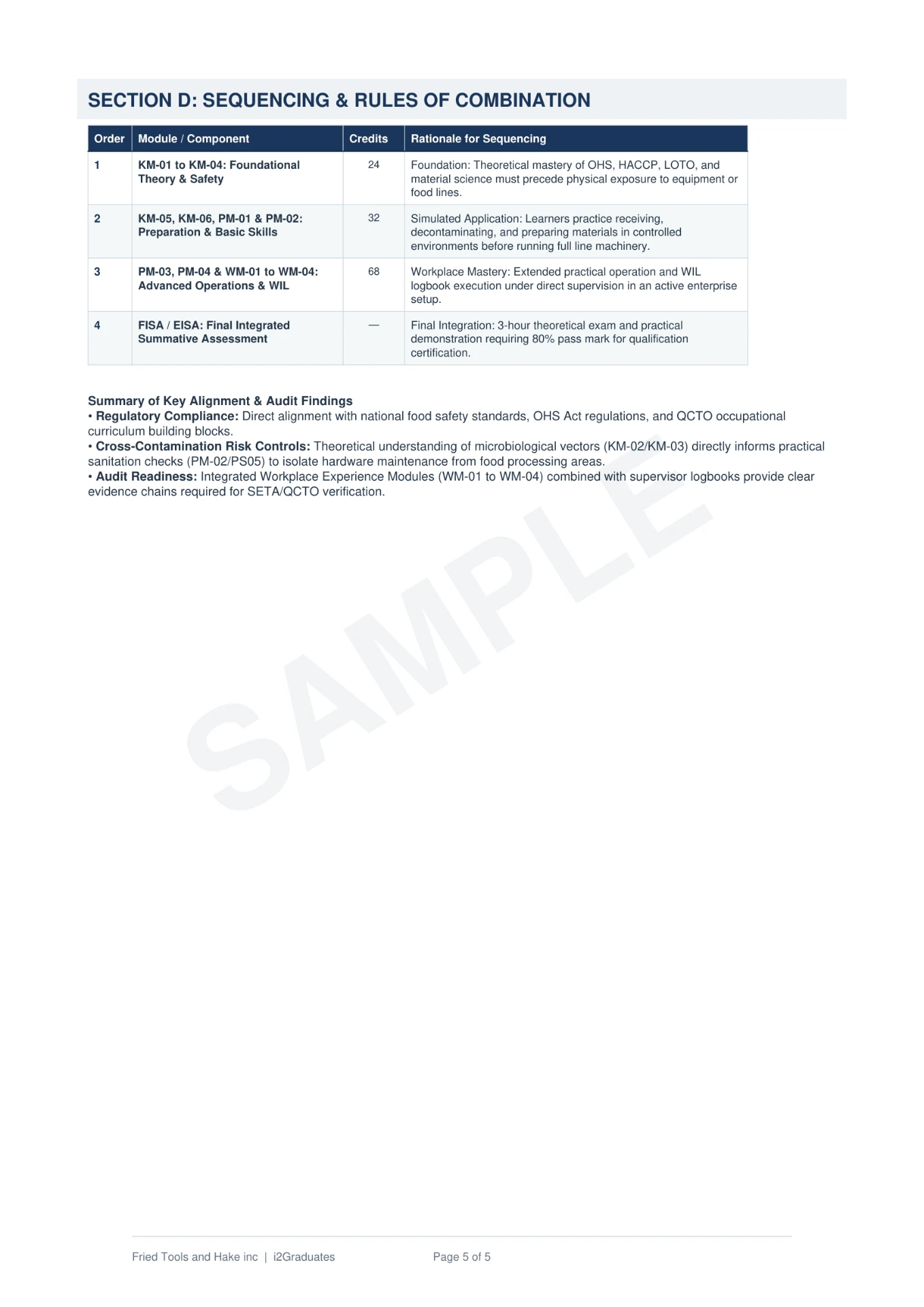
3 KM + 3 PM + 2 WM modules mapped to NQF Level 2
Assessment Bank
Missing formative and summative assessments
Pre-validated assessment bank per module
Alignment Evidence
No alignment matrix — audit fails
IEB alignment matrix included
Facilitation
Facilitators improvise Packaging Operator delivery
Facilitator scripts + learner activities per credit
Portfolio of Evidence
PoE gaps flagged in moderation
PoE templates that survive external moderation
Pricing & Delivery Tiers
Base licence from R42 000
Digital Master Suite
Editable master files, licensed to your SDP
- Learner Guide, Facilitator Guide & Assessment Suite
- Workplace logbook + alignment matrix (editable)
- Instant digital delivery under institutional licence
- Free minor corrections for 12 months
Turnkey Print & Bound Package
Printed, bound and couriered per learner
- Everything in the Digital Master Suite
- Full-colour print, wire-bound learner packs
- Per-learner PoE folders and dividers
- Nationwide courier with tracked delivery
Full Enterprise Accreditation Bundle
Assets plus accreditation support end-to-end
- Everything in the Print & Bound Package
- Bespoke QMS build mapped to your scope
- Moderation dry-run + written remediation report
- Brand & metadata integration across the suite
Complementary Services
Optional add-ons that harden your accreditation scope before an external audit.
Bespoke QMS Build
We author your Quality Management System — policies, procedures, records, matrices — mapped to your accreditation scope. From R18,500.
Request QuoteModeration Consultation
External moderation dry-run on your PoE + delivery pack. Written report with fixes before your real audit. From R4,900.
Book Moderation SessionThe i2Graduates Quality Guarantee
Every page of this bundle is checked for sequence and structural accuracy — no missing pages, no shortcuts. You get pre-validated assessment instruments ready to survive rigorous compliance moderation, wrapped in a curriculum your facilitators will enjoy teaching.