
Occupational Qualification · M55
Discretionary Grant · OpenMilling Machine Operator
- NQF Level
- NQF Level 3
- Credits
- 72
- Duration
- —
- SAQA ID
- 118807
Official QCTO Registry Profile
Source: SAQA / QCTO registry- SAQA ID
- 118807
- Min Credits
- 72
- Registered
- 2022-02-03
- Re-registration
- 2025-12-31
- Field
- Field 06 - Manufacturing, Engineering and Technology
- Sub-field
- Engineering and Related Design
Sample Asset Preview
Overview & Scope
Programme Profile
- Target Designation
- Certified Milling Machine Operator Practitioner
- Competency Focus
- Master specialised practical applications, safety criteria, and regulatory mandates required of a qualified Milling Machine Operator.
- Academic Weight
- Full national recognition at NQF Level 3 yielding 72 credits upon successful PoE verification.
- Work Opportunities
- Deployment across As a qualified milling machine operator, you can find employment opportunities in Manufacturing, Engineering, Automotive. Your skills will be in demand across both public and private sectors, and you may also choose to work as an independent contractor or start your own business in this field. operations under MERSETA scope.
- Audit Objective
- Bridges operational skills deficits under the governing MERSETA quality matrix.
- Value Proposition
- Measurable, legally compliant skills that optimise productivity, satisfy Workplace Skills Plans (WSP), and unlock B-BBEE scorecard weight.
Introduction▾
The Milling Machine Operator is a Occupational Certificate set at NQF Level 3, comprising 72 credits. This qualification has been carefully developed to provide you with the essential knowledge, practical skills, and workplace experience needed to excel in your chosen field. Whether you are starting your career or looking to formalise your existing expertise, this programme offers a structured pathway to competence and recognition.
Purpose▾
The purpose of this part-qualification is to prepare a learner to operate as a Milling Machine Operator. A Milling Machine Operator operates milling machine implementing measurement, materials, and safety (MMS) requirements and conducting conventional machining operations such as facing, boring, drilling, cutting, gear cutting, slotting. A qualified learner should be able to: • Operate conventional milling machine for facing, boring, drilling, cutting, slotting.
Entry Requirements▾
Recognition of Prior Learning (RPL): • Learners will gain access to the part-qualification through RPL for Access as provided for in the QCTO RPL Policy. RPL for access is conducted by accredited education institution, skills development provider or workplace accredited to offer that specific qualification/part qualification. • Learners who have acquired competencies of the modules of a qualification or part qualification will be credited for modules through RPL. RPL for access to the external integrated summative assessment: Accredited providers and approved workplaces must apply the internal assessment criteria specified in the related curriculum document to establish and confirm prior learning. Accredited providers and workplaces must confirm prior learning by issuing a statement of result. Entry Requirements: The minimum entry requirement for this part-qualification is: • NQF Level 2 qualification with Mathematics and Science.
SAQA Rationale▾
The Industrial Policy Action Plan (IPAP) is firmly entrenched in Government's overall policy and plans to address the key challenges of economic and industrial growth and race-based poverty, inequality and unemployment. The Department of Trade and Industry (DTI) incorporated the National Tooling Initiative (NTI) into the Industrial Policy Action Plan - IPAP as a key action programme for the Industrial Development. The NTI is the turnaround intervention programme aimed at the rehabilitation and growth of the Tool, Die and Mould manufacturing (TDM) Sector and has been identified by the DTI as a key programme to uplift the manufacturing industry to international standards to develop the market and showcase the niche competitive advantages and capabilities of South Africa. The aspects of Milling Machine Operator for Tooling in Manufacturing: Tools, Dies & Moulds, Jigs and Fixtures, Gauges and Metrology Equipment are core, key and critical to Manufacturing Competitiveness, as they are key Product Life Cycle Cost Drivers in terms of: • Initial Capital Investment to enable manufacturing of any new product, (Design and Manufacturing Cost of Original Tooling). • Production Cost Competitiveness (through Production Cycle Time, Reject). • Rate, Conversion Efficiency of the product to be produced. • End-product Quality standard. • Reliability of Production output and End product. • Maintenance Cost of Tooling. • Occupational health and safety. The need for revamping and updating the training capacity for the TDM sector cannot be over-emphasised and the QCTO model for provision of training received overwhelming support from the industry. In particular, the advent of this system is considered opportune to address existing problems in the industry, such as: • Improved industrial competitiveness by addressing current loss of work to Europe, China, India, and other far east countries resulting from the lack of skills availability, decline in quality standards (out-dated non-competitive technology), decline in SA TDM companies' ability to meet delivery capacity and timing requirements. • Improve the BBBEE transformation in TDM industry whereas a result of perceived distress in the sector, financial institutions and investors classify this industry sector as high risk, thus empowerment investment to date remains largely insignificant. Capacity building will address start-up SME enterprises in the sector to improve investor perception and improve chances for investment finance. • Improve the Balance of Payments through import substitution resulting from local production and manufacturing competitiveness, i.e., machine setting, tooling adjustment and tool maintenance services. The improved competitiveness will further address downstream problems like plant downtime, higher scrap rates, drop in output efficiencies, quality problems, missed supply deadlines, and increased input costs. The Milling Machine Operator is one of part-qualifications that constitute a Toolmaker. The range of typical learners that will enter this qualification are people who would like to gain access to employment in the Tool and Die Making and manufacturing industries and those with a specific interest in manufacturing and the production of tooling. This qualification resides as one of several in the mechanical engineering and manufacturing environments related to toolmaking and general manufacturing. It acts as feeder occupation within this context to gain access to the Toolmaker and other mechanical engineering qualification. This qualification also makes provision for people to progress to other aspects such as general manufacturing and machining, patternmaking, etc. The main benefits of this qualification for the learner are that the learner has an opportunity to be recognised with a well-structured, relevant, and current competency and have access to entrepreneurial opportunities within the mechanical engineering and manufacturing environments. Society will be served by qualified operators that not only undertake work with improved skills but are also contributing to the competitiveness of South Africa's manufacturing sector. The overall benefits for the economy would include efficient and effective competencies available to be utilised for economic growth purposes.
Learning Assumed to be in Place & RPL▾
Recognition of Prior Learning (RPL): • Learners will gain access to the part-qualification through RPL for Access as provided for in the QCTO RPL Policy. RPL for access is conducted by accredited education institution, skills development provider or workplace accredited to offer that specific qualification/part qualification. • Learners who have acquired competencies of the modules of a qualification or part qualification will be credited for modules through RPL. RPL for access to the external integrated summative assessment: Accredited providers and approved workplaces must apply the internal assessment criteria specified in the related curriculum document to establish and confirm prior learning. Accredited providers and workplaces must confirm prior learning by issuing a statement of result. Entry Requirements: The minimum entry requirement for this part-qualification is: • NQF Level 2 qualification with Mathematics and Science.
Exit Level Outcomes▾
1. Demonstrate the ability to conduct conventional machining operations such as facing, boring, drilling, cutting, slotting.
Learning Material Included
- Learner Guide (Theory and Knowledge Modules)
- Facilitator Guide
- Workplace Logbook
- Formative and Summative Assessment
- Assessor Guide & Marking Memorandum
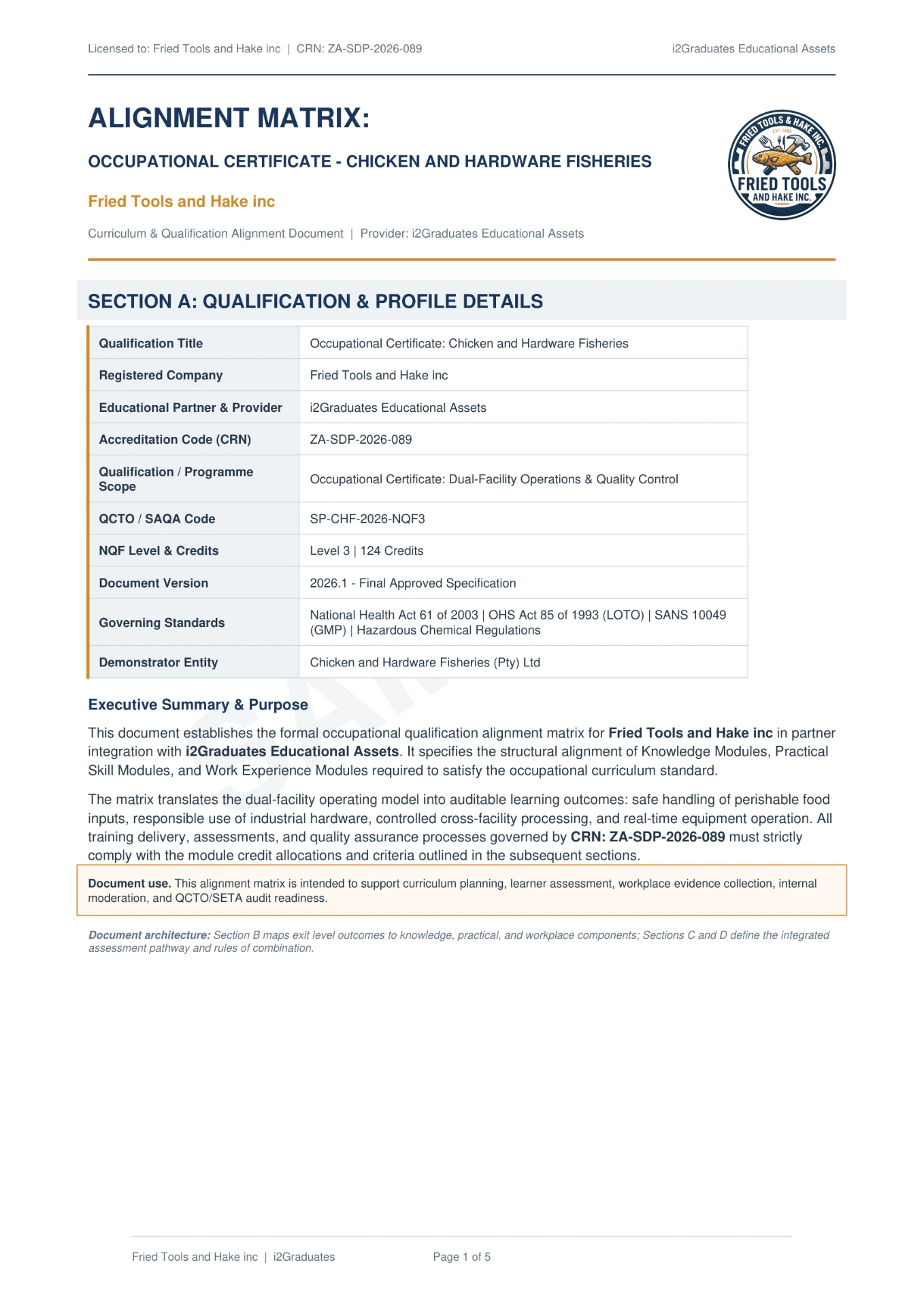
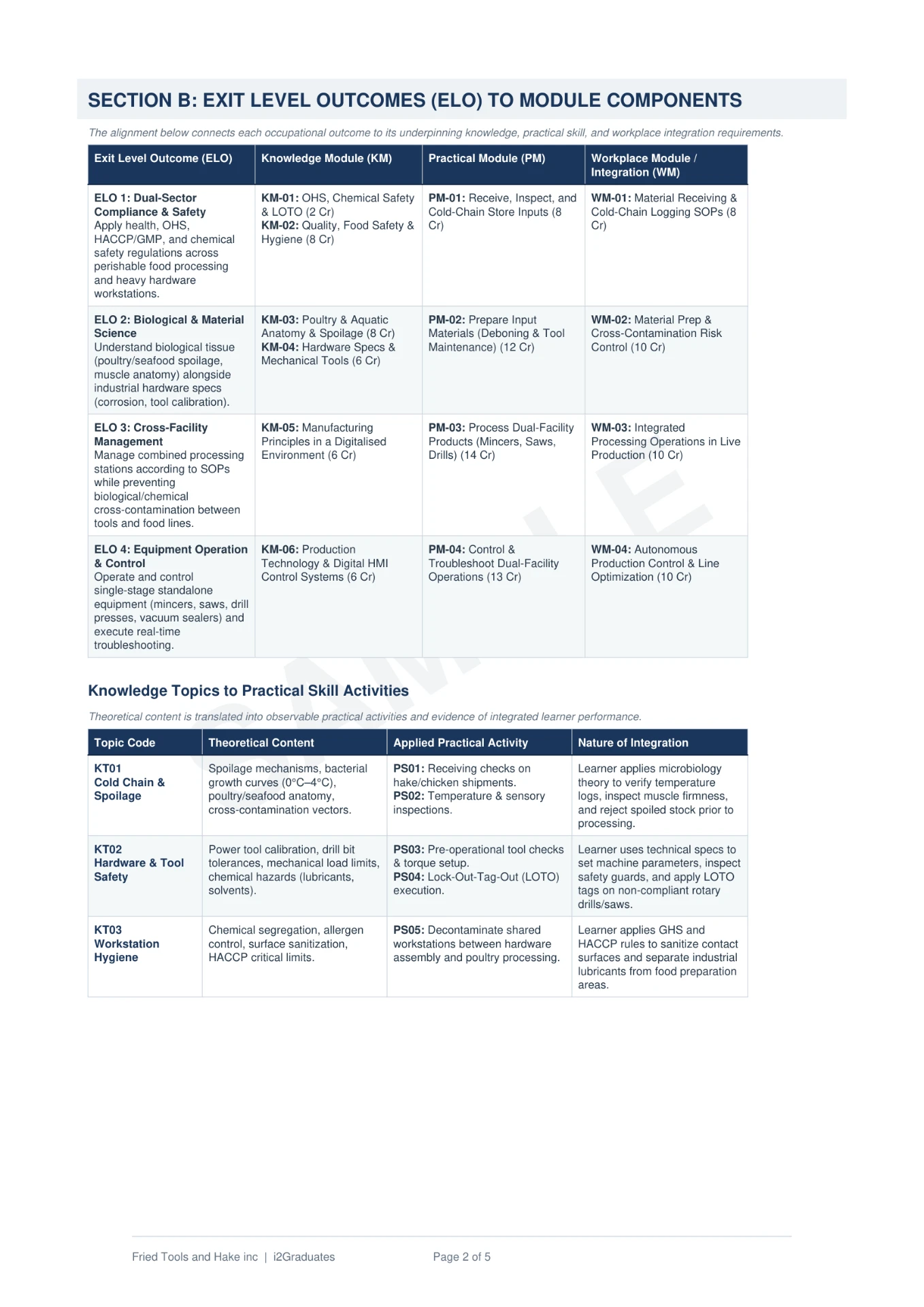
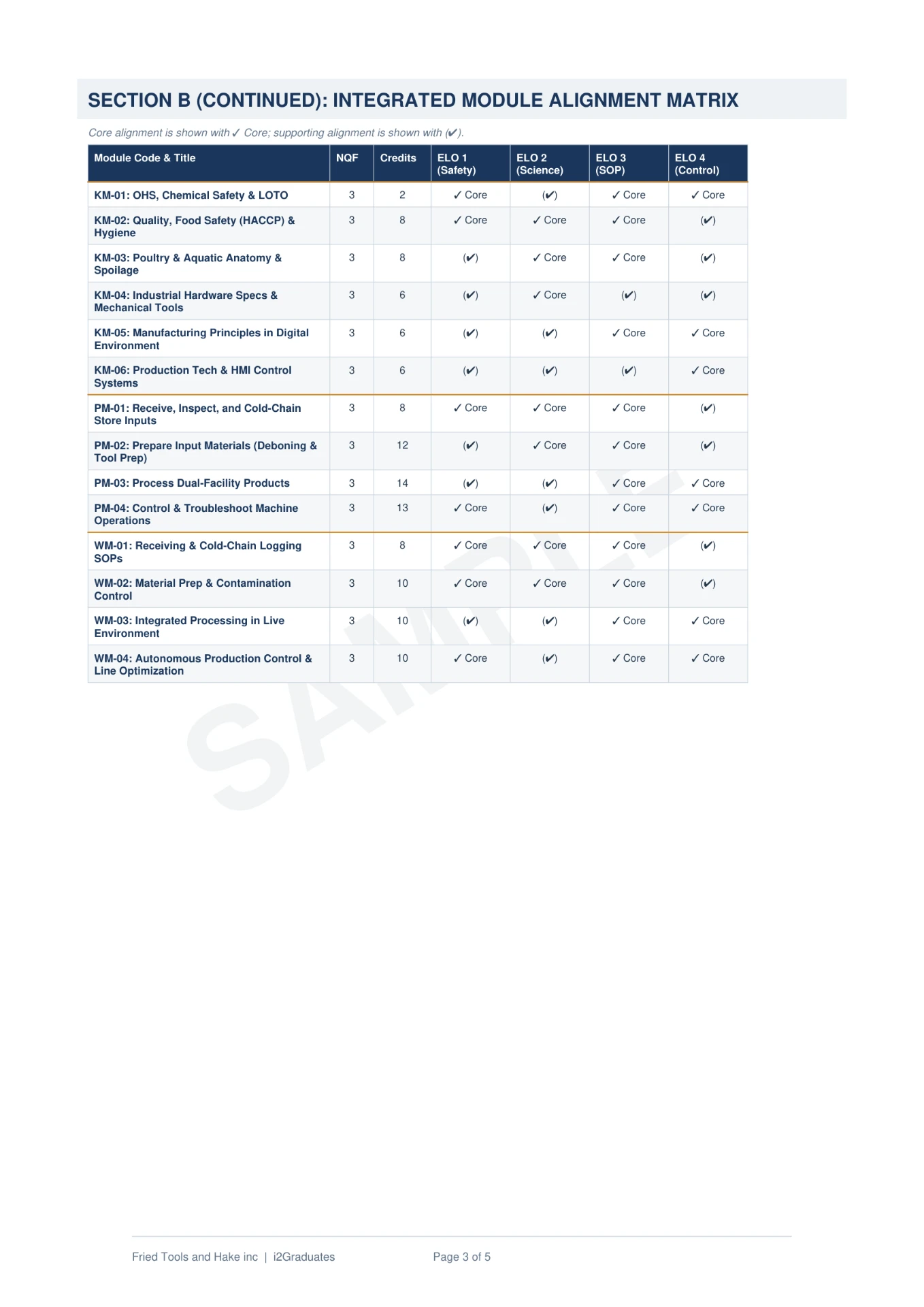
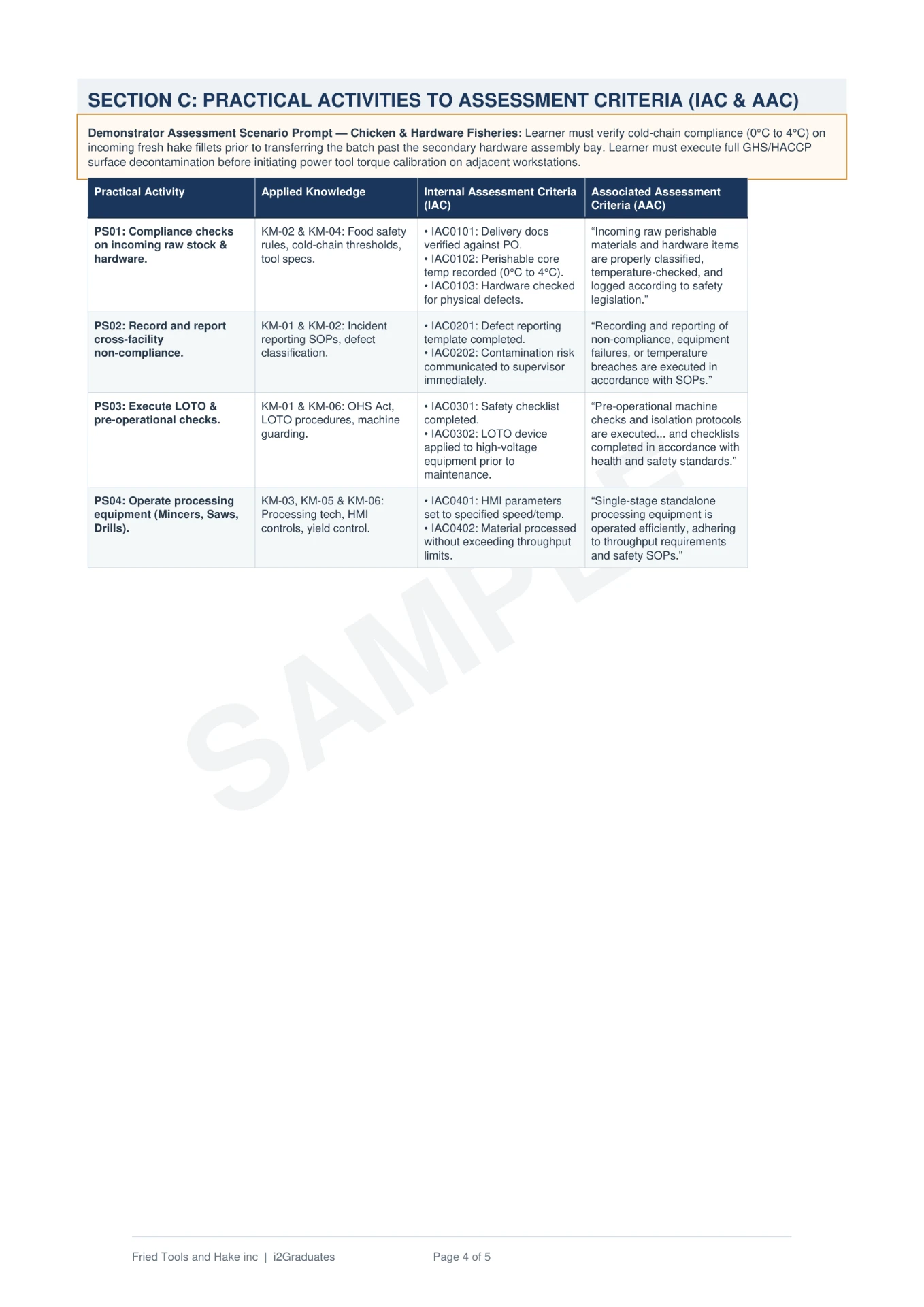
- SETA / QCTO Alignment Matrix
- Administrative & Onboarding Pack
- Implementation Plan
Moderator-Ready Curriculum Breakdown
5 modules · 45 creditsTheory, regulatory and safety knowledge. Each row carries the registered module code, NQF level and credit weight used for formative assessment rubric mapping.
- 652201-000-01-KM-025 cr
Principles and Concepts of Drawings
NQF Level 2
Qualification 118807 · Curriculum Architecture
Occupational Certificate: Milling Machine Operator · NQF Level 3 (72 Credits)
Three Curriculum Pillars
Knowledge Modules
Classroom & E-Learning
- Facilitated lectures & self-study
- Written question banks
- Formative comprehension checks
Practical Skill Modules
Simulated Line Tasks
- Simulated line tasks
- Observation rubrics
- Structured task sheets
Work Experience Modules
On-the-Job Production
- On-the-job rotation
- Mentor logbooks
- Workplace sign-offs
Evidence & Audit Pipeline
Learner Portfolio of Evidence (PoE)Owner · Candidate▾
Admin & Registration
ID, learner contract, induction pack, POPIA consent.
Knowledge Evidence
Written assessments & question banks — KM-01 to KM-07.
Practical Evidence
Task sheets, observation rubrics, assessor photos.
Workplace Evidence
Logbooks, mentor sign-offs, supervisor letters.
Assessor Master FileOwner · Registered Assessor▾
Assessment Reports
Judgements, learner feedback, remediation agreements, appeals log.
Internal Moderation & Quality FileOwner · Moderator / SDP▾
Moderation Evidence
10% sampling matrix, HACCP/LOTO compliance sheets, SDP sign-off.
Final Accreditation Gateway
Issued by the accredited Skills Development Provider once internal moderation is signed off.
Provider submits declaration + PoE to the Assessment Quality Partner (AQP).
QCTO awards the SAQA-registered certificate on successful EISA outcome.
Audit & Compliance
Evidence & Audit Pipeline
From portfolio assembly to external sign-off — the exact route your evidence travels.
- Step 1
PoE Assembly
Learner evidence, formative records and logbook entries filed against the alignment matrix.
- Step 2
Internal Assessment
Registered assessor judges each KM/PM/WM outcome using the supplied instruments.
- Step 3
Internal Moderation
Sampling and verification of assessor decisions, with remediation loop before submission.
- Step 4
External Moderation
SETA/QCTO desktop audit and certification upload against registered credits.
Broken Standard vs i2Graduates Standard
The measurable delta between improvised material and an audit-ready suite.
Broken Standard
i2Graduates Standard
Curriculum Mapping
Photocopied guides with mismatched outcomes
1 KM + 2 PM + 2 WM modules mapped to NQF Level 3
Assessment Bank
Missing formative and summative assessments
Pre-validated assessment bank per module
Alignment Evidence
No alignment matrix — audit fails
MERSETA alignment matrix included
Facilitation
Facilitators improvise Milling Machine Operator delivery
Facilitator scripts + learner activities per credit
Portfolio of Evidence
PoE gaps flagged in moderation
PoE templates that survive external moderation
Pricing & Delivery Tiers
Base licence from R48 600
Digital Master Suite
Editable master files, licensed to your SDP
- Learner Guide, Facilitator Guide & Assessment Suite
- Workplace logbook + alignment matrix (editable)
- Instant digital delivery under institutional licence
- Free minor corrections for 12 months
Turnkey Print & Bound Package
Printed, bound and couriered per learner
- Everything in the Digital Master Suite
- Full-colour print, wire-bound learner packs
- Per-learner PoE folders and dividers
- Nationwide courier with tracked delivery
Full Enterprise Accreditation Bundle
Assets plus accreditation support end-to-end
- Everything in the Print & Bound Package
- Bespoke QMS build mapped to your scope
- Moderation dry-run + written remediation report
- Brand & metadata integration across the suite
Complementary Services
Optional add-ons that harden your accreditation scope before an external audit.
Bespoke QMS Build
We author your Quality Management System — policies, procedures, records, matrices — mapped to your accreditation scope. From R18,500.
Request QuoteModeration Consultation
External moderation dry-run on your PoE + delivery pack. Written report with fixes before your real audit. From R4,900.
Book Moderation SessionThe i2Graduates Quality Guarantee
Every page of this bundle is checked for sequence and structural accuracy — no missing pages, no shortcuts. You get pre-validated assessment instruments ready to survive rigorous compliance moderation, wrapped in a curriculum your facilitators will enjoy teaching.