
Occupational Qualification · F65
Discretionary Grant · RollingFurniture Finisher
- NQF Level
- NQF Level 2
- Credits
- 55
- Duration
- —
- SAQA ID
- 121910
Official QCTO Registry Profile
Source: SAQA / QCTO registry- SAQA ID
- 121910
- Min Credits
- 55
- Registered
- 2024-01-30
- Re-registration
- 2029-01-30
- Field
- Field 06 - Manufacturing, Engineering and Technology
- Sub-field
- Manufacturing and Assembly
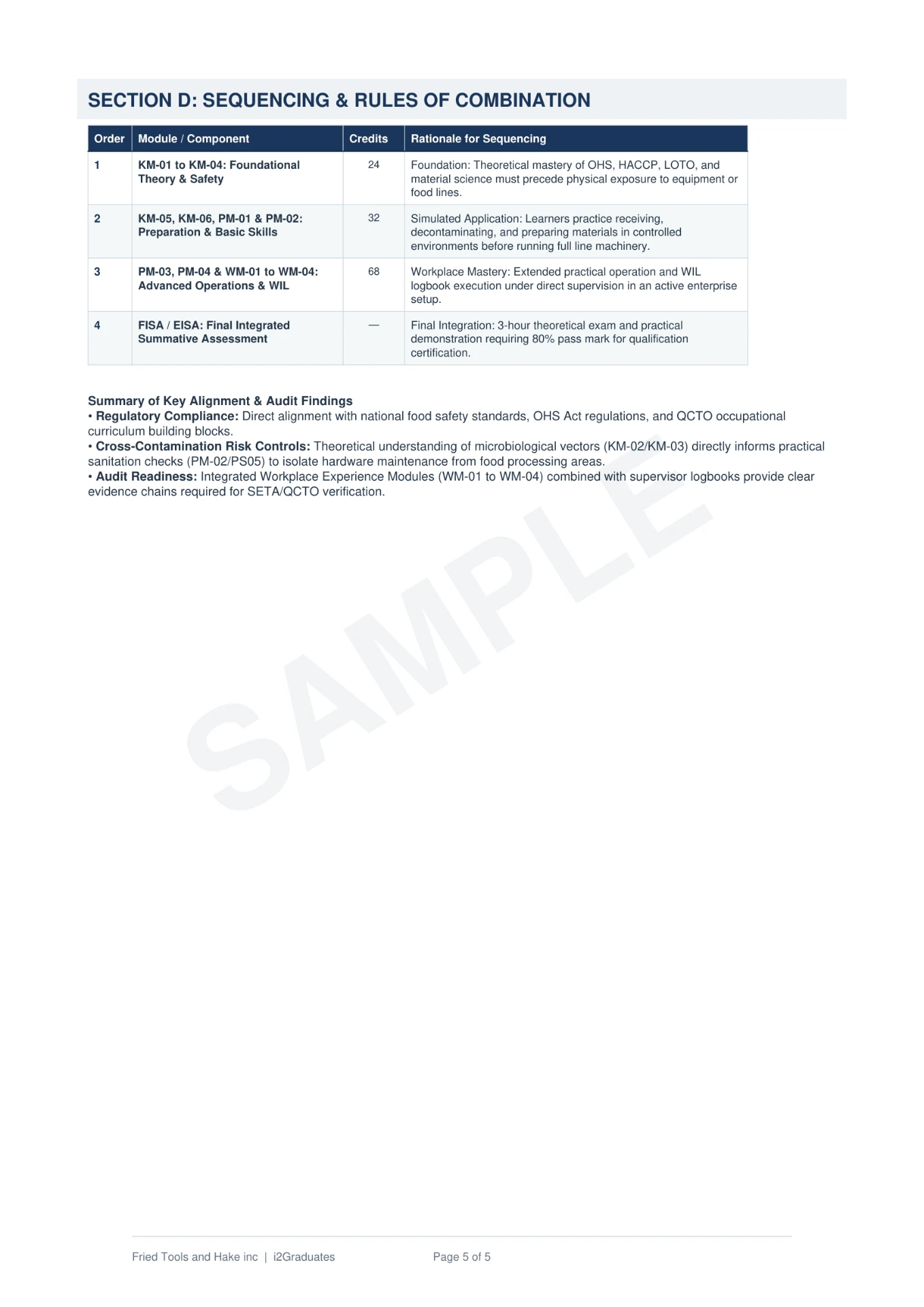
Sample Asset Preview
Overview & Scope
Programme Profile
- Target Designation
- Certified Furniture Finisher Practitioner
- Competency Focus
- Master specialised practical applications, safety criteria, and regulatory mandates required of a qualified Furniture Finisher.
- Academic Weight
- Full national recognition at NQF Level 2 yielding 55 credits upon successful PoE verification.
- Work Opportunities
- Deployment across As a qualified furniture finisher, you can find employment opportunities in Various sectors (depending on specialisation). Your skills will be in demand across both public and private sectors, and you may also choose to work as an independent contractor or start your own business in this field. operations under FPM SETA scope.
- Audit Objective
- Bridges operational skills deficits under the governing FPM SETA quality matrix.
- Value Proposition
- Measurable, legally compliant skills that optimise productivity, satisfy Workplace Skills Plans (WSP), and unlock B-BBEE scorecard weight.
Introduction▾
Designed as a Occupational Certificate at NQF Level 2 worth 55 credits, the Furniture Finisher equips you with both theoretical understanding and hands-on capabilities. You will learn to perform complex tasks, solve real-world problems, and adapt to the demands of a dynamic work environment. This qualification is your stepping stone to becoming a confident, capable professional.
Purpose▾
The purpose of this qualification is to prepare a learner to operate as a Furniture Finisher. A Furniture Finisher prepares the furniture product for final finishing and performs the hand finishing and spraying applications to produce finished wooden furniture. A qualified learner will be able to: • Prepare the product for final finishing and perform the hand finishing and spray applications (conventional and pumps), performing colour matching to produce finished wooden furniture.
Entry Requirements▾
Who should enrol? Entry-level workers, school leavers, or career changers who want to gain foundational skills. The Furniture Finisher welcomes learners from diverse backgrounds, including those with limited formal education but relevant practical experience. The flexible learning approach ensures that everyone can progress at their own pace while achieving the same high standard of competence.
SAQA Rationale▾
A shortage of higher-skilled workers, rising production costs, and poor domestic demand are affecting the performance of local furniture manufacturers. The cost of labour, electricity, raw materials and transportation continue to shrink operating margins and make it difficult for them to compete in local and international markets. The industry is also negatively affected by declining investment in capital equipment, insufficient research and development, and little design improvement or new product development. Imported furniture is often cheaper than what is manufactured locally, and furniture imports grew beyond R7bn during 2019 (according to the Furniture Industry Master Plan 2020). South African furniture manufacturers are also facing competition from Chinese furniture in their important export markets in Africa. With about 80% of the companies in the furniture manufacturing sector classified as micro enterprises, these challenges impose significant pressure on the bulk of players in the industry. There are no other similar qualifications on the NQF. The Furniture Industry Master Plan (FIMP) was established by the South African Government to set clear guidelines and targets for the furniture manufacturing industry, as well as guide public sector procurement as part of government's efforts to support and stimulate the industry. The furniture industry is one of the most labour-intensive industries, with a potential to contribute to the reduction of unemployment, and increase export and development of small, medium and micro enterprises (SMMES). It contributes to the geographical spread of economic activity, since the products can be developed in rural areas with minimal investment. The above identifies to the importance to grow the furniture industry and signals the need for skilled and competent furniture makers at various levels of the furniture production process, whether big companies, or small enterprises or entrepreneurs. Furthermore, it clearly defines the benefits to the sector as well as the economy. The Occupational certificate: Furniture Finisher is designed to equip learners with the skills, knowledge and understanding required to participate effectively in the furniture industry, whether in micro, small, medium or large operations. Learners may find employment as furniture finishers. The Occupational certificate: Furniture Finisher is one of two-part qualifications of the Intermediate Occupational Certificate: Crafted Furniture Assembler. These part qualifications create appropriate exit points where learners may exit the learning with industry required employable skills. The competencies contained in this qualification are essential for social and economic transformation, empowerment and upliftment within the furniture manufacturing environment, whilst simultaneously improving the skills base of the furniture industry. This will enhance the international competitiveness of the furniture sector by means of improving productivity in the various furniture making departments and overall quality of products. Four distinct learner target groups have been identified, namely school leavers wishing to enter the furniture-making industry, persons currently employed in the furniture industry who have no formal qualification in furniture making, persons currently employed in the furniture industry who want to advance their skills or unemployed persons. No professional registration is needed for Furniture Finisher to operate in the industry. Industry associations consulted include: • Cape Furniture Manufacturers Association (CFMA). • KwaZulu Natal Furniture Manufacturers Association (KNFMA). • Allied Business Association (ABA). • Garden Route Employer Association (GREA). • Furniture Bedding and Upholstery Manufacturers Association (FBUMA). • The National Union of Furniture & Allied Workers SA (NUFAWSA). • The Chemical, Energy, Paper, Printing, Wood and Allied Workers' Union (CEPPWAWU).
Exit Level Outcomes▾
- Prepare for finishing of wooden furniture.
- Select and mix chemicals and solvents in the furniture finishing department to produce finished furniture components to specifications.
- Produce finished furniture components and furniture to specifications.
- Inspect the finished product, visually and by feel, checking against specification and applying tolerances to ensure quality and accuracy.
- Conclude finishing operations.
- Explain principles and procedures involved in basic furniture finishing processes in the bulk production of furniture.
Learning Material Included
- Learner Guide (Theory and Knowledge Modules)
- Facilitator Guide
- Workplace Logbook
- Formative and Summative Assessment
- Assessor Guide & Marking Memorandum
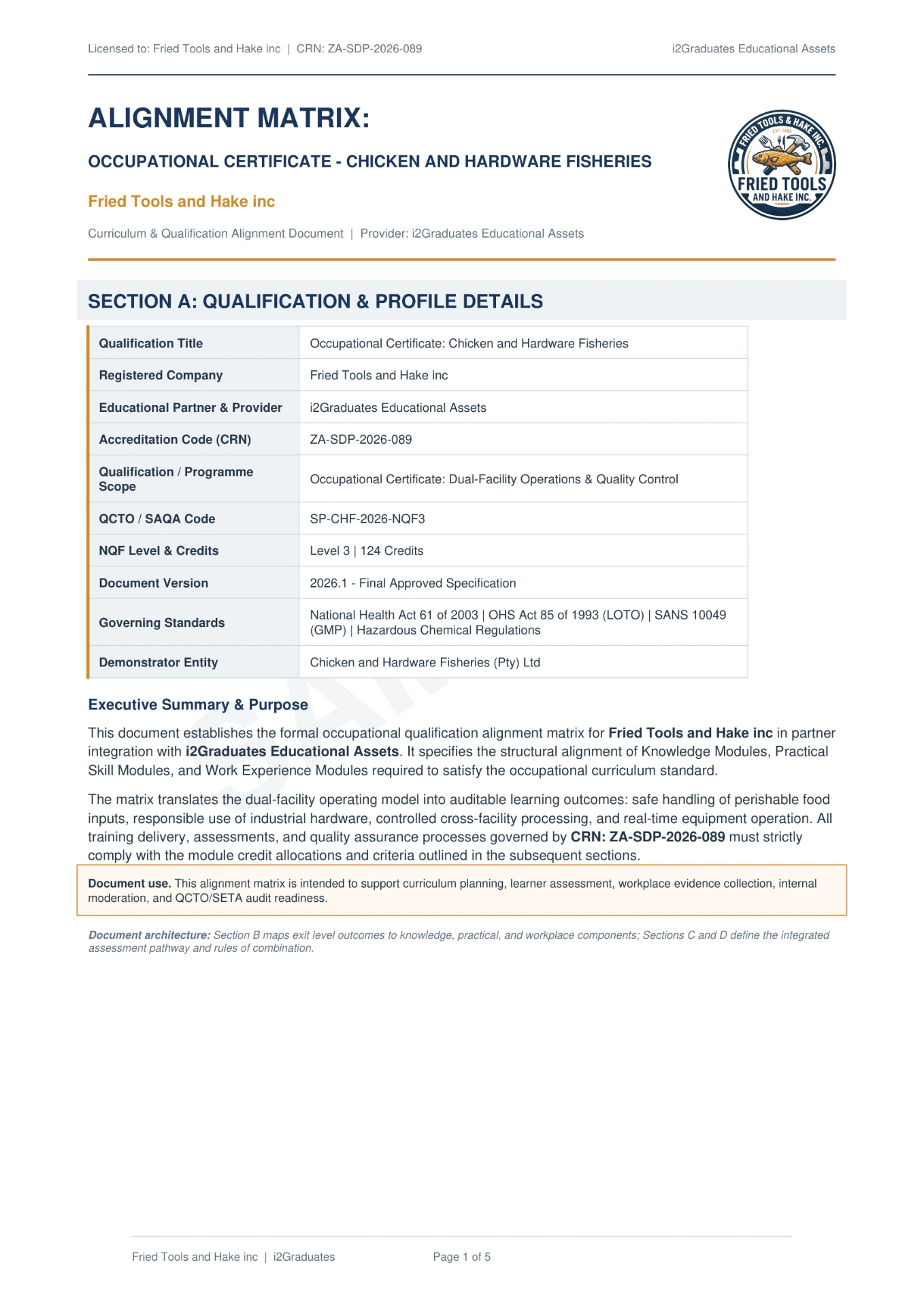
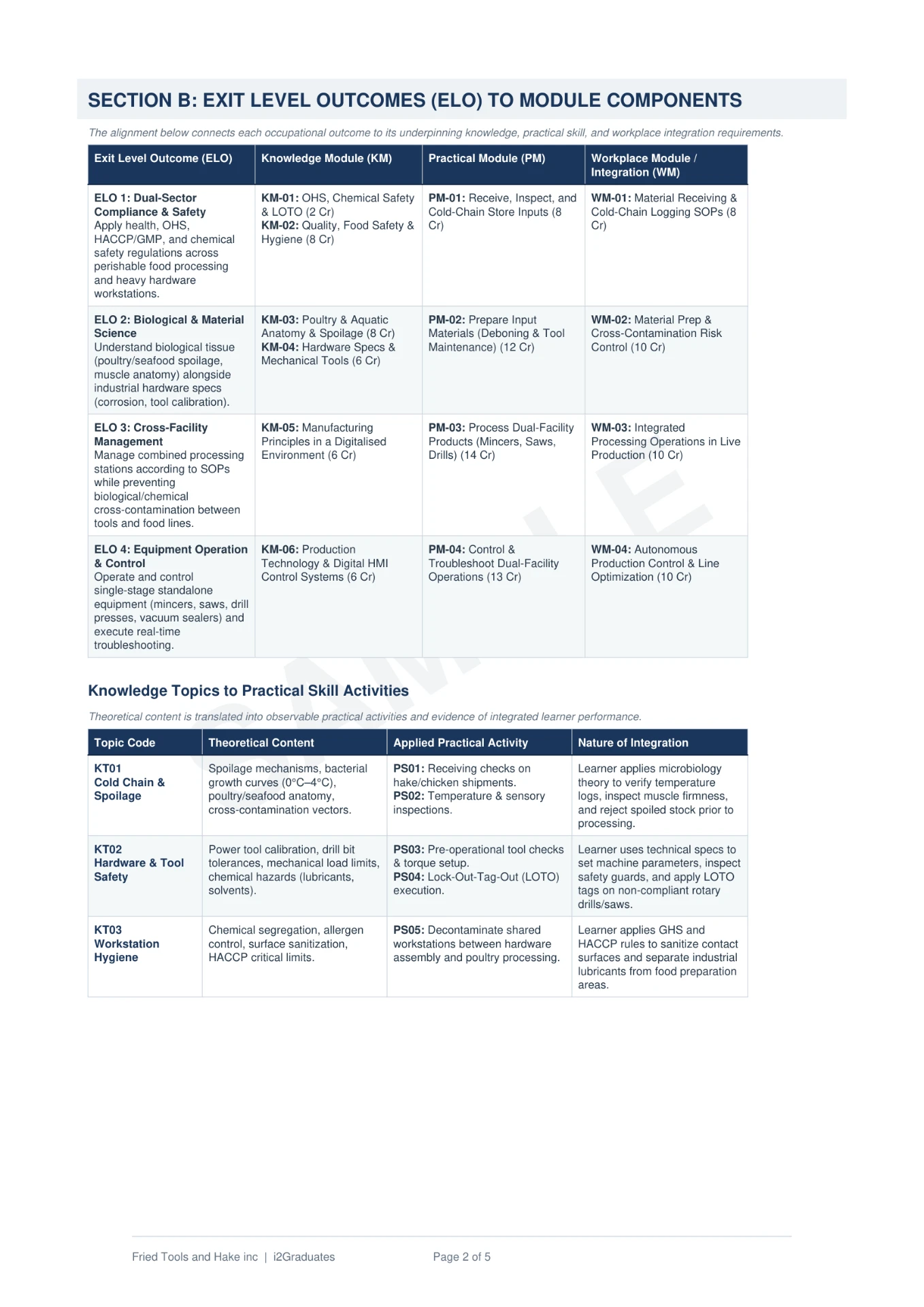
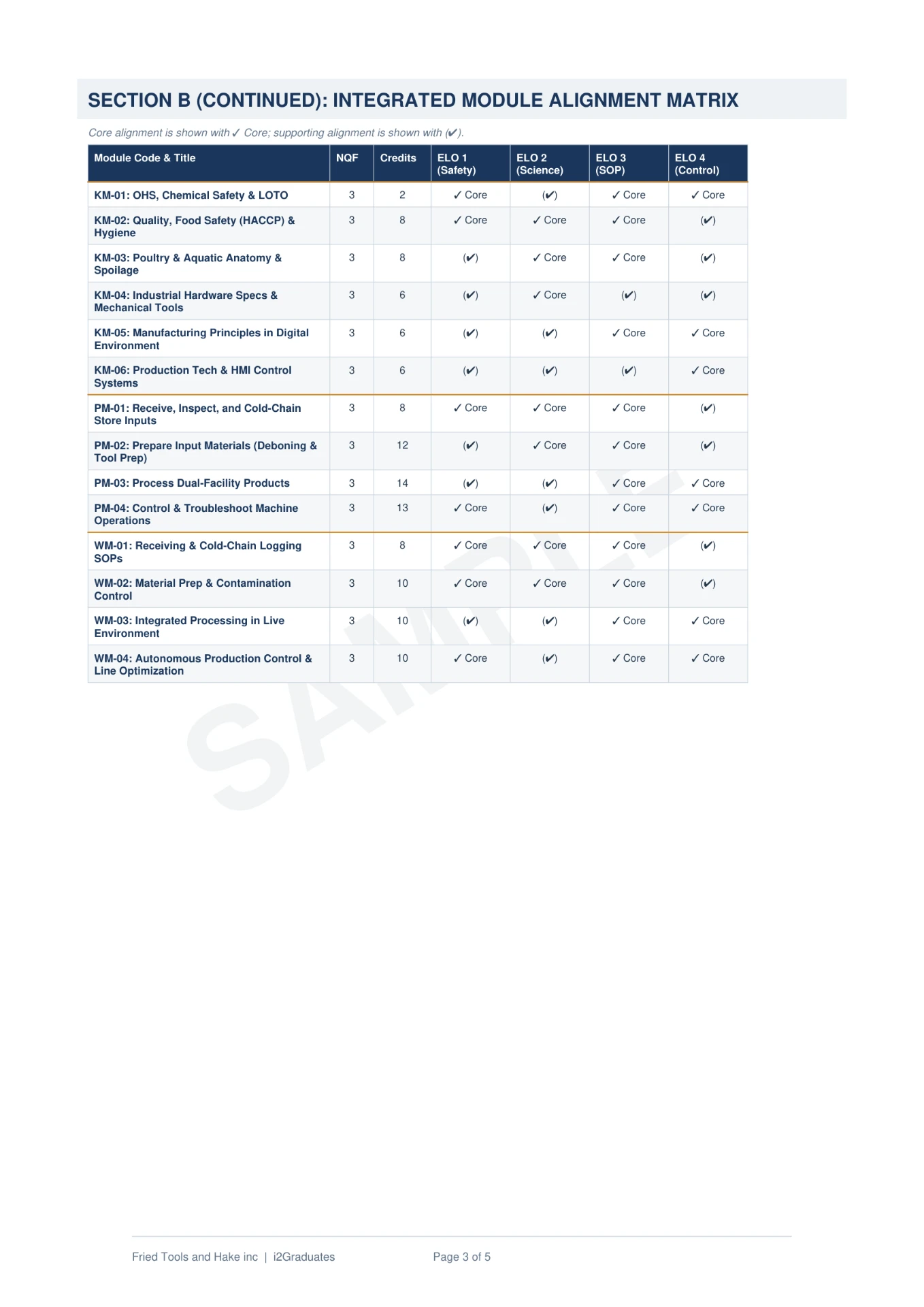
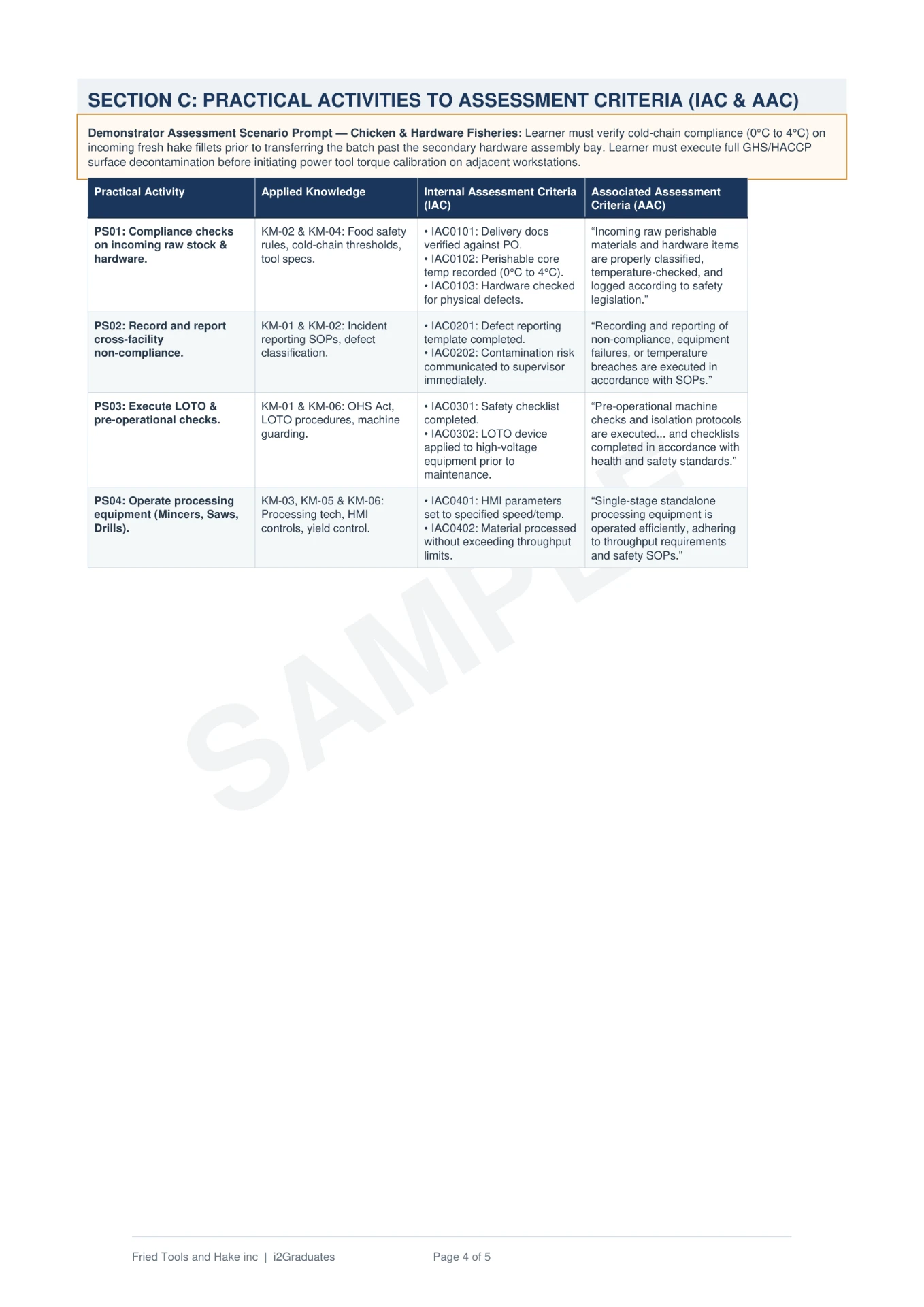
- SETA / QCTO Alignment Matrix
- Administrative & Onboarding Pack
- Implementation Plan
Qualification 121910 · Curriculum Architecture
Occupational Certificate: Furniture Finisher · NQF Level 2 (55 Credits)
Three Curriculum Pillars
Knowledge Modules
Classroom & E-Learning
- Facilitated lectures & self-study
- Written question banks
- Formative comprehension checks
Practical Skill Modules
Simulated Line Tasks
- Simulated line tasks
- Observation rubrics
- Structured task sheets
Work Experience Modules
On-the-Job Production
- On-the-job rotation
- Mentor logbooks
- Workplace sign-offs
Evidence & Audit Pipeline
Learner Portfolio of Evidence (PoE)Owner · Candidate▾
Admin & Registration
ID, learner contract, induction pack, POPIA consent.
Knowledge Evidence
Written assessments & question banks — KM-01 to KM-07.
Practical Evidence
Task sheets, observation rubrics, assessor photos.
Workplace Evidence
Logbooks, mentor sign-offs, supervisor letters.
Assessor Master FileOwner · Registered Assessor▾
Assessment Reports
Judgements, learner feedback, remediation agreements, appeals log.
Internal Moderation & Quality FileOwner · Moderator / SDP▾
Moderation Evidence
10% sampling matrix, HACCP/LOTO compliance sheets, SDP sign-off.
Final Accreditation Gateway
Issued by the accredited Skills Development Provider once internal moderation is signed off.
Provider submits declaration + PoE to the Assessment Quality Partner (AQP).
QCTO awards the SAQA-registered certificate on successful EISA outcome.
Audit & Compliance
Evidence & Audit Pipeline
From portfolio assembly to external sign-off — the exact route your evidence travels.
- Step 1
PoE Assembly
Learner evidence, formative records and logbook entries filed against the alignment matrix.
- Step 2
Internal Assessment
Registered assessor judges each KM/PM/WM outcome using the supplied instruments.
- Step 3
Internal Moderation
Sampling and verification of assessor decisions, with remediation loop before submission.
- Step 4
External Moderation
SETA/QCTO desktop audit and certification upload against registered credits.
Broken Standard vs i2Graduates Standard
The measurable delta between improvised material and an audit-ready suite.
Broken Standard
i2Graduates Standard
Curriculum Mapping
Photocopied guides with mismatched outcomes
3 KM + 3 PM + 2 WM modules mapped to NQF Level 2
Assessment Bank
Missing formative and summative assessments
Pre-validated assessment bank per module
Alignment Evidence
No alignment matrix — audit fails
FPM SETA alignment matrix included
Facilitation
Facilitators improvise Furniture Finisher delivery
Facilitator scripts + learner activities per credit
Portfolio of Evidence
PoE gaps flagged in moderation
PoE templates that survive external moderation
Pricing & Delivery Tiers
Base licence from R42 750
Digital Master Suite
Editable master files, licensed to your SDP
- Learner Guide, Facilitator Guide & Assessment Suite
- Workplace logbook + alignment matrix (editable)
- Instant digital delivery under institutional licence
- Free minor corrections for 12 months
Turnkey Print & Bound Package
Printed, bound and couriered per learner
- Everything in the Digital Master Suite
- Full-colour print, wire-bound learner packs
- Per-learner PoE folders and dividers
- Nationwide courier with tracked delivery
Full Enterprise Accreditation Bundle
Assets plus accreditation support end-to-end
- Everything in the Print & Bound Package
- Bespoke QMS build mapped to your scope
- Moderation dry-run + written remediation report
- Brand & metadata integration across the suite
Complementary Services
Optional add-ons that harden your accreditation scope before an external audit.
Bespoke QMS Build
We author your Quality Management System — policies, procedures, records, matrices — mapped to your accreditation scope. From R18,500.
Request QuoteModeration Consultation
External moderation dry-run on your PoE + delivery pack. Written report with fixes before your real audit. From R4,900.
Book Moderation SessionThe i2Graduates Quality Guarantee
Every page of this bundle is checked for sequence and structural accuracy — no missing pages, no shortcuts. You get pre-validated assessment instruments ready to survive rigorous compliance moderation, wrapped in a curriculum your facilitators will enjoy teaching.