
Occupational Qualification · F6
Discretionary Grant · RollingFalsework Inspector
- NQF Level
- NQF Level 4
- Credits
- 115
- Duration
- —
- SAQA ID
- 125098
Official QCTO Registry Profile
Source: SAQA / QCTO registry- SAQA ID
- 125098
- Min Credits
- 115
- Registered
- 2025-11-13
- Re-registration
- 2029-11-13
- Field
- Field 12 - Physical Planning and Construction
- Sub-field
- Civil Engineering Construction
Sample Asset Preview
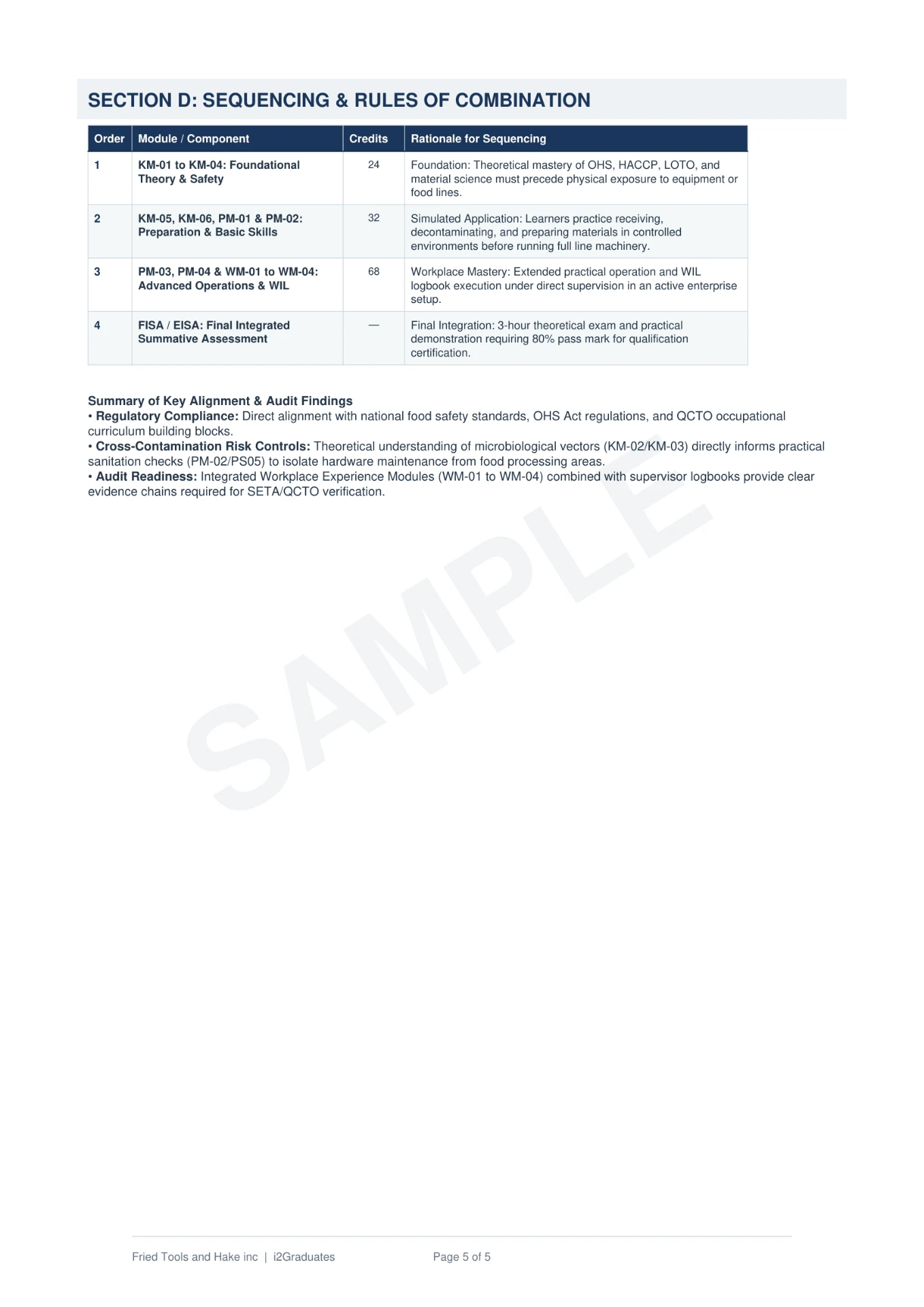
Overview & Scope
Programme Profile
- Target Designation
- Certified Falsework Inspector Practitioner
- Competency Focus
- Master specialised practical applications, safety criteria, and regulatory mandates required of a qualified Falsework Inspector.
- Academic Weight
- Full national recognition at NQF Level 4 yielding 115 credits upon successful PoE verification.
- Work Opportunities
- Deployment across As a qualified falsework inspector, you can find employment opportunities in Construction, Civil Engineering. Your skills will be in demand across both public and private sectors, and you may also choose to work as an independent contractor or start your own business in this field. operations under CETA scope.
- Audit Objective
- Bridges operational skills deficits under the governing CETA quality matrix.
- Value Proposition
- Measurable, legally compliant skills that optimise productivity, satisfy Workplace Skills Plans (WSP), and unlock B-BBEE scorecard weight.
Introduction▾
The Falsework Inspector is a Occupational Certificate set at NQF Level 4, comprising 115 credits. This qualification has been carefully developed to provide you with the essential knowledge, practical skills, and workplace experience needed to excel in your chosen field. Whether you are starting your career or looking to formalise your existing expertise, this programme offers a structured pathway to competence and recognition.
Purpose▾
The purpose of this part qualification is to prepare a learner to operate as a Falsework Inspector. A qualified Falsework Inspector can work across a diverse range of professions and sectors where falsework plays a crucial role. In addition, learner attributes (including problem-solving, decision-making, ethics, interpreting information, and communication) will be integrated into the learning process. Learners will have to prove competence of the below knowledge, skills, attitudes, responsibilities, and tasks embedded in the exit level outcomes. A Falsework Inspector inspects Falsework for compliance and signs it off for use. A qualified learner will be able to: • Prepare for falsework erection activities • Construct and maintain falsework structures • Inspect the integrity of falsework structures A competent Falsework Inspector will exhibit key attributes, amongst others, the following: • Effective communication. • Stakeholder relations and management. • Conflict resolutions. • Negotiation. • Acts and regulations. • Research skills. • Analytical and decision-making skills. • Report writing skills. • Basic auditing and assessment skills. • Calm and focused. • Accurate and precise. • Organised and efficient. • Ethical and professional.
Entry Requirements▾
Recognition of Prior Learning (RPL): • Learners may use the RPL process to gain access to training opportunities for a programme of learning, part-qualification if they do not meet the formal, minimum entry requirements for admission. RPL assessment provides an alternative access route into a programme of learning, part-qualification. • Such an RPL assessment may be developed, moderated, and conducted by the accredited Skills Development Provider which offers that specific part qualification. Such an assessment must ensure that the learner is able to display the equivalent level of competencies required for access, based on the NQF level descriptors. • For exemption from modules through RPL, learners who have gained the stipulated competencies of the modules of a programme of learning, part-qualification through any means of formal, informal or non-formal learning and/or work experience, may be awarded credits towards relevant modules, and gaps identified for training, which is then concluded. • For exemption from modules through RPL, learners who have gained the stipulated competencies of the modules of a programme of learning, part-qualification through any means of formal, informal, or non-formal learning and/or work experience, may be awarded credits towards relevant modules, and gaps identified for training, which is then concluded. • A valid Statement of Results is required for admission to the EISA in which confirmation of achievement is provided that all internal assessment criteria for all modules in the related curriculum document have been achieved. Upon successful completion of the EISA, RPL learners will be issued with the QCTO certificate for the part-qualification. Quality Partners are responsible for ensuring the RPL mechanism and process for qualifications and part-qualification is approved by the QCTO. Entry Requirements: The minimum entry requirement for this qualification is: • NQF Level 3 qualification.
SAQA Rationale▾
The need for this Part Qualification: Falsework Inspector was identified during the development of the National Occupational Certificate: Falsework Foreman. Currently, there is no registered qualification aimed at falsework (including formwork and support work) construction. Falsework consists of a temporary structure used in construction to support a permanent structure (such as buildings and bridges) until it has gained sufficient strength to support itself. Currently, there are no SANS (South African National Standards) for Falsework, and the British and EN (European Nations) Standards have mainly been adopted in industry to ensure minimum standards in the quality of work. There is a specific need for a qualification for Falsework Inspectors as part of the career path for false workers. This part qualification is structured to allow access for first-time entrants into the building/construction sector and many other industries and also caters for several job advancement opportunities as the person progresses through the various exit points. It envisages a person starting as a semi-skilled worker and progressing up to the Supervisor level over a period of time without ever having to relinquish previously acquired skills. A qualifying falsework inspector typically operates in professions related to construction and engineering, where temporary structures are needed to support or hold other construction elements in place. The professions that collaborated in the development of this qualification are either involved, working with, or overseeing falsework in their various capacities to ensure that temporary support systems are properly installed, maintained, and removed as needed during the construction process. Professional registration with the relevant professional body is a requirement for this occupation and the learning process. The Falsework Inspector part qualification will benefit a variety of industries by providing employers with competent and certified Falsework Inspectors who have the knowledge and skills to contribute to safer workplaces. The well-being of the South African economy is reliant on the creation of work opportunities in the building, construction, and infrastructure sectors. Key skills to drive these industries are in short supply, and this part qualification opens the door for the inclusion of previously disadvantaged persons so that they can contribute to the growth of the economy and, at the same time, build lifelong careers that will improve their lives. Qualified Falsework Inspectors will enhance safe working conditions on construction sites and decrease the number of incidents at height. The quality of falsework structures also directly impacts the quality and safety of the structure being supported. Construction-related accidents contribute not only to human loss and injury but also to economic losses. This part-qualification will thus benefit the sector, society, and the economy. Typical learners likely to be attracted to this part-qualification are those who have been working in the construction industry, as well as new entrants to the industry with a specific interest in falsework. This part-qualification will contribute to the development of the learner within the construction industry by providing them with the skills, knowledge, insights, and competence to inspect and sign off falsework in national, provincial, or local construction projects. This part-qualification provides for further learning and career progression opportunities. Learners who have completed this part-qualification can enroll for the National Occupational Certificate: Falsework Foreman. Learners following this route will be granted recognition for modules already completed through Credit Accumulation and Transfer. The typical learners who could enrol for the Falsework Inspector qualification include employees in various industries as part of the organisational legal requirements. The vertical and diagonal articulation possibilities could not be accomplished, as this is a part qualification. Furthermore, prospective youth and local community members with an interest in Falsework will also form part of the typical learners. Collaboration with relevant stakeholders: • Representatives from relevant industries, including manufacturing, mining, construction, retail, and cleaning and hiring. • Regulators - Department of Employment and Labour. • The Professional Body. • Subject matter experts in the Work at height industry. • Educators and trainers with experience in facilitating, assessment, and moderation of Falsework. List typical occupations in which the qualifying learner will operate include: • Construction workers. • Builders. • Machine operators. • Maintenance workers. • Painters, cleaners. • Mine workers. • Facilitators/trainers who have to train others. Profession(s) related: Collaboration with relevant stakeholders: • Representatives from relevant industries, including manufacturing, mining, construction, retail, and cleaning and hiring. • Regulators. The Professional Body: • Subject matter experts in the Work at height industry. • Educators and trainers with experience in facilitating, assessment, and moderation of Falsework. List typical professions in which the qualifying learner will operate include: Construction Sector: • Commercial Construction: Inspecting falsework used in commercial buildings, including offices, retail spaces, and high-rises. • Residential Construction: Ensuring the safety and stability of falsework in residential building projects, such as apartment complexes and houses. • Industrial Construction: Overseeing temporary structures for industrial facilities, factories, and warehouses. Infrastructure and Civil Engineering: • Bridge Construction: Inspecting falsework used in the construction of bridges, including support for beams, arches, and deck forms. • Highways and Roads: Ensuring the integrity of falsework used in the construction of roadways and related structures. • Tunnels and Underground Construction: Evaluating temporary support systems for tunnel construction and underground works. Specialized Engineering and Projects: • Marine and Coastal Engineering: Inspecting falsework used in marine construction projects, such as piers, docks, and offshore structures. • Energy Sector: Overseeing temporary support structures for energy projects, including power plants, refineries, and wind turbine installations. Scaffolding and Formwork Industry: • Scaffold Erectors and Inspectors: Working alongside scaffold erectors to ensure that scaffold systems and falsework are correctly installed and meet safety standards. • Formwork Specialists: Inspecting falsework used to support formwork systems for concrete pouring and setting. Regulatory and Compliance: • Safety Compliance Officers: Ensuring that falsework adheres to safety regulations and industry standards to prevent accidents and ensure worker safety. • Building Inspectors: Conducting inspections to verify that falsework and related temporary structures comply with building codes and regulations. Project Management and Quality Assurance: • Project Managers: Collaborating with project managers to ensure that falsework is properly designed, installed, and maintained throughout the construction process. • Quality Assurance Inspectors: Verifying the quality and integrity of falsework systems as part of a broader quality control role. Consulting and Advisory: • Construction Consultants: Providing expert advice on the design, installation, and safety of falsework systems for various construction projects. • Engineering Consultants: Offering specialized knowledge in the use of falsework for complex engineering and construction projects. A qualified Falsework Inspector plays a critical role in ensuring the safety, stability, and compliance of temporary support structures across these various sectors and professions. Their expertise helps to prevent accidents, maintain quality standards, and ensure the successful completion of construction projects.
Learning Assumed to be in Place & RPL▾
Recognition of Prior Learning (RPL): • Learners may use the RPL process to gain access to training opportunities for a programme of learning, part-qualification if they do not meet the formal, minimum entry requirements for admission. RPL assessment provides an alternative access route into a programme of learning, part-qualification. • Such an RPL assessment may be developed, moderated, and conducted by the accredited Skills Development Provider which offers that specific part qualification. Such an assessment must ensure that the learner is able to display the equivalent level of competencies required for access, based on the NQF level descriptors. • For exemption from modules through RPL, learners who have gained the stipulated competencies of the modules of a programme of learning, part-qualification through any means of formal, informal or non-formal learning and/or work experience, may be awarded credits towards relevant modules, and gaps identified for training, which is then concluded. • For exemption from modules through RPL, learners who have gained the stipulated competencies of the modules of a programme of learning, part-qualification through any means of formal, informal, or non-formal learning and/or work experience, may be awarded credits towards relevant modules, and gaps identified for training, which is then concluded. • A valid Statement of Results is required for admission to the EISA in which confirmation of achievement is provided that all internal assessment criteria for all modules in the related curriculum document have been achieved. Upon successful completion of the EISA, RPL learners will be issued with the QCTO certificate for the part-qualification. Quality Partners are responsible for ensuring the RPL mechanism and process for qualifications and part-qualification is approved by the QCTO. Entry Requirements: The minimum entry requirement for this qualification is: • NQF Level 3 qualification.
Exit Level Outcomes▾
Exit Level Outcomes: 1. Construct and maintain safe falsework structures applying essential knowledge, methods, procedures, and techniques. 2. Evaluate the integrity of Falsework by applying essential methods, procedures, and techniques to gather relevant information and address shortcomings.
Learning Material Included
- Learner Guide (Theory and Knowledge Modules)
- Facilitator Guide
- Workplace Logbook
- Formative and Summative Assessment
- Assessor Guide & Marking Memorandum
- SETA / QCTO Alignment Matrix
- Administrative & Onboarding Pack
- Implementation Plan
Moderator-Ready Curriculum Breakdown
12 modules · 115 creditsTheory, regulatory and safety knowledge. Each row carries the registered module code, NQF level and credit weight used for formative assessment rubric mapping.
- 641902-002-00-KM-012 cr
Business ethics and time management
NQF Level 3
- 641902-002-00-KM-024 cr
Knowledge of self to contribute to team performance
NQF Level 2
- 641902-002-00-KM-042 cr
Introduction to falsework
NQF Level 2
- 641902-002-00-KM-064 cr
Principles of falsework erection
NQF Level 3
- 641902-002-00-KM-073 cr
Rules of falsework inspection
NQF Level 4
- 641902-002-00-KM-083 cr
Advanced safety, health, and environment related legislation in the construction workplace
NQF Level 4
Qualification 125098 · Curriculum Architecture
Occupational Certificate: Falsework Inspector · NQF Level 4 (115 Credits)
Three Curriculum Pillars
Knowledge Modules
Classroom & E-Learning
- Facilitated lectures & self-study
- Written question banks
- Formative comprehension checks
Practical Skill Modules
Simulated Line Tasks
- Simulated line tasks
- Observation rubrics
- Structured task sheets
Work Experience Modules
On-the-Job Production
- On-the-job rotation
- Mentor logbooks
- Workplace sign-offs
Evidence & Audit Pipeline
Learner Portfolio of Evidence (PoE)Owner · Candidate▾
Admin & Registration
ID, learner contract, induction pack, POPIA consent.
Knowledge Evidence
Written assessments & question banks — KM-01 to KM-07.
Practical Evidence
Task sheets, observation rubrics, assessor photos.
Workplace Evidence
Logbooks, mentor sign-offs, supervisor letters.
Assessor Master FileOwner · Registered Assessor▾
Assessment Reports
Judgements, learner feedback, remediation agreements, appeals log.
Internal Moderation & Quality FileOwner · Moderator / SDP▾
Moderation Evidence
10% sampling matrix, HACCP/LOTO compliance sheets, SDP sign-off.
Final Accreditation Gateway
Issued by the accredited Skills Development Provider once internal moderation is signed off.
Provider submits declaration + PoE to the Assessment Quality Partner (AQP).
QCTO awards the SAQA-registered certificate on successful EISA outcome.
Audit & Compliance
Evidence & Audit Pipeline
From portfolio assembly to external sign-off — the exact route your evidence travels.
- Step 1
PoE Assembly
Learner evidence, formative records and logbook entries filed against the alignment matrix.
- Step 2
Internal Assessment
Registered assessor judges each KM/PM/WM outcome using the supplied instruments.
- Step 3
Internal Moderation
Sampling and verification of assessor decisions, with remediation loop before submission.
- Step 4
External Moderation
SETA/QCTO desktop audit and certification upload against registered credits.
Broken Standard vs i2Graduates Standard
The measurable delta between improvised material and an audit-ready suite.
Broken Standard
i2Graduates Standard
Curriculum Mapping
Photocopied guides with mismatched outcomes
6 KM + 4 PM + 2 WM modules mapped to NQF Level 4
Assessment Bank
Missing formative and summative assessments
Pre-validated assessment bank per module
Alignment Evidence
No alignment matrix — audit fails
CETA alignment matrix included
Facilitation
Facilitators improvise Falsework Inspector delivery
Facilitator scripts + learner activities per credit
Portfolio of Evidence
PoE gaps flagged in moderation
PoE templates that survive external moderation
Pricing & Delivery Tiers
Base licence from R55 750
Digital Master Suite
Editable master files, licensed to your SDP
- Learner Guide, Facilitator Guide & Assessment Suite
- Workplace logbook + alignment matrix (editable)
- Instant digital delivery under institutional licence
- Free minor corrections for 12 months
Turnkey Print & Bound Package
Printed, bound and couriered per learner
- Everything in the Digital Master Suite
- Full-colour print, wire-bound learner packs
- Per-learner PoE folders and dividers
- Nationwide courier with tracked delivery
Full Enterprise Accreditation Bundle
Assets plus accreditation support end-to-end
- Everything in the Print & Bound Package
- Bespoke QMS build mapped to your scope
- Moderation dry-run + written remediation report
- Brand & metadata integration across the suite
Complementary Services
Optional add-ons that harden your accreditation scope before an external audit.
Bespoke QMS Build
We author your Quality Management System — policies, procedures, records, matrices — mapped to your accreditation scope. From R18,500.
Request QuoteModeration Consultation
External moderation dry-run on your PoE + delivery pack. Written report with fixes before your real audit. From R4,900.
Book Moderation SessionThe i2Graduates Quality Guarantee
Every page of this bundle is checked for sequence and structural accuracy — no missing pages, no shortcuts. You get pre-validated assessment instruments ready to survive rigorous compliance moderation, wrapped in a curriculum your facilitators will enjoy teaching.