
Occupational Qualification · E1
Discretionary Grant · UpcomingE-Waste Operations Controller
- NQF Level
- NQF Level 4
- Credits
- 167
- Duration
- —
- SAQA ID
- 119264
Official QCTO Registry Profile
Source: SAQA / QCTO registry- SAQA ID
- 119264
- Min Credits
- 167
- Registered
- 2022-06-21
- Re-registration
- 2025-12-31
- Field
- Field 07 - Human and Social Studies
- Sub-field
- Environmental Relations
Sample Asset Preview
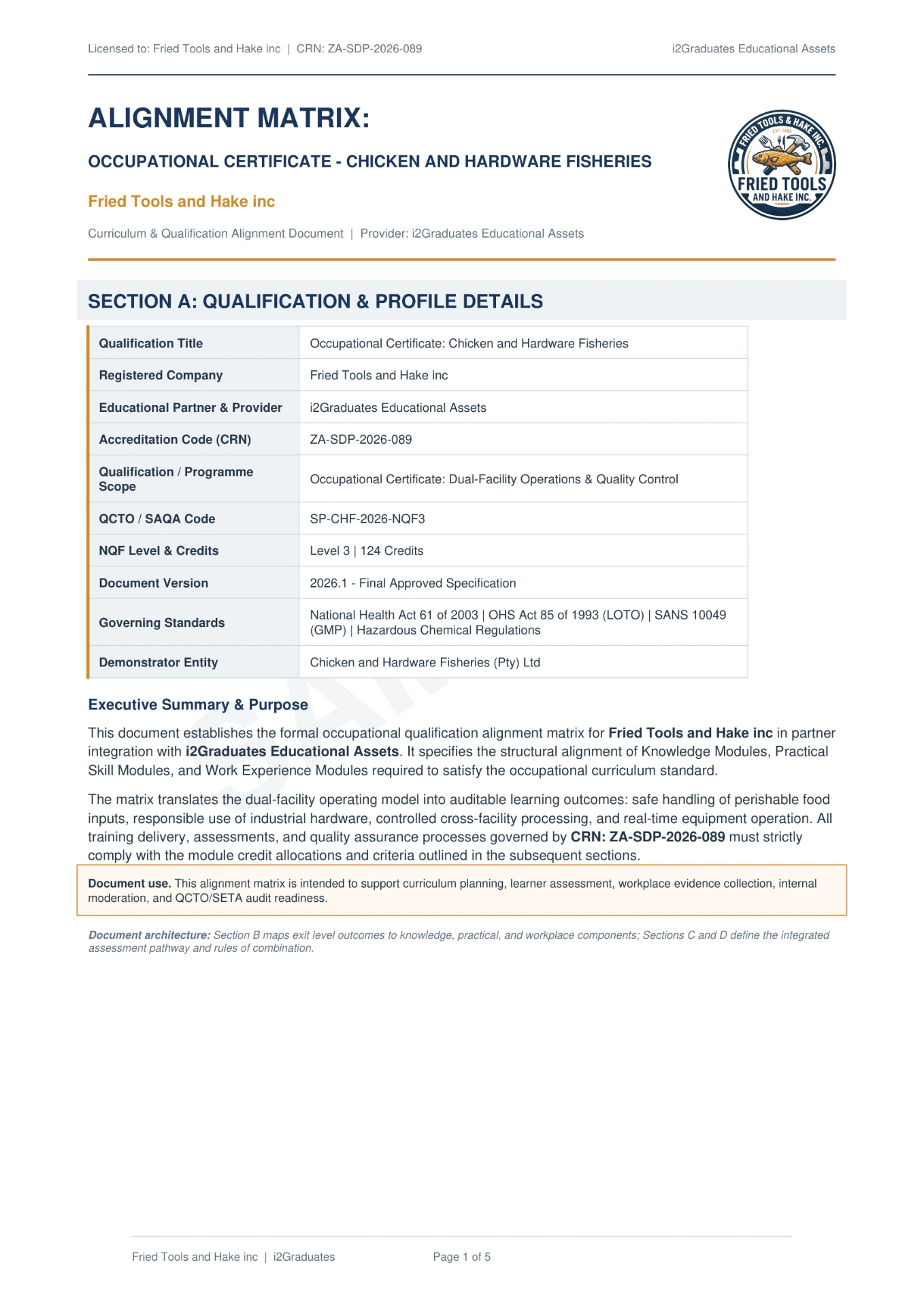
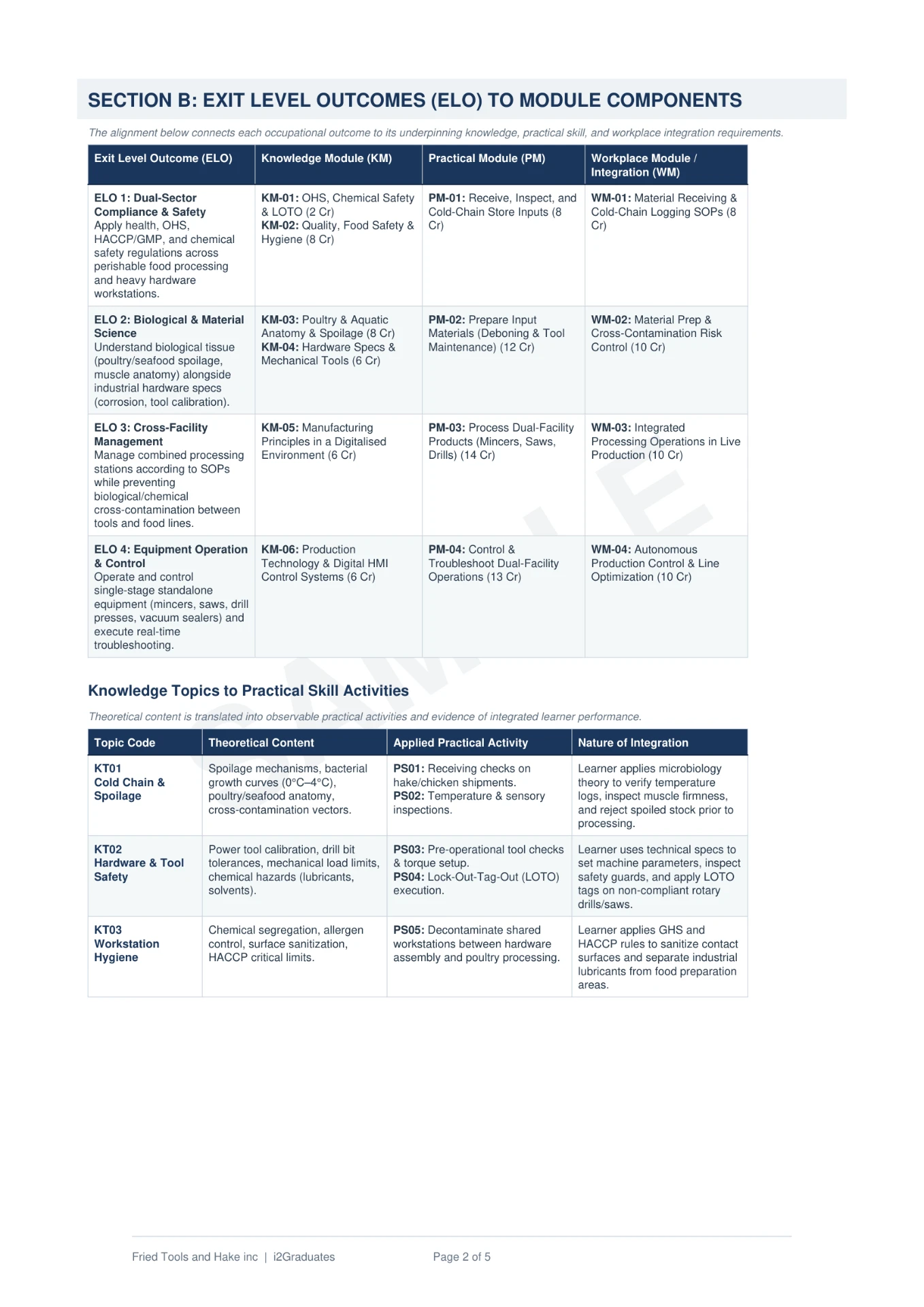
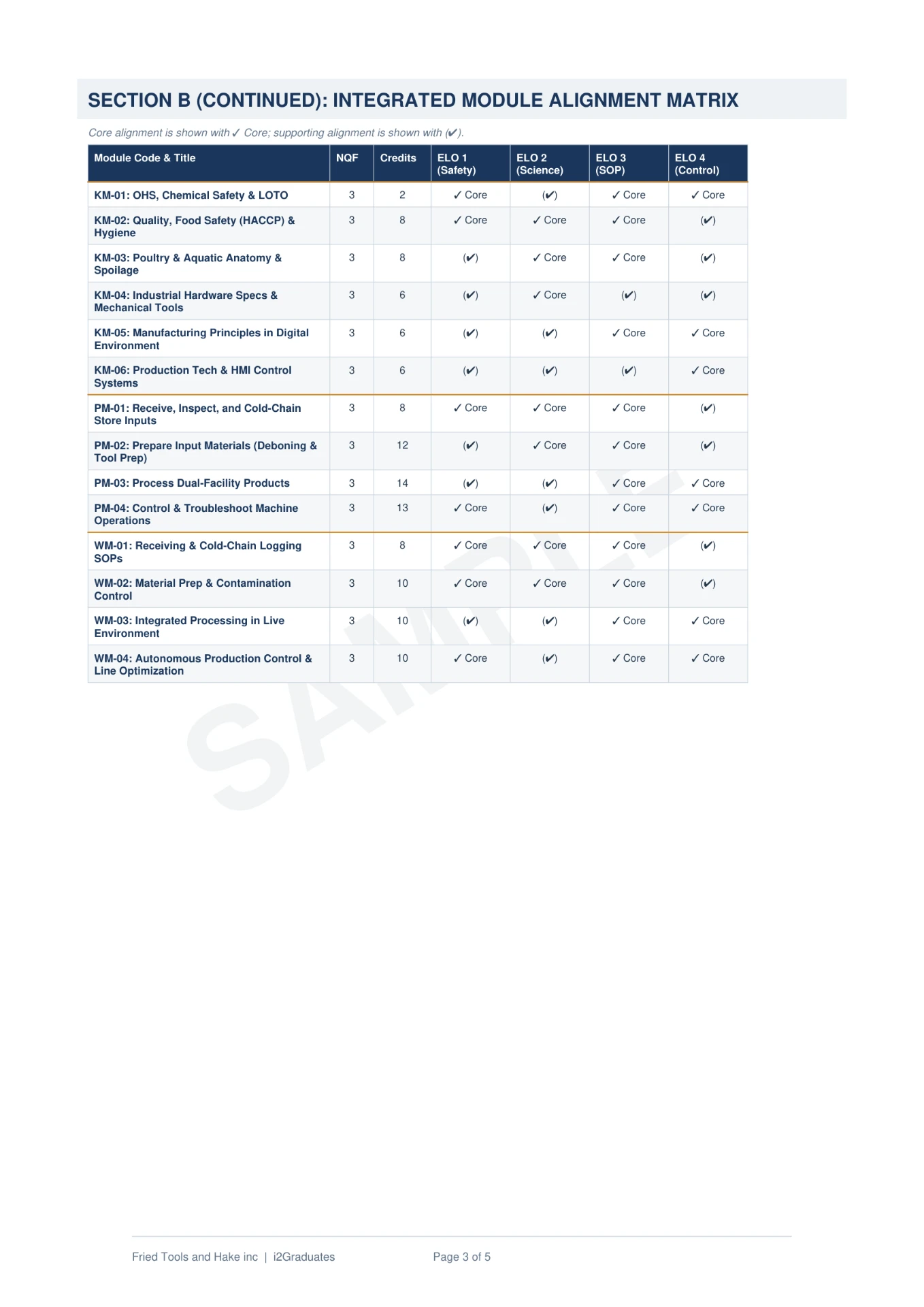
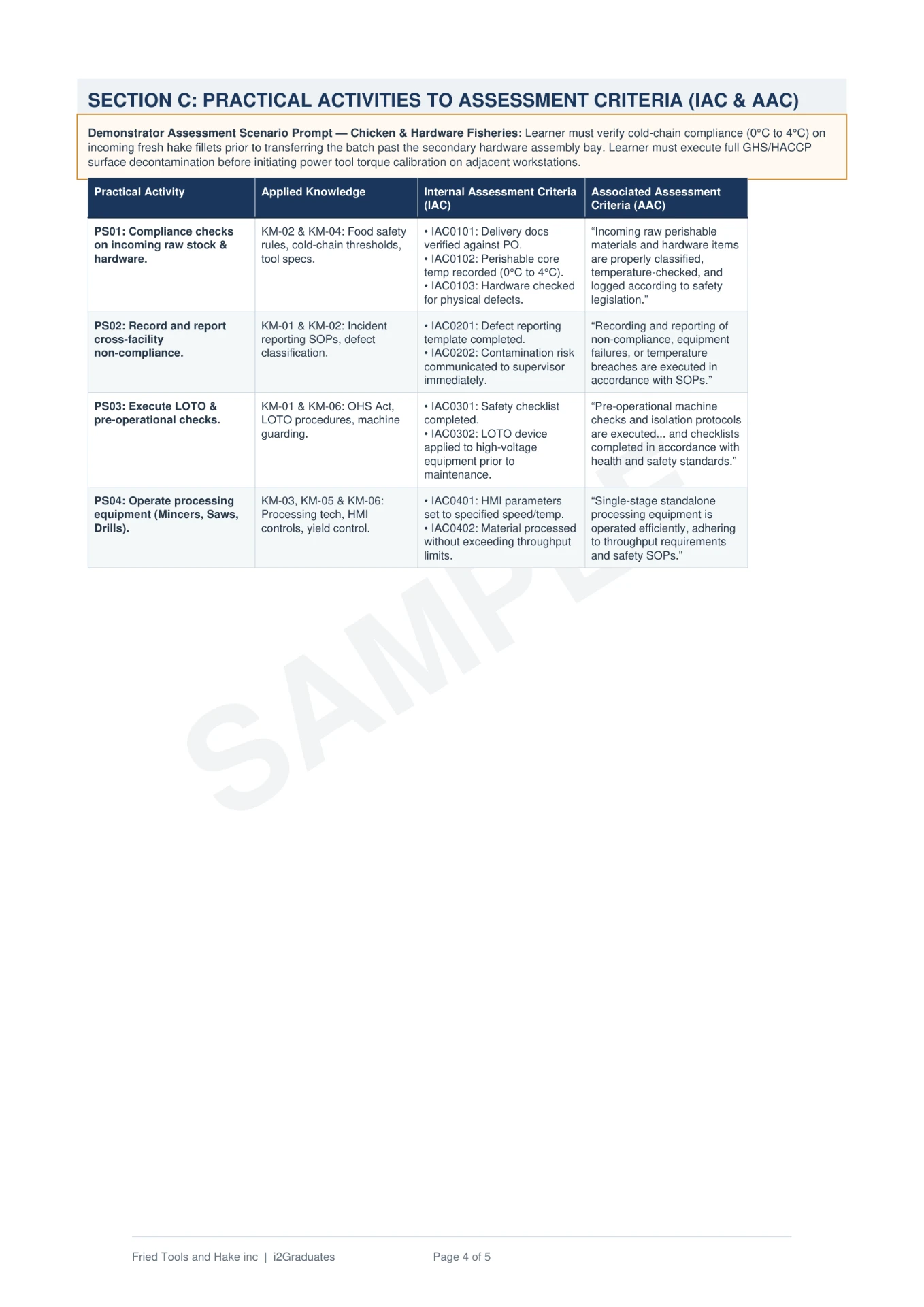
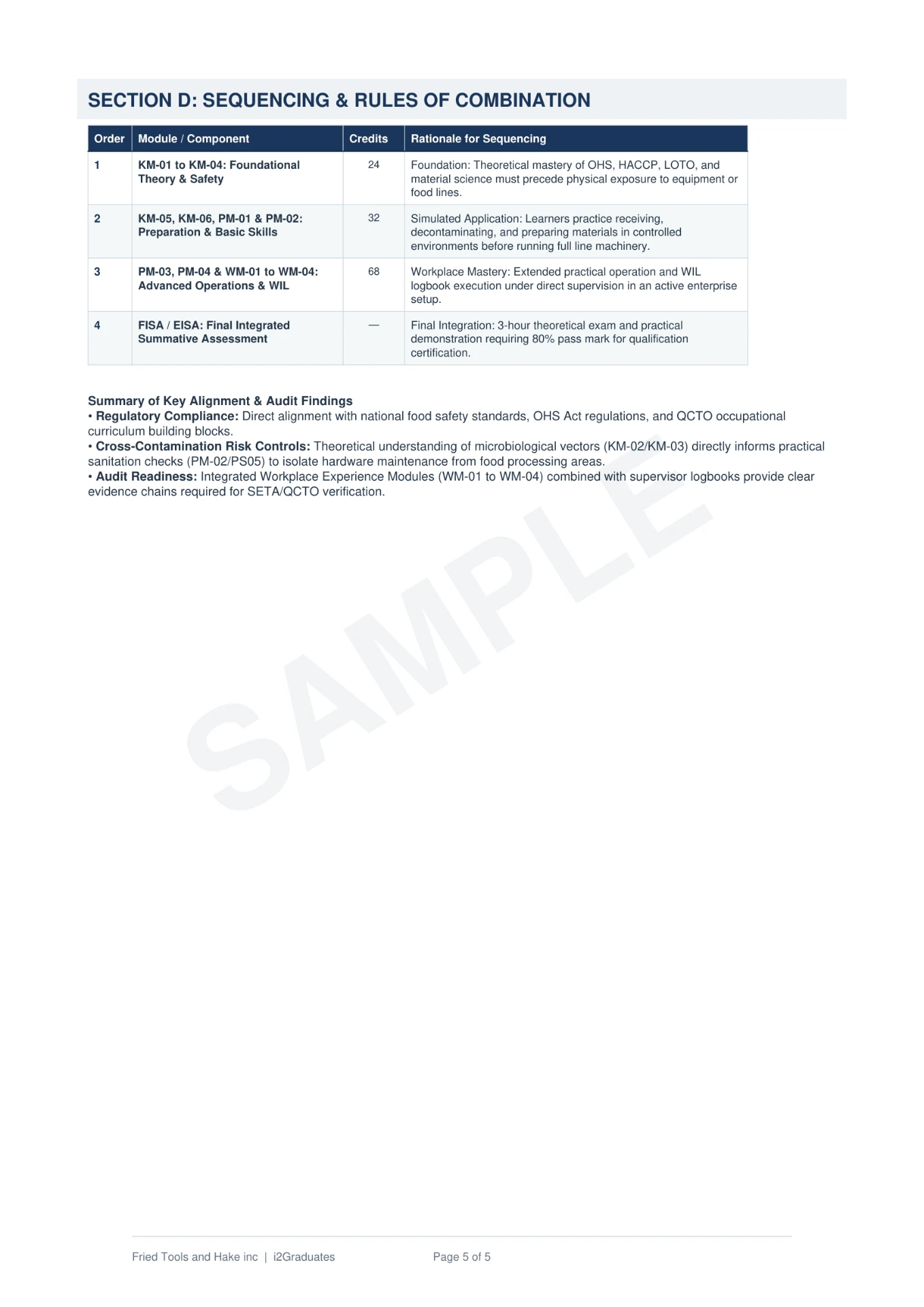
Overview & Scope
Programme Profile
- Target Designation
- Certified E-Waste Operations Controller Practitioner
- Competency Focus
- Master specialised practical applications, safety criteria, and regulatory mandates required of a qualified E-Waste Operations Controller.
- Academic Weight
- Full national recognition at NQF Level 4 yielding 167 credits upon successful PoE verification.
- Work Opportunities
- Deployment across As a qualified e-waste operations controller, you can find employment opportunities in Information Technology, Media, Communications. Your skills will be in demand across both public and private sectors, and you may also choose to work as an independent contractor or start your own business in this field. operations under MICTSETA scope.
- Audit Objective
- Bridges operational skills deficits under the governing MICTSETA quality matrix.
- Value Proposition
- Measurable, legally compliant skills that optimise productivity, satisfy Workplace Skills Plans (WSP), and unlock B-BBEE scorecard weight.
Introduction▾
The E-Waste Operations Controller is a Occupational Certificate set at NQF Level 4, comprising 167 credits. This qualification has been carefully developed to provide you with the essential knowledge, practical skills, and workplace experience needed to excel in your chosen field. Whether you are starting your career or looking to formalise your existing expertise, this programme offers a structured pathway to competence and recognition.
Purpose▾
The purpose of this qualification is to prepare a learner to operate as an E-Waste Operations Controller. An e-Waste Operations Controller oversees sustainable processes and practices to fulfil the entire recycling chain from collection, repurposing and beneficiation of suitable parts and components in accordance with circular economy-based pollution prevention and resource conservation principles. A qualified learner will be able to: • Plan, lead, organise and control financially feasible, environmentally safe, socially equitable and ethical sound e-waste recycling operations along the entire recycling value chain allowing for the reuse, beneficiation (repurposing) and disposal of e-waste. • Regularly control, monitor, keep record of and take remedial action to ensure compliance with all relevant aspects limited to the applicable legal framework thus endeavouring for environmental management compliance of systems, operations and procedures.
Entry Requirements▾
Recognition of Prior Learning (RPL): RPL for Access to the External Integrated Summative Assessment: • Accredited providers and approved workplaces must apply the internal assessment criteria specified in the related curriculum document to establish and confirm prior learning. Accredited providers and workplaces must confirm prior learning by issuing a statement of result. • Learners who have acquired competencies of the modules of a qualification or part qualification will be credited for modules through RPL. RPL for Access to the Qualification: • Learners will gain access to the qualification through RPL for Access as provided for in the QCTO RPL Policy. RPL for access is conducted by accredited education institution, skills development provider or workplace accredited to offer that specific qualification/part qualification. Entry Requirements: The minimum entry requirement for this qualification is: • NQF Level 3 qualification.
SAQA Rationale▾
Currently, there are no similar qualifications at NQF Level 4 registered on the NQF. However, there are registered qualifications at lower levels (Occupational Certificate: Collaborative Recycler, NQF Level 2 and Occupational Certificate: Materials Recycler (Paper and Packaging Collector), NQF Level 3) in the space of waste recycling. The focus of the Occupational Certificate: E-Waste Operations Controller is on e-waste. Computers and other electronic equipment are manufactured from natural as well as man-made materials. While some naturally occurring substances, such as chromium, are relatively harmless in nature, their use in the manufacture of electronic equipment often results in compounds which are toxic being especially harmful to human health and the environment if not disposed of correctly. On average, the total weight (excluding photovoltaic panels) of global electric and electronic equipment (EEE) consumption increases annually by 2.5 million metric tons (Mt). In 2019, the world generated a striking 53.6 Mt of e-waste, an average of 7.3 kg per capita. One example of such e-waste is that globally 7,7 billion people now have mobile phones, which generally gets replaced every two years. There is 360,000 tons of e-waste produced per annum in South Africa. Of that, only 25,000 to 35,000tons are being formally and legally compliant recycled. A large portion of the waste electric and electronic equipment (WEEE) generated in South Africa is stored in national and provincial government departments, business entities and households, while some leaks into the waste system is eventually disposed of in landfill sites. To address current internal stockpiles, National Government has recently developed an asset release management strategy. When these historical WEEE streams are eventually released into the system this will put additional burden on the existing and currently inadequate capacities of formal recycling service providers. Government is planning for an asset release strategy. This release of WEEE will put further current lack of capacity of recyclers. This illustrates the need for people skilled in the management of e-waste and the development of a suitable qualification thereof. In addition, on 5 November 2020 the Minister of Forestry, Fisheries and the Environment published regulations extending producer responsibility with regards to e-Waste. This places the onus of producers whose products will eventually fall within the e-waste category, to instil plans to manage such waste in future. Electronic waste has a potentially huge value from the materials like ferrous and precious metals, glass and plastic but it also has toxic elements and, as such, is a difficult waste stream to manage. It is also a challenging sector because of the volume of e-waste being generated. The current e-waste recyclers are not going to be able to deal with the targeted volumes. However, given that there are so few e-waste recyclers in the country that follow best practices, and given their current volumes of collecting and recycling, even if they double those volumes there is considerable scope for new enterprises throughout the value chain. E-waste and the management thereof can and will have a marked impact on the economy as a new and fast-growing industry. This qualification will address awareness about E-Waste, its impact, and solutions. As the economy grows, so will the need for skilled employees - the economic and social impact of the e-waste sector will be substantial. This qualification aims to contribute to the country's ability to manage e-waste. It aims to provide junior management with knowledge and skills in the planning, leading, organising and controlling operations in electronic waste recycling, beneficiation and disposal of e-waste in a circular economy; controlling, monitoring and record keeping, take remedial action and for compliance purposes. Typical learners include school leavers, qualifying learners from TVET Colleges and those currently in employment without formal recognition of competencies. No professional registration or licencing is expected for E-Waste Operations Controller to seek employment in the sector. E-waste Operations Controller can be employed as Waste Facility Controllers, Solid Waste Operations Controllers and Landfill Controllers.
Learning Assumed to be in Place & RPL▾
Recognition of Prior Learning (RPL): RPL for Access to the External Integrated Summative Assessment: • Accredited providers and approved workplaces must apply the internal assessment criteria specified in the related curriculum document to establish and confirm prior learning. Accredited providers and workplaces must confirm prior learning by issuing a statement of result. • Learners who have acquired competencies of the modules of a qualification or part qualification will be credited for modules through RPL. RPL for Access to the Qualification: • Learners will gain access to the qualification through RPL for Access as provided for in the QCTO RPL Policy. RPL for access is conducted by accredited education institution, skills development provider or workplace accredited to offer that specific qualification/part qualification. Entry Requirements: The minimum entry requirement for this qualification is: • NQF Level 3 qualification.
Exit Level Outcomes▾
- Plan, lead, organise and control financially feasible, environmentally safe, socially equitable and ethical sound e-waste recycling operations.
- Plan and control environmentally compliant and safe operations along the entire recycling chain.
- Control, monitor, record and take remedial action to ensure compliance with all aspects of the environmental regulatory framework governing e-waste management in South Africa as well as applicable for export.
Learning Material Included
- Learner Guide (Theory and Knowledge Modules)
- Facilitator Guide
- Workplace Logbook
- Formative and Summative Assessment
- Assessor Guide & Marking Memorandum
- SETA / QCTO Alignment Matrix
- Administrative & Onboarding Pack
- Implementation Plan
Moderator-Ready Curriculum Breakdown
20 modules · 167 creditsTheory, regulatory and safety knowledge. Each row carries the registered module code, NQF level and credit weight used for formative assessment rubric mapping.
- 311906-001-00-KM-014 cr
Introduction to Circular Economy, Sustainability, Legislation and Compliance
NQF Level 4
- 311906-001-00-KM-024 cr
e-Waste Facility Management Principles
NQF Level 4
- 311906-001-00-KM-034 cr
e-Waste Facility Business Principles and Finances
NQF Level 4
- 311906-001-00-KM-044 cr
e-Waste Plant Administration Principles and Practices
NQF Level 4
- 311906-001-00-KM-058 cr
e-Waste Plant Production Systems and Processes
NQF Level 4
- 311906-001-00-KM-064 cr
Beginner, Intermediate and Advanced Computer Technology and Utilisation
NQF Level 3
- 311906-001-00-KM-074 cr
e-Waste Facility Infrastructure, Technology and Automation
NQF Level 4
- 311906-001-00-KM-081 cr
Design Thinking Principles for Innovation
NQF Level 4
- 311906-001-00-KM-098 cr
4IR, Future Skills and Ethics
NQF Level 4
- 311906-001-00-KM-108 cr
Computer Skills and Use of Software Packages (beginner and intermediate)
NQF Level 4
Qualification 119264 · Curriculum Architecture
Occupational Certificate: E-Waste Operations Controller · NQF Level 4 (167 Credits)
Three Curriculum Pillars
Knowledge Modules
Classroom & E-Learning
- Facilitated lectures & self-study
- Written question banks
- Formative comprehension checks
Practical Skill Modules
Simulated Line Tasks
- Simulated line tasks
- Observation rubrics
- Structured task sheets
Work Experience Modules
On-the-Job Production
- On-the-job rotation
- Mentor logbooks
- Workplace sign-offs
Evidence & Audit Pipeline
Learner Portfolio of Evidence (PoE)Owner · Candidate▾
Admin & Registration
ID, learner contract, induction pack, POPIA consent.
Knowledge Evidence
Written assessments & question banks — KM-01 to KM-07.
Practical Evidence
Task sheets, observation rubrics, assessor photos.
Workplace Evidence
Logbooks, mentor sign-offs, supervisor letters.
Assessor Master FileOwner · Registered Assessor▾
Assessment Reports
Judgements, learner feedback, remediation agreements, appeals log.
Internal Moderation & Quality FileOwner · Moderator / SDP▾
Moderation Evidence
10% sampling matrix, HACCP/LOTO compliance sheets, SDP sign-off.
Final Accreditation Gateway
Issued by the accredited Skills Development Provider once internal moderation is signed off.
Provider submits declaration + PoE to the Assessment Quality Partner (AQP).
QCTO awards the SAQA-registered certificate on successful EISA outcome.
Audit & Compliance
Evidence & Audit Pipeline
From portfolio assembly to external sign-off — the exact route your evidence travels.
- Step 1
PoE Assembly
Learner evidence, formative records and logbook entries filed against the alignment matrix.
- Step 2
Internal Assessment
Registered assessor judges each KM/PM/WM outcome using the supplied instruments.
- Step 3
Internal Moderation
Sampling and verification of assessor decisions, with remediation loop before submission.
- Step 4
External Moderation
SETA/QCTO desktop audit and certification upload against registered credits.
Broken Standard vs i2Graduates Standard
The measurable delta between improvised material and an audit-ready suite.
Broken Standard
i2Graduates Standard
Curriculum Mapping
Photocopied guides with mismatched outcomes
10 KM + 7 PM + 3 WM modules mapped to NQF Level 4
Assessment Bank
Missing formative and summative assessments
Pre-validated assessment bank per module
Alignment Evidence
No alignment matrix — audit fails
MICTSETA alignment matrix included
Facilitation
Facilitators improvise E-Waste Operations Controller delivery
Facilitator scripts + learner activities per credit
Portfolio of Evidence
PoE gaps flagged in moderation
PoE templates that survive external moderation
Pricing & Delivery Tiers
Base licence from R58 350
Digital Master Suite
Editable master files, licensed to your SDP
- Learner Guide, Facilitator Guide & Assessment Suite
- Workplace logbook + alignment matrix (editable)
- Instant digital delivery under institutional licence
- Free minor corrections for 12 months
Turnkey Print & Bound Package
Printed, bound and couriered per learner
- Everything in the Digital Master Suite
- Full-colour print, wire-bound learner packs
- Per-learner PoE folders and dividers
- Nationwide courier with tracked delivery
Full Enterprise Accreditation Bundle
Assets plus accreditation support end-to-end
- Everything in the Print & Bound Package
- Bespoke QMS build mapped to your scope
- Moderation dry-run + written remediation report
- Brand & metadata integration across the suite
Complementary Services
Optional add-ons that harden your accreditation scope before an external audit.
Bespoke QMS Build
We author your Quality Management System — policies, procedures, records, matrices — mapped to your accreditation scope. From R18,500.
Request QuoteModeration Consultation
External moderation dry-run on your PoE + delivery pack. Written report with fixes before your real audit. From R4,900.
Book Moderation SessionThe i2Graduates Quality Guarantee
Every page of this bundle is checked for sequence and structural accuracy — no missing pages, no shortcuts. You get pre-validated assessment instruments ready to survive rigorous compliance moderation, wrapped in a curriculum your facilitators will enjoy teaching.