
Occupational Qualification · D9
Discretionary Grant · UpcomingDesign Thinking Practitioner
- NQF Level
- NQF Level 4
- Credits
- 100
- Duration
- —
- SAQA ID
- 118705
Official QCTO Registry Profile
Source: SAQA / QCTO registry- SAQA ID
- 118705
- Min Credits
- 100
- Registered
- 2022-02-03
- Re-registration
- 2025-12-31
- Field
- Field 02 - Culture and Arts
- Sub-field
- Design Studies
Sample Asset Preview
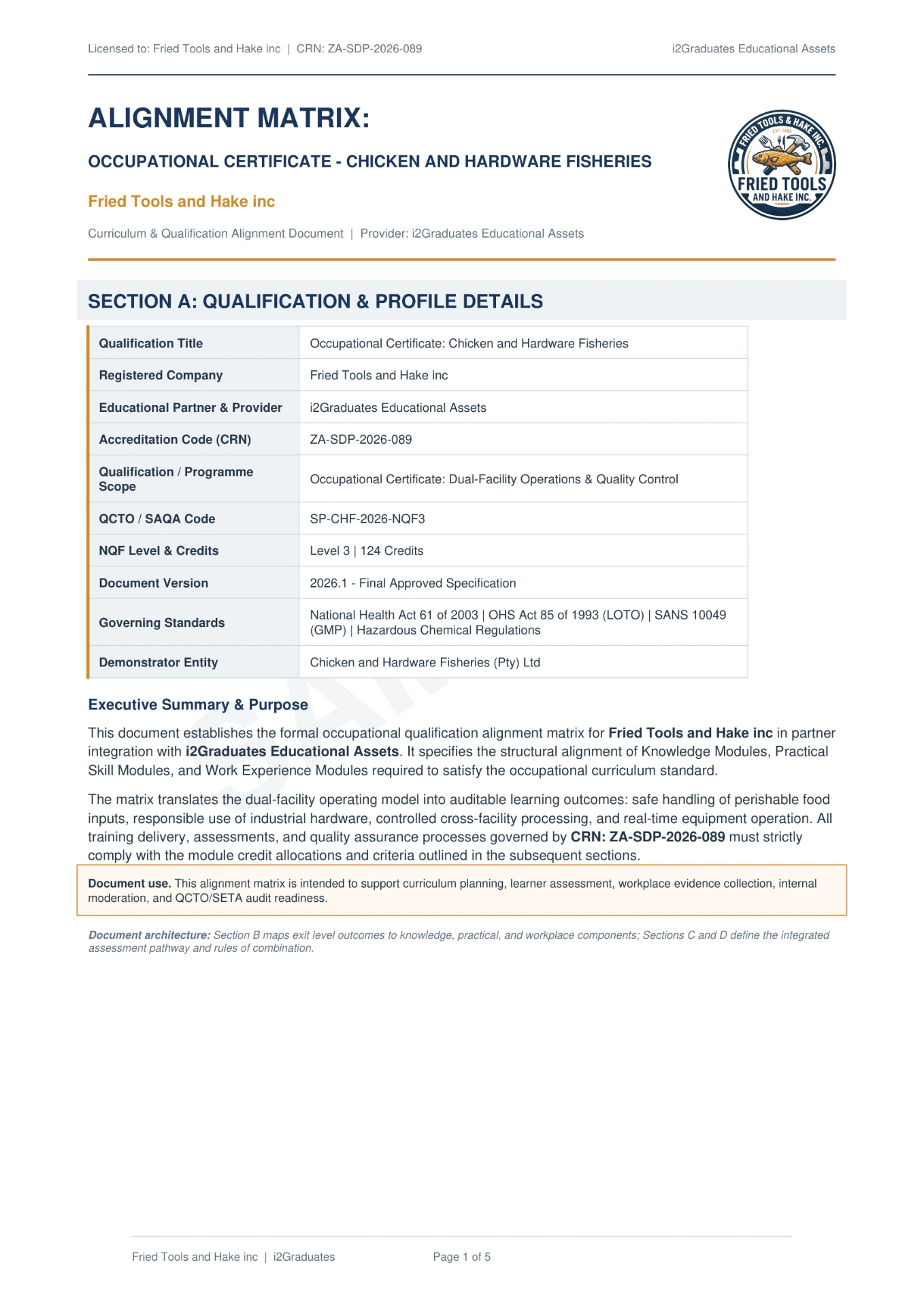
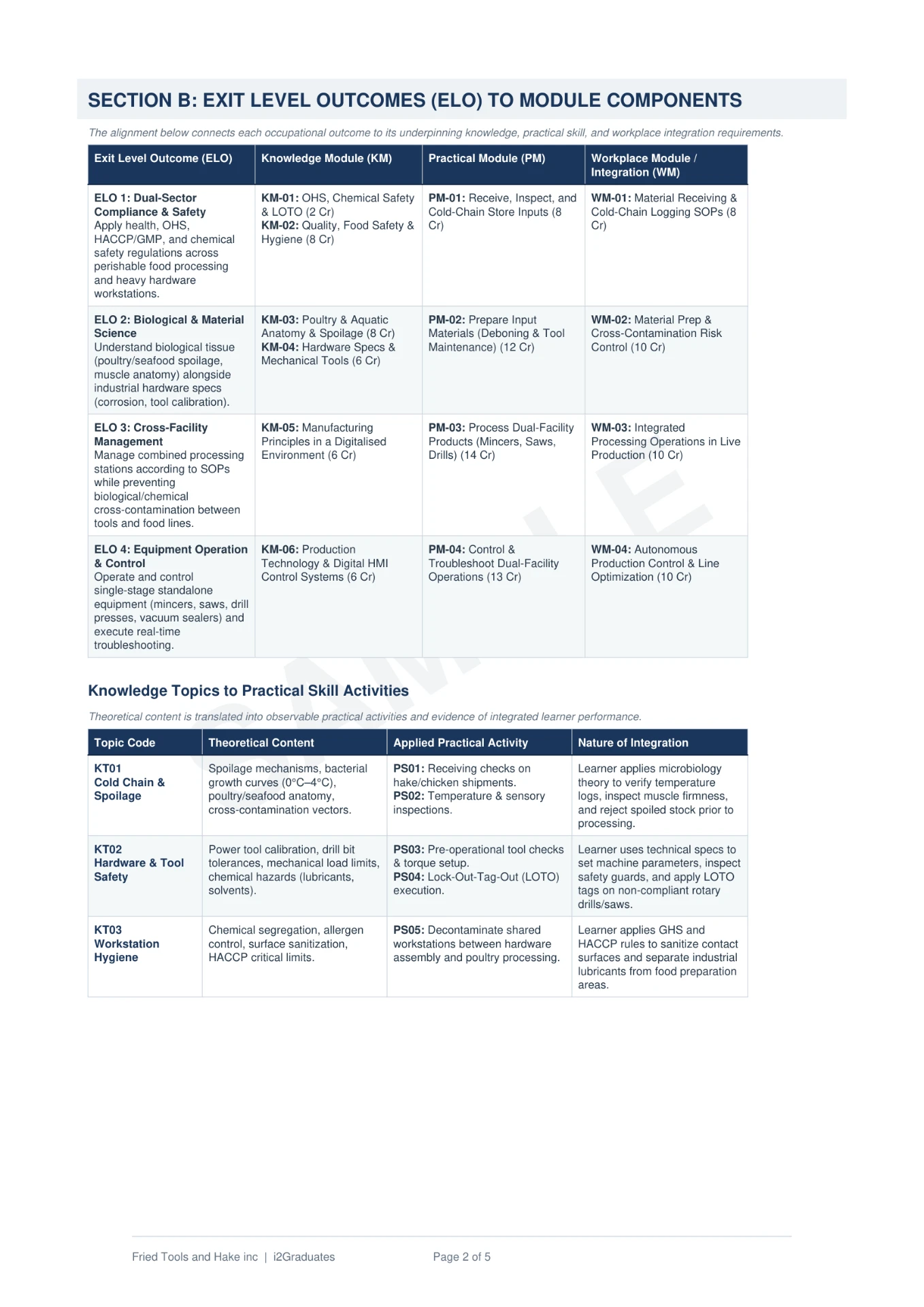
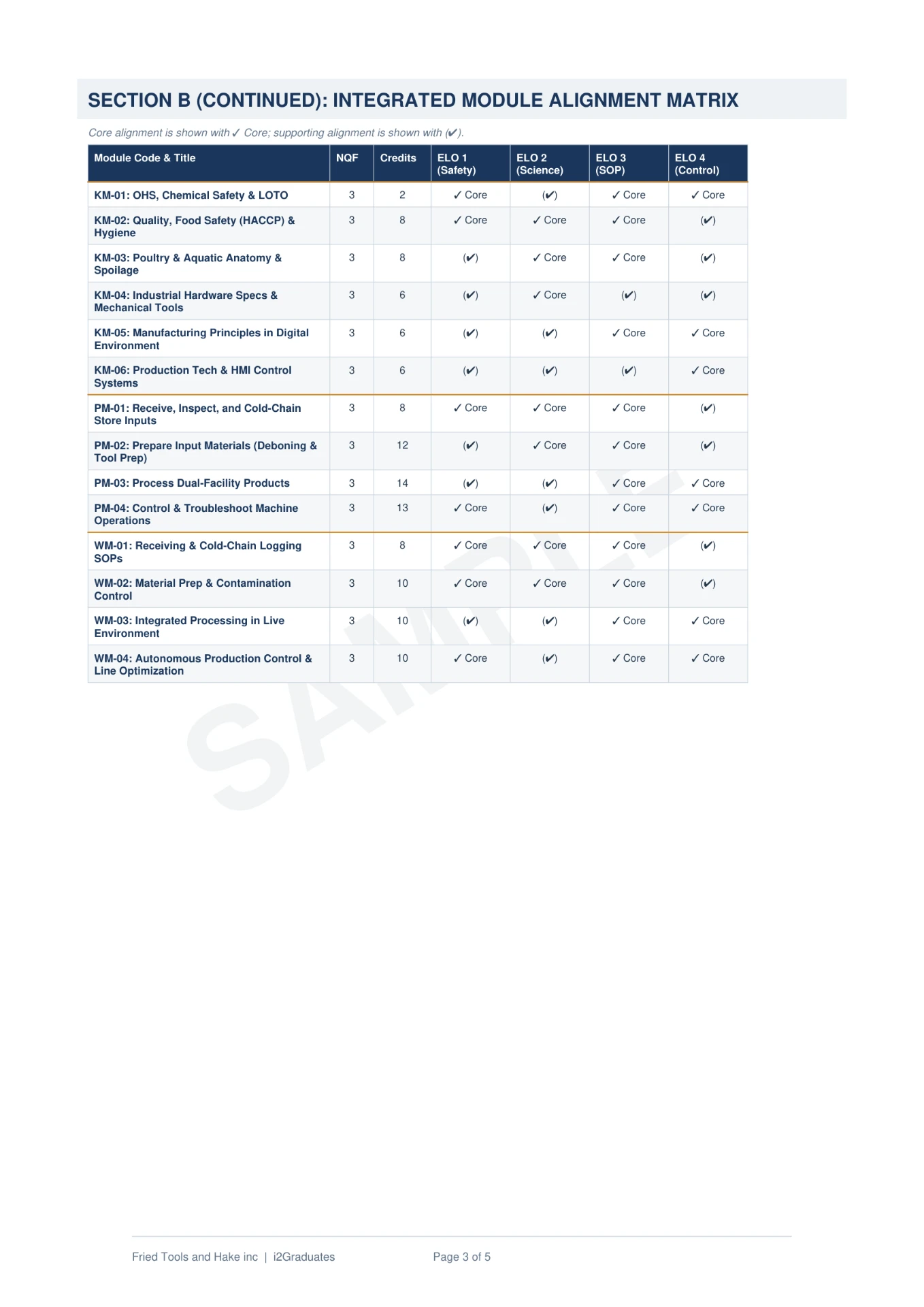
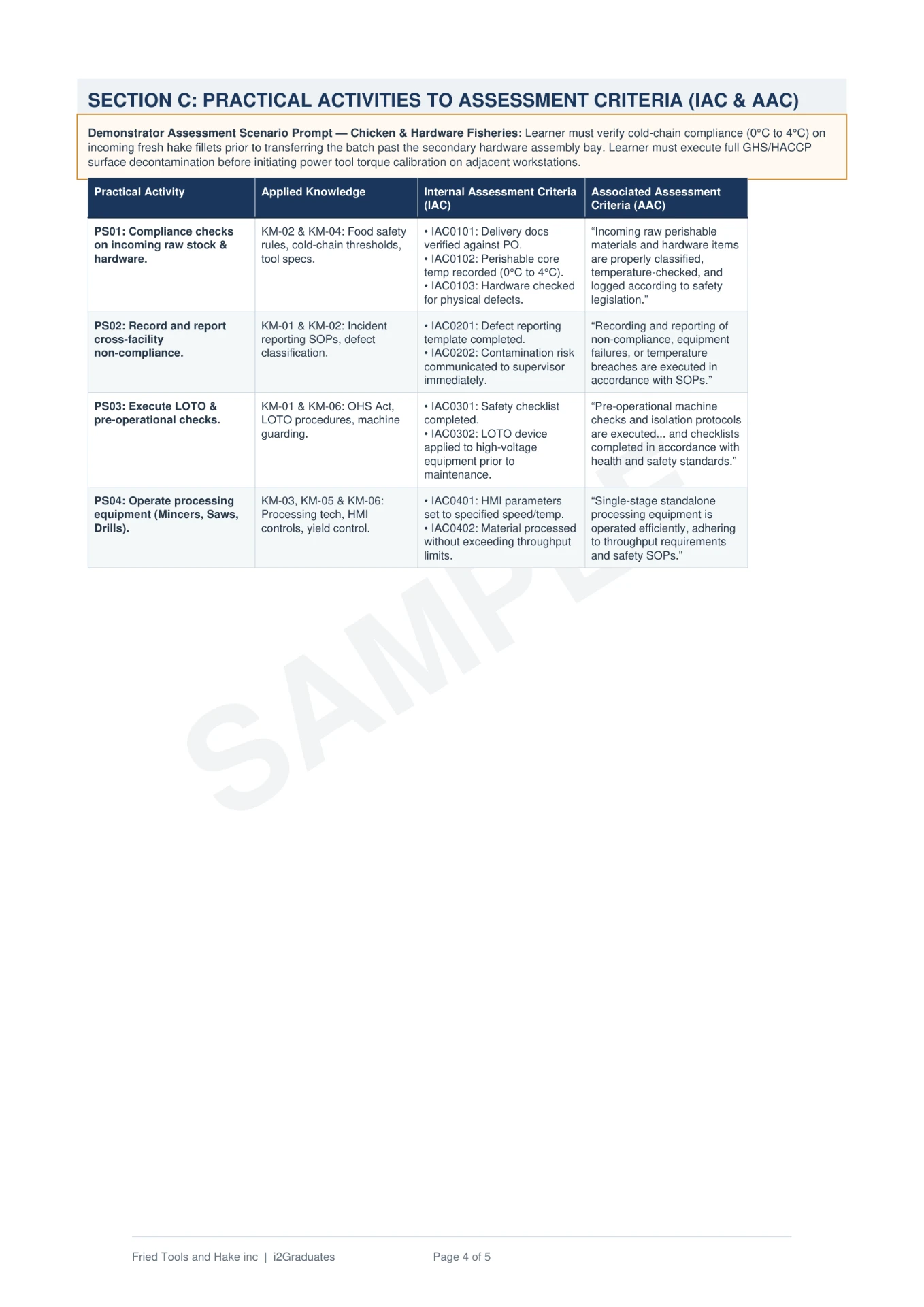
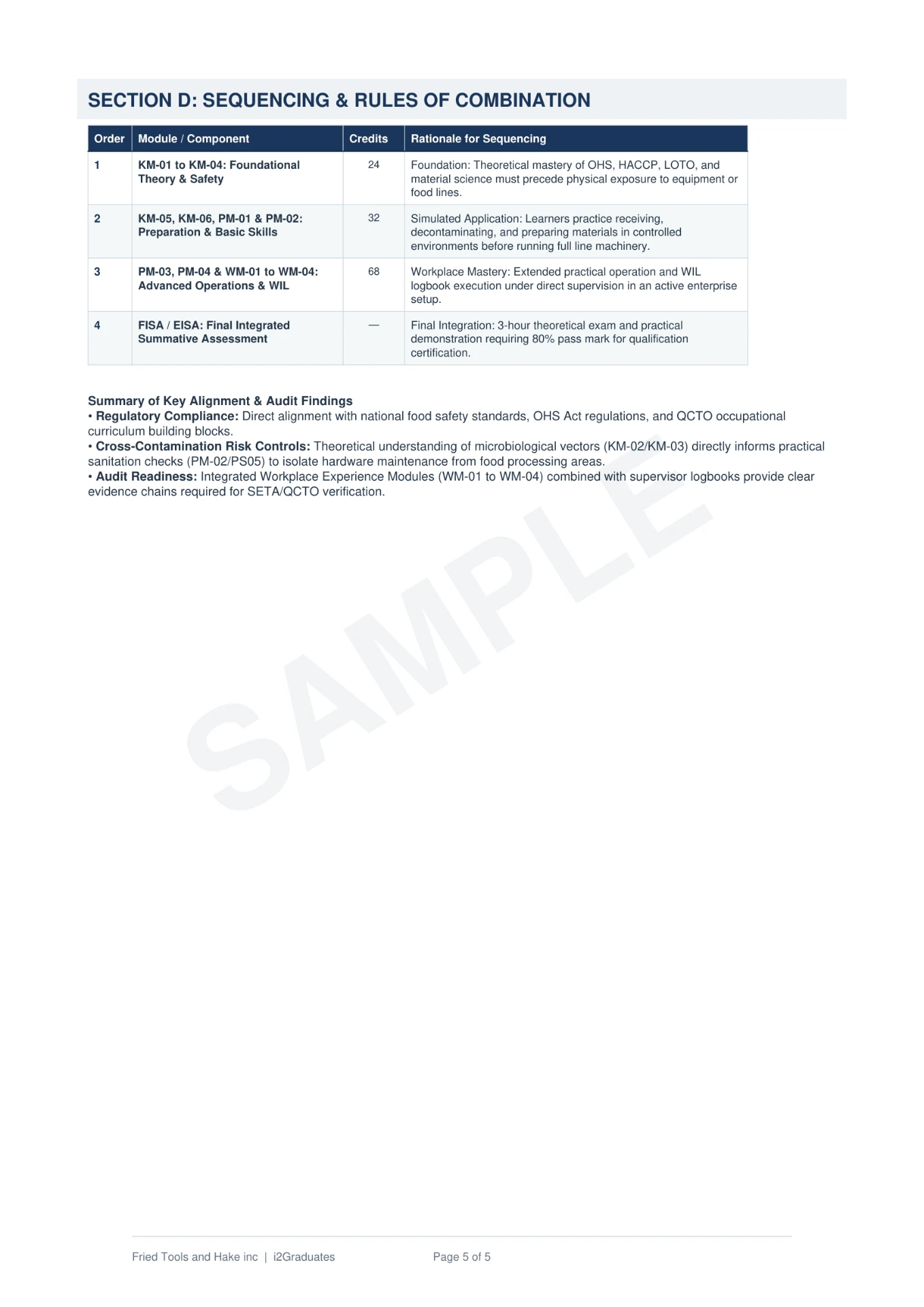
Overview & Scope
Programme Profile
- Target Designation
- Certified Design Thinking Practitioner Practitioner
- Competency Focus
- Master specialised practical applications, safety criteria, and regulatory mandates required of a qualified Design Thinking Practitioner.
- Academic Weight
- Full national recognition at NQF Level 4 yielding 100 credits upon successful PoE verification.
- Work Opportunities
- Deployment across As a qualified design thinking practitioner, you can find employment opportunities in Information Technology, Media, Communications. Your skills will be in demand across both public and private sectors, and you may also choose to work as an independent contractor or start your own business in this field. operations under MICT SETA scope.
- Audit Objective
- Bridges operational skills deficits under the governing MICT SETA quality matrix.
- Value Proposition
- Measurable, legally compliant skills that optimise productivity, satisfy Workplace Skills Plans (WSP), and unlock B-BBEE scorecard weight.
Introduction▾
Designed as a Occupational Certificate at NQF Level 4 worth 100 credits, the Design Thinking Practitioner equips you with both theoretical understanding and hands-on capabilities. You will learn to perform complex tasks, solve real-world problems, and adapt to the demands of a dynamic work environment. This qualification is your stepping stone to becoming a confident, capable professional.
Purpose▾
The purpose of this part-qualification is to prepare a learner to operate as a Design Thinking Practitioner. Design Thinking Practitioners apply design thinking approaches and methodologies to understand and address complex challenges and to collaboratively create innovative solutions that address human needs. They immerse themselves in the environment and context of the problem and approach it from multiple perspectives and collaboratively analyse, synthesise, and make sense of data to inform the development of relevant and innovative solutions. A qualified learner will be able to: • Conduct applied ethnographic research and immerse self in the environment and context to augment engagement and empathise with stakeholders and conduct problem analysis. • Apply the design thinking process and methodology to stimulate creativity and innovation for the design and creation of innovative solutions to solve a problem.
Entry Requirements▾
Recognition of Prior Learning (RPL): RPL for Access to the External Integrated Summative Assessment Accredited providers and approved workplaces must apply the internal assessment criteria specified in the related curriculum document to establish and confirm prior learning. Accredited providers and workplaces must confirm prior learning by issuing a statement of result. RPL for Access to the Qualification • Learners will gain access to the qualification through RPL for Access as provided for in the QCTO RPL Policy. RPL for access is conducted by accredited education institution, skills development provider or workplace accredited to offer that specific qualification/part qualification. • Learners who have acquired competencies of the modules of a qualification or part qualification will be credited for modules through RPL. RPL for access to the external integrated summative assessment Accredited providers and approved workplaces must apply the internal assessment criteria specified in the related curriculum document to establish and confirm prior learning. Accredited providers and workplaces must confirm prior learning by issuing a statement of result. Entry Requirements: The minimum entry requirement for this qualification is: • NQF Level 3 Qualification.
SAQA Rationale▾
Design thinking is an iterative process that diverse teams use to understand users as well as problems, challenge assumptions, redefine problems and create innovative solutions to and test those solutions with various stakeholders and subsequently develop implementation strategies. It involves various phases and is most useful to tackle problems that are ill-defined or unknown. The 4IR is premised on exponential changes that were brought about by the constant evolution of digital technology. Digital transformation is changing the way we live and work, which influences business practices and the world we live in. In today's world, technological capabilities are constantly improving and to stay relevant, the workforce must be upskilled continuously for organisations to be agile and innovative as they integrate these digital technologies into their business practices. Using design thinking to support an organisation's digital transformation helps reframe and solve complex problems by using a people-centred, creative, hands-on approach to interact with consumers and suppliers to understand challenges and innovate solutions. Today, data provide the information that initiates the design thinking process. People with design thinking skills are needed and there is a growing demand as businesses evolve constantly into the digital space. Through demonstrating innovation, the Design Thinking Practitioner can apply these methodologies for creative and innovative solutions to complex problems and the changes brought by digitalisation. A recent study on digital transformation by Dell unveils most organisations are unprepared: • 45% fear becoming obsolete in 3-5 years. • 48% are unaware of what their industry will look like in 3 years. • only 7% are classified as Digital Leaders. This illustrates the need to enable the workforce and businesses to operate in the digital environment and that the ability to do so will have a positive economic and social impact. By proactively adjusting and upskilling, organisations can leverage digital technology to successfully participate in the local and global economy. This part-qualification opens the employment of Design Thinking Practitioner to other sectors, e.g., art, engineering and so forth. It provides opportunities to any person to augment his/her career with the addition of design thinking skills for creating innovative solutions to complex or ambiguous problems without having to skill themselves as team leaders or coaching. This will enable learners to exit at an appropriate level with sufficient skills to exit learning and earn an income as a Design Thinking Practitioner, as well as providing a seamless entry into the Occupational Certificate: Design Thinking Innovation Lead. It therefore also reduces the timeframe of learning before a learner can become employable. Being a part qualification, these skills can be accessible to any industry. There is currently a registered qualification on the NQF, namely the Higher Certificate in Design Thinking which was analysed and was found not to be like the Occupational Certificate: Design Thinking Innovation Lead because the qualification Higher Certificate focuses on creative arts. Furthermore, the registration end-date is 2021-06-30 and it is a provider specific qualification registered within the HEQSF. The essential embedded knowledge of the Higher Certificate in Design Thinking seems to be only 10% similar. Benefits to economy: This qualification affords organisations (such as Government, Public and Private Entities, Education and NGOs) to grow innovation and design thinking skills in their quest to advance the economy. Various industries, such as media, information, communication, advertising, health, education and electronics, augmented reality, animation, digital design, and education technology (EdTech) will benefit from employing Design Thinking Practitioners to apply innovation practices that lead to sustainable innovative solutions to problems. With empathy as one of the core principles for innovation, human centred design thinking enables the organisation to continuously sense and detect and build for the future while responding to customer needs quicker than they are able to change. Benefits to society: Design thinking addresses the needs of the people who will consume a product or service and the infrastructure that enables it. Through the application of human centred methodologies, Design Thinking Practitioners contribute to an organisation's ability to design experiences that are truly centred around its customers' latent and unconscious needs. Design thinking principles enable the design of digital learning solutions to provide access to quality education to all learners irrespective of economical or demographic circumstances, e.g., current education challenges due to the COVID-19 pandemic. Design Thinking Practitioners can also help organisations to create the right environment for real and much broader understanding of the voice of the customer. It helps move beyond the monologue of research and, if incorporating prototyping and testing, begins an ongoing process of dialogue with current and potential customers. The ICT sector will benefit from including design thinking skills into the various 4IR developed or qualifications to be developed including artificial intelligence (AI), augmented reality (AR), internet of things (IoT), cloud computing, robotic process automation (RPA), quality test automation, e-waste management, cyber security and data science. Typical learners include school leavers, graduates from TVET colleges and other learning institutions, those currently employed without formal recognition of competencies, those who want to upskill themselves for future challenges or who want to make a career change and any unemployed person. No professional registration or licencing is expected for Design Thinking Practitioners to find employment in the sector. Design Thinking Practitioners can find employment as innovation solution developers (in any sector where design thinking skills can be applied) or become entrepreneurs.
Learning Assumed to be in Place & RPL▾
Recognition of Prior Learning (RPL): RPL for Access to the External Integrated Summative Assessment Accredited providers and approved workplaces must apply the internal assessment criteria specified in the related curriculum document to establish and confirm prior learning. Accredited providers and workplaces must confirm prior learning by issuing a statement of result. RPL for Access to the Qualification • Learners will gain access to the qualification through RPL for Access as provided for in the QCTO RPL Policy. RPL for access is conducted by accredited education institution, skills development provider or workplace accredited to offer that specific qualification/part qualification. • Learners who have acquired competencies of the modules of a qualification or part qualification will be credited for modules through RPL. RPL for access to the external integrated summative assessment Accredited providers and approved workplaces must apply the internal assessment criteria specified in the related curriculum document to establish and confirm prior learning. Accredited providers and workplaces must confirm prior learning by issuing a statement of result. Entry Requirements: The minimum entry requirement for this qualification is: • NQF Level 3 Qualification.
Exit Level Outcomes▾
- Demonstrate an understanding of the approach, principles and methodologies of design thinking for innovation.
- Apply the design thinking process and methodology to stimulate creativity and innovation when designing an innovative solution.
- Conduct applied ethnographic research to augment engagement with stakeholders and problem analysis.
- Communicate at different levels using appropriate methods to present ideas.
Learning Material Included
- Learner Guide (Theory and Knowledge Modules)
- Facilitator Guide
- Workplace Logbook
- Formative and Summative Assessment
- Assessor Guide & Marking Memorandum
- SETA / QCTO Alignment Matrix
- Administrative & Onboarding Pack
- Implementation Plan
Moderator-Ready Curriculum Breakdown
16 modules · 100 creditsTheory, regulatory and safety knowledge. Each row carries the registered module code, NQF level and credit weight used for formative assessment rubric mapping.
- 242102-001-00-01-KM-014 cr
Human Centred Innovation
NQF Level 4
- 242102-001-00-01-KM-024 cr
Design Thinking Fundamentals
NQF Level 4
- 242102-001-00-01-KM-034 cr
Collaboration
NQF Level 4
- 242102-001-00-01-KM-044 cr
Fundamentals of Positive Psychology for Design Thinking
NQF Level 4
- 242102-001-00-01-KM-054 cr
Research to Inform Design Thinking Processes
NQF Level 4
- 242102-001-00-01-KM-062 cr
Benefits of Design Thinking
NQF Level 4
- 242102-001-00-01-KM-074 cr
Introduction to Project Management for Design Thinking
NQF Level 5
- 242102-001-00-01-KM-082 cr
Introduction to Design Thinking Governance, Legislation and Ethics
NQF Level 4
- 242102-001-00-01-KM-094 cr
4IR and Future Skills
NQF Level 4
- 242102-001-00-01-KM-102 cr
Beginner, Intermediate and Advanced Computer Technology and Utilisation
NQF Level 3
Qualification 118705 · Curriculum Architecture
Occupational Certificate: Design Thinking Practitioner · NQF Level 4 (100 Credits)
Three Curriculum Pillars
Knowledge Modules
Classroom & E-Learning
- Facilitated lectures & self-study
- Written question banks
- Formative comprehension checks
Practical Skill Modules
Simulated Line Tasks
- Simulated line tasks
- Observation rubrics
- Structured task sheets
Work Experience Modules
On-the-Job Production
- On-the-job rotation
- Mentor logbooks
- Workplace sign-offs
Evidence & Audit Pipeline
Learner Portfolio of Evidence (PoE)Owner · Candidate▾
Admin & Registration
ID, learner contract, induction pack, POPIA consent.
Knowledge Evidence
Written assessments & question banks — KM-01 to KM-07.
Practical Evidence
Task sheets, observation rubrics, assessor photos.
Workplace Evidence
Logbooks, mentor sign-offs, supervisor letters.
Assessor Master FileOwner · Registered Assessor▾
Assessment Reports
Judgements, learner feedback, remediation agreements, appeals log.
Internal Moderation & Quality FileOwner · Moderator / SDP▾
Moderation Evidence
10% sampling matrix, HACCP/LOTO compliance sheets, SDP sign-off.
Final Accreditation Gateway
Issued by the accredited Skills Development Provider once internal moderation is signed off.
Provider submits declaration + PoE to the Assessment Quality Partner (AQP).
QCTO awards the SAQA-registered certificate on successful EISA outcome.
Audit & Compliance
Evidence & Audit Pipeline
From portfolio assembly to external sign-off — the exact route your evidence travels.
- Step 1
PoE Assembly
Learner evidence, formative records and logbook entries filed against the alignment matrix.
- Step 2
Internal Assessment
Registered assessor judges each KM/PM/WM outcome using the supplied instruments.
- Step 3
Internal Moderation
Sampling and verification of assessor decisions, with remediation loop before submission.
- Step 4
External Moderation
SETA/QCTO desktop audit and certification upload against registered credits.
Broken Standard vs i2Graduates Standard
The measurable delta between improvised material and an audit-ready suite.
Broken Standard
i2Graduates Standard
Curriculum Mapping
Photocopied guides with mismatched outcomes
10 KM + 4 PM + 2 WM modules mapped to NQF Level 4
Assessment Bank
Missing formative and summative assessments
Pre-validated assessment bank per module
Alignment Evidence
No alignment matrix — audit fails
MICT SETA alignment matrix included
Facilitation
Facilitators improvise Design Thinking Practitioner delivery
Facilitator scripts + learner activities per credit
Portfolio of Evidence
PoE gaps flagged in moderation
PoE templates that survive external moderation
Pricing & Delivery Tiers
Base licence from R55 000
Digital Master Suite
Editable master files, licensed to your SDP
- Learner Guide, Facilitator Guide & Assessment Suite
- Workplace logbook + alignment matrix (editable)
- Instant digital delivery under institutional licence
- Free minor corrections for 12 months
Turnkey Print & Bound Package
Printed, bound and couriered per learner
- Everything in the Digital Master Suite
- Full-colour print, wire-bound learner packs
- Per-learner PoE folders and dividers
- Nationwide courier with tracked delivery
Full Enterprise Accreditation Bundle
Assets plus accreditation support end-to-end
- Everything in the Print & Bound Package
- Bespoke QMS build mapped to your scope
- Moderation dry-run + written remediation report
- Brand & metadata integration across the suite
Complementary Services
Optional add-ons that harden your accreditation scope before an external audit.
Bespoke QMS Build
We author your Quality Management System — policies, procedures, records, matrices — mapped to your accreditation scope. From R18,500.
Request QuoteModeration Consultation
External moderation dry-run on your PoE + delivery pack. Written report with fixes before your real audit. From R4,900.
Book Moderation SessionThe i2Graduates Quality Guarantee
Every page of this bundle is checked for sequence and structural accuracy — no missing pages, no shortcuts. You get pre-validated assessment instruments ready to survive rigorous compliance moderation, wrapped in a curriculum your facilitators will enjoy teaching.