
Occupational Qualification · B9
Discretionary Grant · RollingBeaming and Sizing Machine Operator
- NQF Level
- NQF Level 2
- Credits
- 150
- Duration
- —
- SAQA ID
- 103181
Official QCTO Registry Profile
Source: SAQA / QCTO registry- SAQA ID
- 103181
- Min Credits
- 150
- Registered
- 2018-09-12
- Re-registration
- 2025-12-30
- Field
- Field 06 - Manufacturing, Engineering and Technology
- Sub-field
- Manufacturing and Assembly
Sample Asset Preview
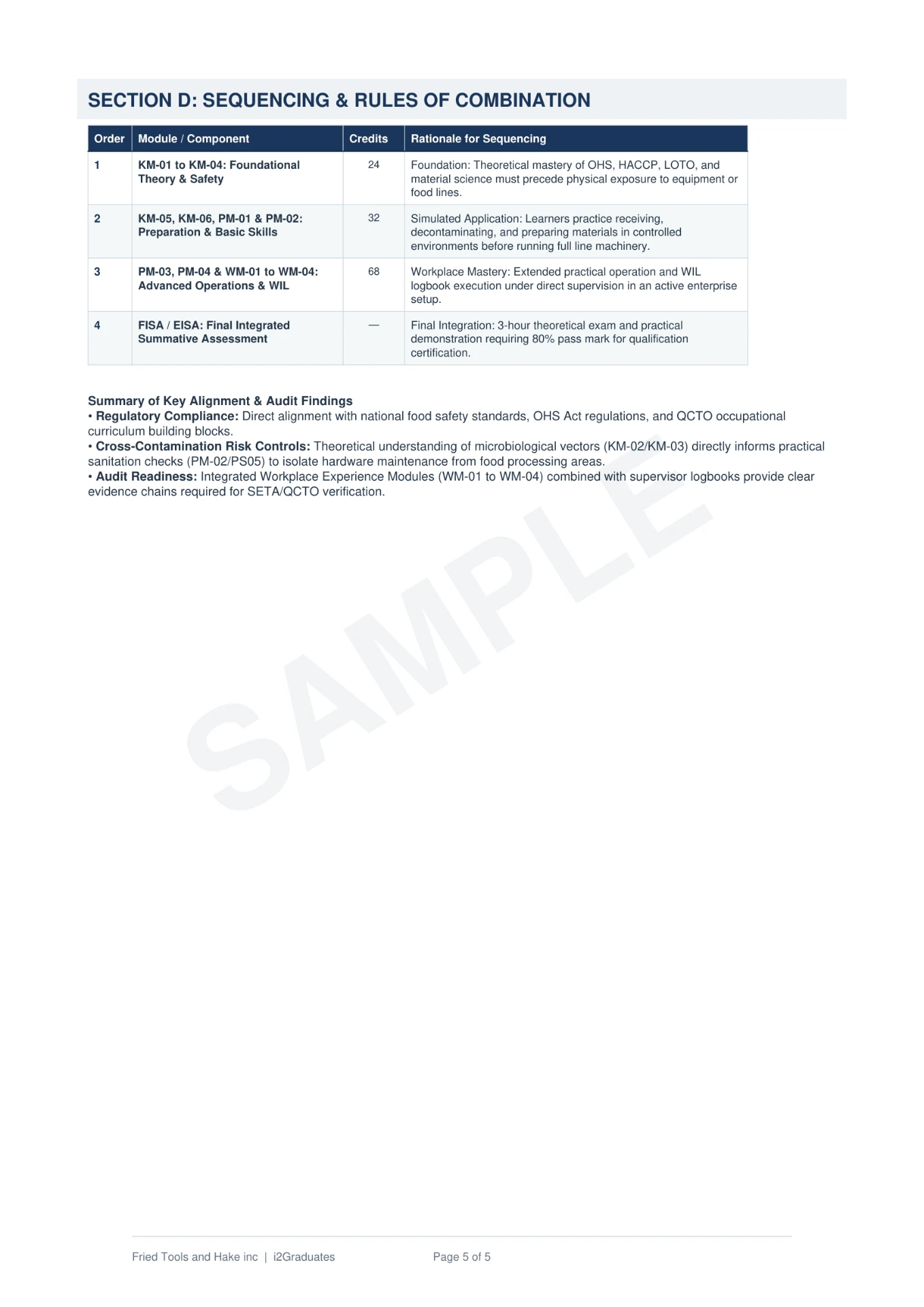
Overview & Scope
Programme Profile
- Target Designation
- Certified Beaming and Sizing Machine Operator Practitioner
- Competency Focus
- Master specialised practical applications, safety criteria, and regulatory mandates required of a qualified Beaming and Sizing Machine Operator.
- Academic Weight
- Full national recognition at NQF Level 2 yielding 150 credits upon successful PoE verification.
- Work Opportunities
- Deployment across As a qualified beaming and sizing machine operator, you can find employment opportunities in Furniture, Paper, Printing, Packaging, Forestry. Your skills will be in demand across both public and private sectors, and you may also choose to work as an independent contractor or start your own business in this field. operations under FP&M SETA scope.
- Audit Objective
- Bridges operational skills deficits under the governing FP&M SETA quality matrix.
- Value Proposition
- Measurable, legally compliant skills that optimise productivity, satisfy Workplace Skills Plans (WSP), and unlock B-BBEE scorecard weight.
Introduction▾
Designed as a Occupational Certificate at NQF Level 2 worth 150 credits, the Beaming and Sizing Machine Operator equips you with both theoretical understanding and hands-on capabilities. You will learn to perform complex tasks, solve real-world problems, and adapt to the demands of a dynamic work environment. This qualification is your stepping stone to becoming a confident, capable professional.
Purpose▾
The purpose of this qualification is to equip a learner with knowledge, skills and competencies to perform duties as a Beaming and Sizing Machine Operator. A Beaming and Sizing Machine Operator cleans, loads, prepares, operates and monitors beaming and sizing machines to process textile yarns into a sized weaver's beam, according to specification, output and quality standards. Qualifying learners will have acquired the competencies to operate textile beaming and sizing machines to full capacity as required by the company, detect deviations in set standards and react appropriately to address such deviations related to the machine operation, conversion process and product quality. They will have a thorough understanding of the importance of achieving and maintaining quantity standards related to aspects such as machine efficiency and minimising machine down-time as well as quality standards for sized yarn sheet and full weaver's beam products. A qualified learner will be able to: • Conduct pre-production processes in order to prepare and set beaming and sizing machines for production according to beaming and sizing specifications to ensure weaver's beams comply with customer requirements and quality standards. • Operate and monitor beaming and sizing machines to convert yarn into sized weaver's beams according to set standards. • Identify and rectify deviations from beaming and sizing product specifications during the patrolling and monitoring process to ensure product quality. • Comply with health, safety and environment standards and housekeeping practices when operating beaming and sizing machines, to minimize hazards and reduce waste.
Entry Requirements▾
Recognition of Prior Learning (RPL): RPL for Access to the External Integrated Summative Assessment: • Accredited providers and approved workplaces must apply the internal assessment criteria specified in the related curriculum document to establish and confirm prior learning. Accredited providers and workplaces must confirm prior learning by issuing a statement of result or certifying a work experience record. RPL for Access to the Qualification: • Accredited providers and approved workplaces may recognise prior learning against the relevant access requirements. Entry Requirements: • NQF Level 1 qualification with communication. Or • 3 years of workplace experience in a Beaming and Sizing Department.
SAQA Rationale▾
In 2013, the Clothing, Textiles, Footwear and Leather (CTFL) industry accounted for about 14% of manufacturing employment and represented South Africa's second largest source of tax revenue. The industry facilitates an estimated 80 000 jobs and contributes around 8% to the Gross domestic product (GDP) of the country. The textile industry can be found mostly in the Western Cape and KwaZulu-Natal, with some activity taking place in Gauteng. The textile industry can be found mostly in the Western Cape and KwaZulu-Natal, with some activity taking place in Gauteng. Owing to technological developments that are closing the major product gaps, local textile production has evolved into a capital-intensive industry, producing synthetic fibres in ever-increasing proportions. In July 2007, Cabinet endorsed the first Industrial Policy Action Plan (IPAP) that detailed key action and timeframes for the implementation of the policy. The textile sector was selected for support due to its strategic importance for its contribution to employment and the desire to retain the core capabilities that had been developed in the industry. The Clothing and Textiles Competitiveness Programme (CTCP) was introduced in 2009 and is subdivided into the Competitiveness Improvement Programme (CIP) and Production Incentive Programme (PIP). Both CIP and PIP make provision for skills development, aimed at addressing the persistent skills deficits and mismatches that continue to hamper individual and technological development. This qualification will support the above national strategies. Two distinct groups have been identified. Firstly, new entrants into the industry who have a school qualification or adults with limited basic schooling, and secondly, existing employees/operators who have been operating in the industry for a number of years without receiving appropriate recognition for the competencies acquired in the workplace and who are operating without the necessary underpinning knowledge. The textile industry is in a growth phase due to the ongoing support by government with new employment opportunities being created in specialised textiles. The replacement of an ageing workforce approaching retirement will create employment opportunities. The qualification is well suited to promote employment in capital intensive sub-sectors in the textile industry in general. The qualification will contribute to improved productivity, efficiency and quality, increase labour stability, reduce accidents, and extend the life of production machinery and equipment. Qualifying against the new qualification will increase job security and improve employability in this occupation as well as in related operational activities. In addition, the qualification will assist towards qualifying a learner for career advancement, particularly into a supervisory or artisanal role. Various employer organisations and a trade union participated in the process of developing this qualification by identifying representatives to participate in the working groups and supplying input and comment during the consultation processes. These are: • South African Cotton Textile Processing Employers' Association (SACTPEA). • South African Carpet Manufacturing Employers' Association (SACMEA). • National Manufactured Fibres Employers' Association (NMFEA). • National Association of Worsted Textile Manufacturers (NAWTM). • Narrow Fabric Manufacturers Association (NFMA). • South African Wool and Mohair Processors' Employers' Organisation (SAWAMPEO). • National Textile Manufacturers' Association (NTMA). • South African Home Textiles Manufacturers Employers' Organisation (HOMETEX). • South African Blankets Manufacturers Employers' Organisation (SABMEO). • South African Clothing and Textile Workers Union (SACTWU) (Trade Union).
Learning Assumed to be in Place & RPL▾
Recognition of Prior Learning (RPL): RPL for Access to the External Integrated Summative Assessment: • Accredited providers and approved workplaces must apply the internal assessment criteria specified in the related curriculum document to establish and confirm prior learning. Accredited providers and workplaces must confirm prior learning by issuing a statement of result or certifying a work experience record. RPL for Access to the Qualification: • Accredited providers and approved workplaces may recognise prior learning against the relevant access requirements. Entry Requirements: • NQF Level 1 qualification with communication. Or • 3 years of workplace experience in a Beaming and Sizing Department.
Exit Level Outcomes▾
- Prepare (clean, load, draw and set) beam stands and sizing machines to assemble a weaver's beam according to product specification and yarn/thread path.
- Operate and control (check, start, run, stop, doff) beaming and sizing machines to process textile yarns into weaver's beams according to operating procedures.
- Patrol beaming and sizing machines and monitor the beaming and sizing processes to ensure continuous production and maximum efficiency.
- Inspect and maintain the quality of beaming and sizing products according to product specifications and waste control measures.
- Apply safety, housekeeping and record keeping standards when operating beaming and sizing machines, to minimise hazards and reduce waste.
Learning Material Included
- Learner Guide (Theory and Knowledge Modules)
- Facilitator Guide
- Workplace Logbook
- Formative and Summative Assessment
- Assessor Guide & Marking Memorandum
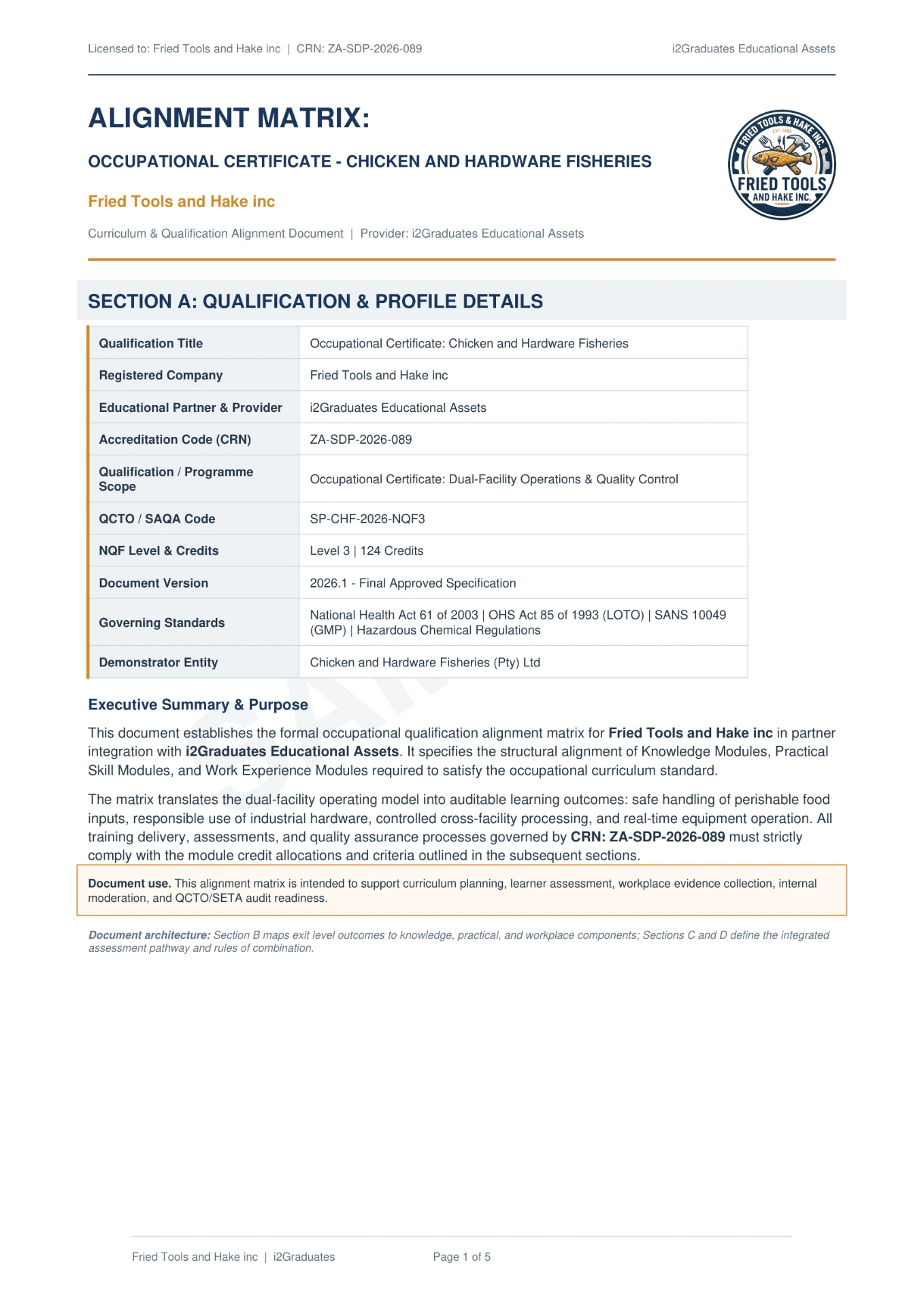
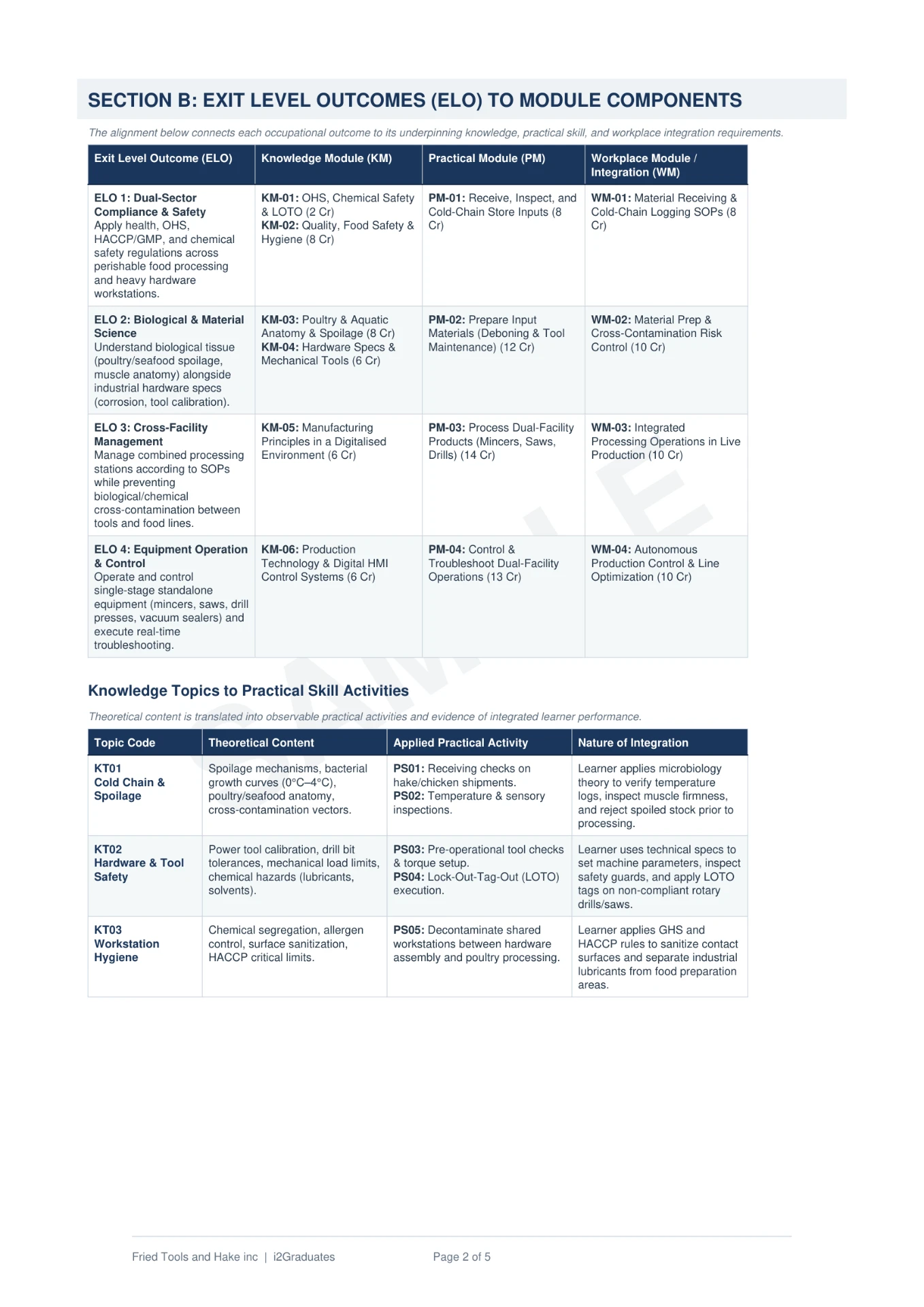
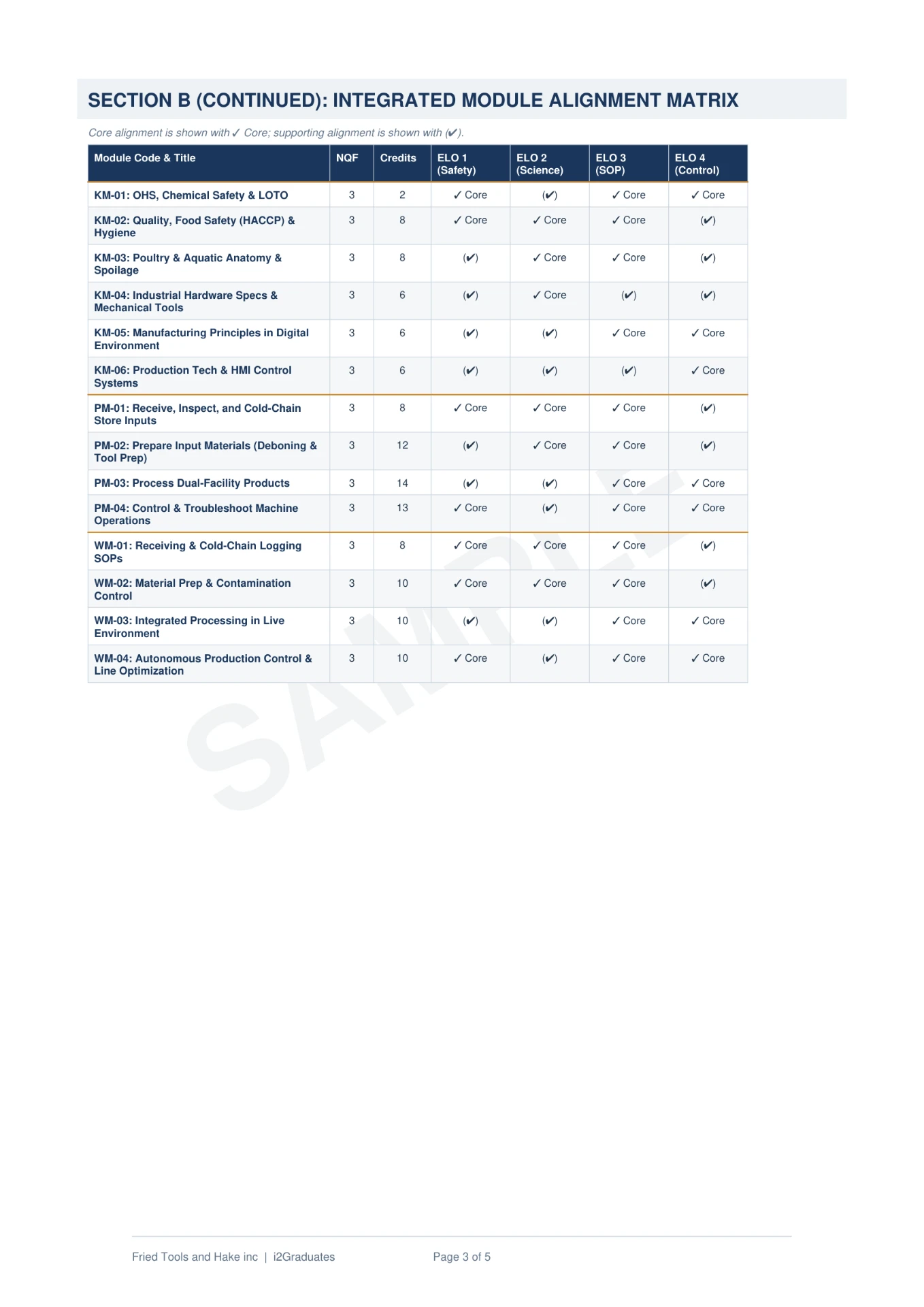
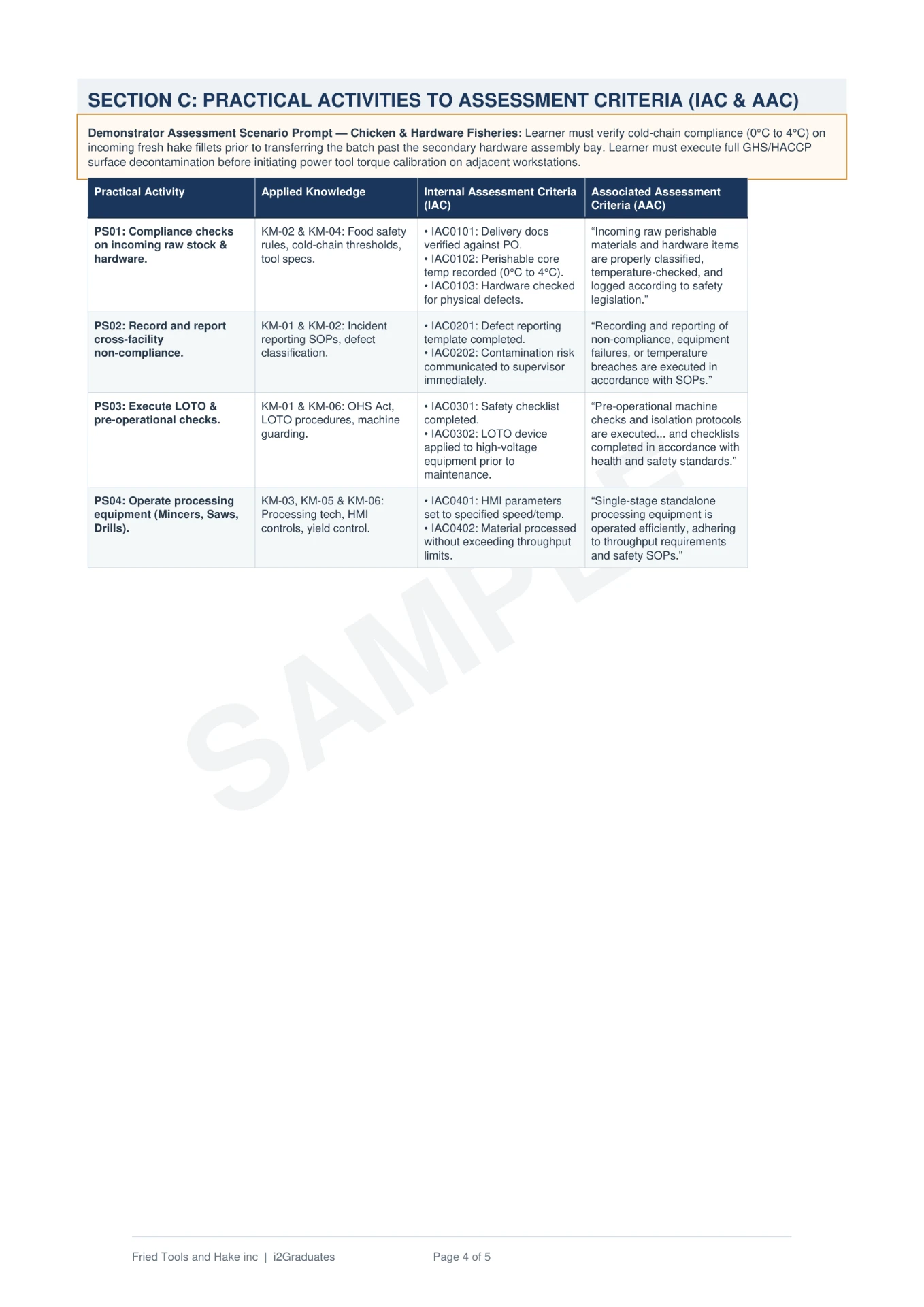
- SETA / QCTO Alignment Matrix
- Administrative & Onboarding Pack
- Implementation Plan
Moderator-Ready Curriculum Breakdown
14 modules · 150 creditsTheory, regulatory and safety knowledge. Each row carries the registered module code, NQF level and credit weight used for formative assessment rubric mapping.
- 715202-002-00-00-KM-0124 cr
Beaming and Sizing Process Technology
NQF Level 2
- 715202-002-00-00-KM-028 cr
Textile Production and Manufacturing Concepts
NQF Level 2
- 715202-002-00-00-KM-034 cr
Applied Numerical Literacy in the Textile Industry
NQF Level 2
- 715202-002-00-00-KM-044 cr
Applied English Literacy for the Textile Industry
NQF Level 2
Qualification 103181 · Curriculum Architecture
Occupational Certificate: Beaming and Sizing Machine Operator · NQF Level 2 (150 Credits)
Three Curriculum Pillars
Knowledge Modules
Classroom & E-Learning
- Facilitated lectures & self-study
- Written question banks
- Formative comprehension checks
Practical Skill Modules
Simulated Line Tasks
- Simulated line tasks
- Observation rubrics
- Structured task sheets
Work Experience Modules
On-the-Job Production
- On-the-job rotation
- Mentor logbooks
- Workplace sign-offs
Evidence & Audit Pipeline
Learner Portfolio of Evidence (PoE)Owner · Candidate▾
Admin & Registration
ID, learner contract, induction pack, POPIA consent.
Knowledge Evidence
Written assessments & question banks — KM-01 to KM-07.
Practical Evidence
Task sheets, observation rubrics, assessor photos.
Workplace Evidence
Logbooks, mentor sign-offs, supervisor letters.
Assessor Master FileOwner · Registered Assessor▾
Assessment Reports
Judgements, learner feedback, remediation agreements, appeals log.
Internal Moderation & Quality FileOwner · Moderator / SDP▾
Moderation Evidence
10% sampling matrix, HACCP/LOTO compliance sheets, SDP sign-off.
Final Accreditation Gateway
Issued by the accredited Skills Development Provider once internal moderation is signed off.
Provider submits declaration + PoE to the Assessment Quality Partner (AQP).
QCTO awards the SAQA-registered certificate on successful EISA outcome.
Audit & Compliance
Evidence & Audit Pipeline
From portfolio assembly to external sign-off — the exact route your evidence travels.
- Step 1
PoE Assembly
Learner evidence, formative records and logbook entries filed against the alignment matrix.
- Step 2
Internal Assessment
Registered assessor judges each KM/PM/WM outcome using the supplied instruments.
- Step 3
Internal Moderation
Sampling and verification of assessor decisions, with remediation loop before submission.
- Step 4
External Moderation
SETA/QCTO desktop audit and certification upload against registered credits.
Broken Standard vs i2Graduates Standard
The measurable delta between improvised material and an audit-ready suite.
Broken Standard
i2Graduates Standard
Curriculum Mapping
Photocopied guides with mismatched outcomes
4 KM + 5 PM + 5 WM modules mapped to NQF Level 2
Assessment Bank
Missing formative and summative assessments
Pre-validated assessment bank per module
Alignment Evidence
No alignment matrix — audit fails
FP&M SETA alignment matrix included
Facilitation
Facilitators improvise Beaming and Sizing Machine Operator delivery
Facilitator scripts + learner activities per credit
Portfolio of Evidence
PoE gaps flagged in moderation
PoE templates that survive external moderation
Pricing & Delivery Tiers
Base licence from R47 500
Digital Master Suite
Editable master files, licensed to your SDP
- Learner Guide, Facilitator Guide & Assessment Suite
- Workplace logbook + alignment matrix (editable)
- Instant digital delivery under institutional licence
- Free minor corrections for 12 months
Turnkey Print & Bound Package
Printed, bound and couriered per learner
- Everything in the Digital Master Suite
- Full-colour print, wire-bound learner packs
- Per-learner PoE folders and dividers
- Nationwide courier with tracked delivery
Full Enterprise Accreditation Bundle
Assets plus accreditation support end-to-end
- Everything in the Print & Bound Package
- Bespoke QMS build mapped to your scope
- Moderation dry-run + written remediation report
- Brand & metadata integration across the suite
Complementary Services
Optional add-ons that harden your accreditation scope before an external audit.
Bespoke QMS Build
We author your Quality Management System — policies, procedures, records, matrices — mapped to your accreditation scope. From R18,500.
Request QuoteModeration Consultation
External moderation dry-run on your PoE + delivery pack. Written report with fixes before your real audit. From R4,900.
Book Moderation SessionThe i2Graduates Quality Guarantee
Every page of this bundle is checked for sequence and structural accuracy — no missing pages, no shortcuts. You get pre-validated assessment instruments ready to survive rigorous compliance moderation, wrapped in a curriculum your facilitators will enjoy teaching.