
Occupational Qualification · B8
Discretionary Grant · RollingBeam House Machine Operator
- NQF Level
- NQF Level 2
- Credits
- 134
- Duration
- —
- SAQA ID
- 101551
Official QCTO Registry Profile
Source: SAQA / QCTO registry- SAQA ID
- 101551
- Min Credits
- 134
- Registered
- 2018-07-01
- Re-registration
- 2025-12-30
- Field
- Field 06 - Manufacturing, Engineering and Technology
- Sub-field
- Manufacturing and Assembly
Sample Asset Preview
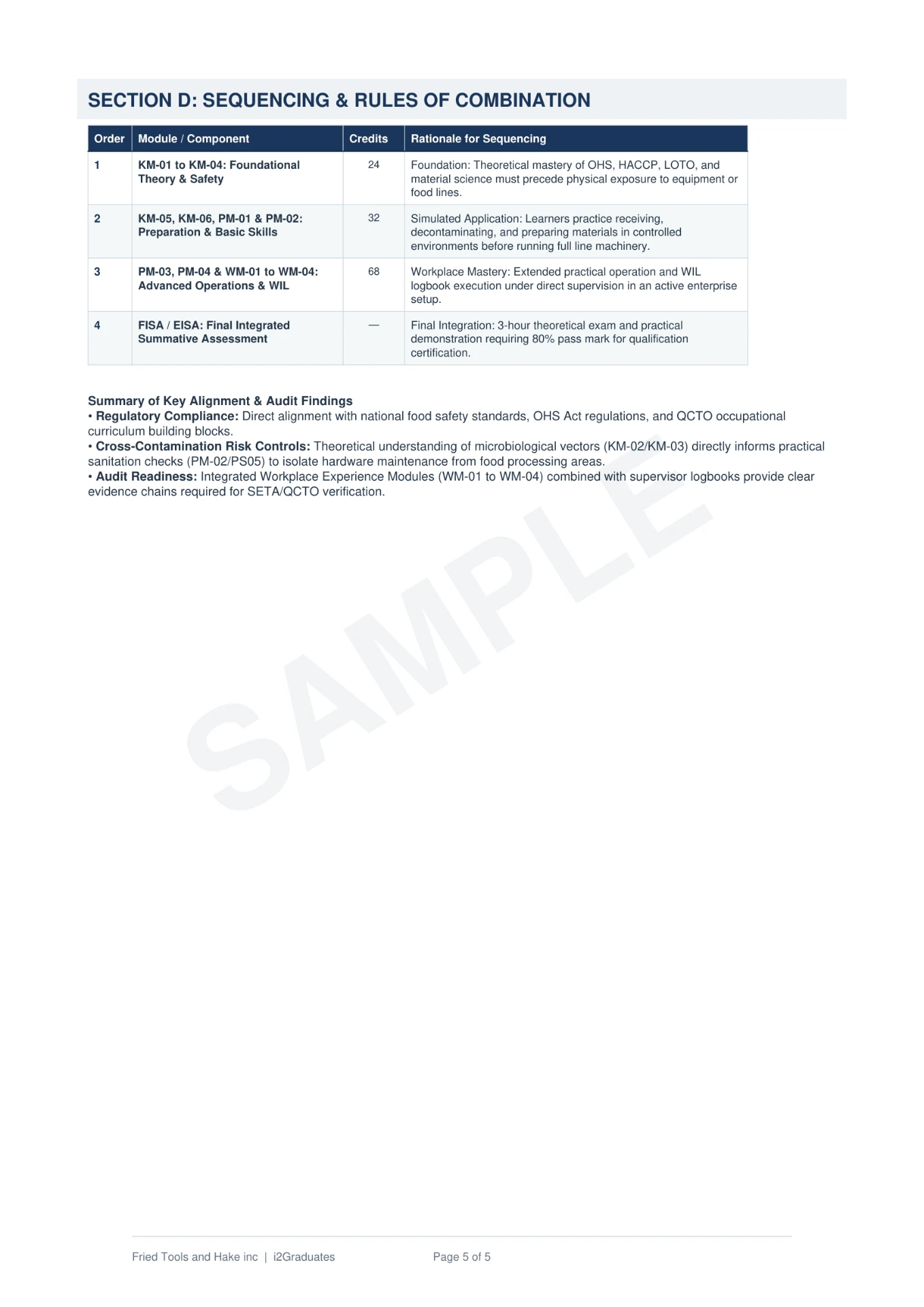
Overview & Scope
Programme Profile
- Target Designation
- Certified Beam House Machine Operator Practitioner
- Competency Focus
- Master specialised practical applications, safety criteria, and regulatory mandates required of a qualified Beam House Machine Operator.
- Academic Weight
- Full national recognition at NQF Level 2 yielding 134 credits upon successful PoE verification.
- Work Opportunities
- Deployment across As a qualified beam house machine operator, you can find employment opportunities in Furniture, Paper, Printing, Packaging, Forestry. Your skills will be in demand across both public and private sectors, and you may also choose to work as an independent contractor or start your own business in this field. operations under FP&M SETA scope.
- Audit Objective
- Bridges operational skills deficits under the governing FP&M SETA quality matrix.
- Value Proposition
- Measurable, legally compliant skills that optimise productivity, satisfy Workplace Skills Plans (WSP), and unlock B-BBEE scorecard weight.
Introduction▾
The Beam House Machine Operator is a Occupational Certificate set at NQF Level 2, comprising 134 credits. This qualification has been carefully developed to provide you with the essential knowledge, practical skills, and workplace experience needed to excel in your chosen field. Whether you are starting your career or looking to formalise your existing expertise, this programme offers a structured pathway to competence and recognition.
Purpose▾
The purpose of this qualification is to prepare a learner to operate as a Beam House Machine Operator. A Beam House Machine Operator handles raw hides and operates machinery and equipment in the lime yard to prepare raw hides and skins for tanning and convert raw hides and skins into pelts ready for the tanning operations. A qualified learner will be able to: • Handle raw hides/skins and operate a drum/paddle in the liming process to produce plumped hide/skin that has hair removed. • Handle raw hides/skins and operate a fleshing machine to remove fat and flesh from a hide/skin or limed hide/skin to produce a fleshed hide or a pelt. • Handle a limed and fleshed hide and operate a splitting machine by feeding in the pelt in such a way that there is as little variation in the thicknesses/substance of the split thus producing a grain split and a drop split.
Entry Requirements▾
Recognition of Prior Learning (RPL): RPL for access to the external integrated summative assessment: Accredited providers and approved workplaces must apply the internal assessment criteria specified in the related curriculum document to establish and confirm prior learning. Accredited providers and workplaces must confirm prior learning by issuing a statement of result or certifying a work experience record. RPL for access to the qualification: Accredited providers and approved workplaces may recognise prior learning against the relevant access requirements. Entry Requirements: • Level 1 with Mathematics.
SAQA Rationale▾
According to information available from the International Trade Centre (ITC), leather is one of the world's most widely traded commodities. The trade in leather and leather products - worth more than US$ 60 billion per year - is predicted to grow even further. Trade in hides and skins, and semi-processed tanned leather is a lucrative business. Exports of hides and skins have fallen in recent years to below 4%, and at the same time, the livestock population has jumped about 25% over the last decade, faster than the world trend. The ITC, with financial support from the Netherlands, launched its Integrated Leather Sector Export Development Programme for support to the leather manufacturing industry and to boost exports whereby the entire continent stands to benefit. The successful development of the sector could help reduce poverty in rural areas. As a labour-intensive industry, it is an important source of employment. A Blueprint for the African Leather Industry is a report commissioned by the United Nations (UN) Industrial Development Organisation and jointly prepared by ITC, the Food and Agriculture Organisation and the Common Fund for Commodities. It identifies Africa's potential and makes recommendations to players in the supply chain - governments, the private sector and international organisations. The report is the outcome of the "Meet in Africa 2002" meeting that brought together 25 African experts in Tunis. Information from the Department of Agriculture, Forestry and Fisheries, on the leather manufacturing industry in South Africa shows that hides, skins and leather are by-products of farming stock and wild animals bred primarily for meat consumption and are mainly recovered from slaughterhouses and farms. Because the leather industry depends on the recovery of hides and skins of the farming stock and wild animals, availability of raw material directly depends on the size of the animal population, the take-off ratio and the weight/size of the hide/skin recovered. The quality of South African hides has been positively influenced by the rise in the number of feedlots operating in the meat industry, with animals thus spending less time in the open veldt. These hides are rated to be superior to other sub-Saharan African and most Asian hides, but inferior to most hides from Australia, Argentina, the United States (US) and Europe. Their relatively small size renders them just marginally suited for upholstery and automotive leather. However, over 60% of South African hides are regarded as suitable for automotive leather. The Motor Industry Development Program (MIDP) was introduced to support the leather manufacturing industry. The key component of the MIDP with regards to automotive upholstery is that it contained an import-export complementation scheme. Export of stitched leather seat covers responded positively to this incentive and increased the demand for local hides and skins. The raw skins, hides and leather industry are also an important earner of foreign exchange through the export of raw leather and tanned leather. The industry exports mainly to Europe (Italy, Turkey and Germany) and to Asia (Japan, Republic of Korea, Hong Kong and China).
Learning Assumed to be in Place & RPL▾
Recognition of Prior Learning (RPL): RPL for access to the external integrated summative assessment: Accredited providers and approved workplaces must apply the internal assessment criteria specified in the related curriculum document to establish and confirm prior learning. Accredited providers and workplaces must confirm prior learning by issuing a statement of result or certifying a work experience record. RPL for access to the qualification: Accredited providers and approved workplaces may recognise prior learning against the relevant access requirements. Entry Requirements: • Level 1 with Mathematics.
Exit Level Outcomes▾
- Produce a limed hide/skin to company standards by operating a drum/paddle whilst complying with safety and company standards.
- Mix chemicals for a range of liquors used in the liming and soaking process.
- Interpret and apply the indicators on the liming process sheet.
- Apply basic calculations to the liming and soaking procedures in the beam house.
- Correctly identify and handle a range of raw hide and skin according to type, substance and consistency to conform to quality standards.
- Operate the fleshing machine by presenting the hide in the correct manner to the machine to produce a fleshed hide.
- Operate a splitting machine to perform a split of a hide/skin to produce a grain or drop split.
- Maintain the quality of the split.
- Comply with safety and health standards and requirements during operation of the fleshing machine.
Learning Material Included
- Learner Guide (Theory and Knowledge Modules)
- Facilitator Guide
- Workplace Logbook
- Formative and Summative Assessment
- Assessor Guide & Marking Memorandum
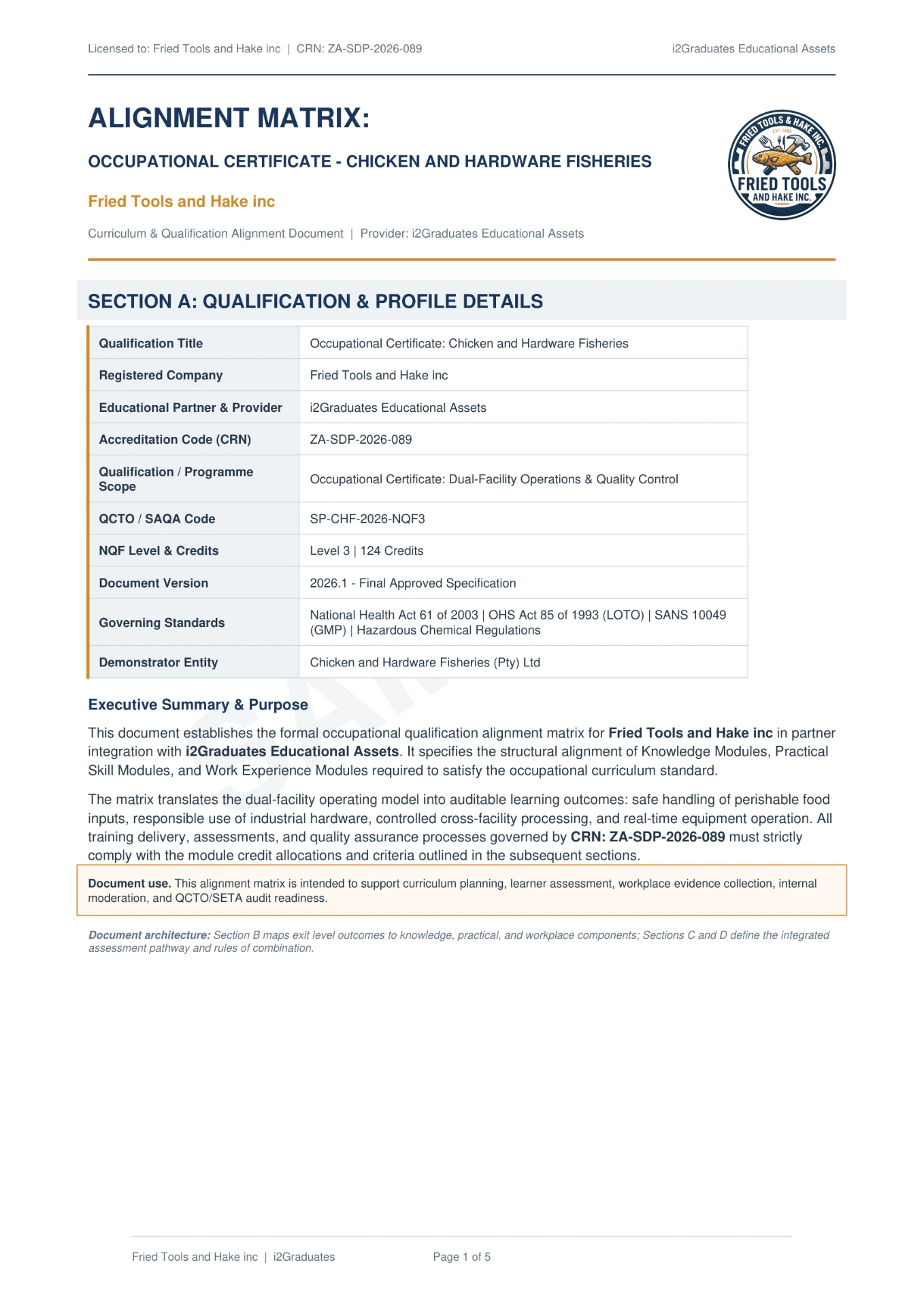
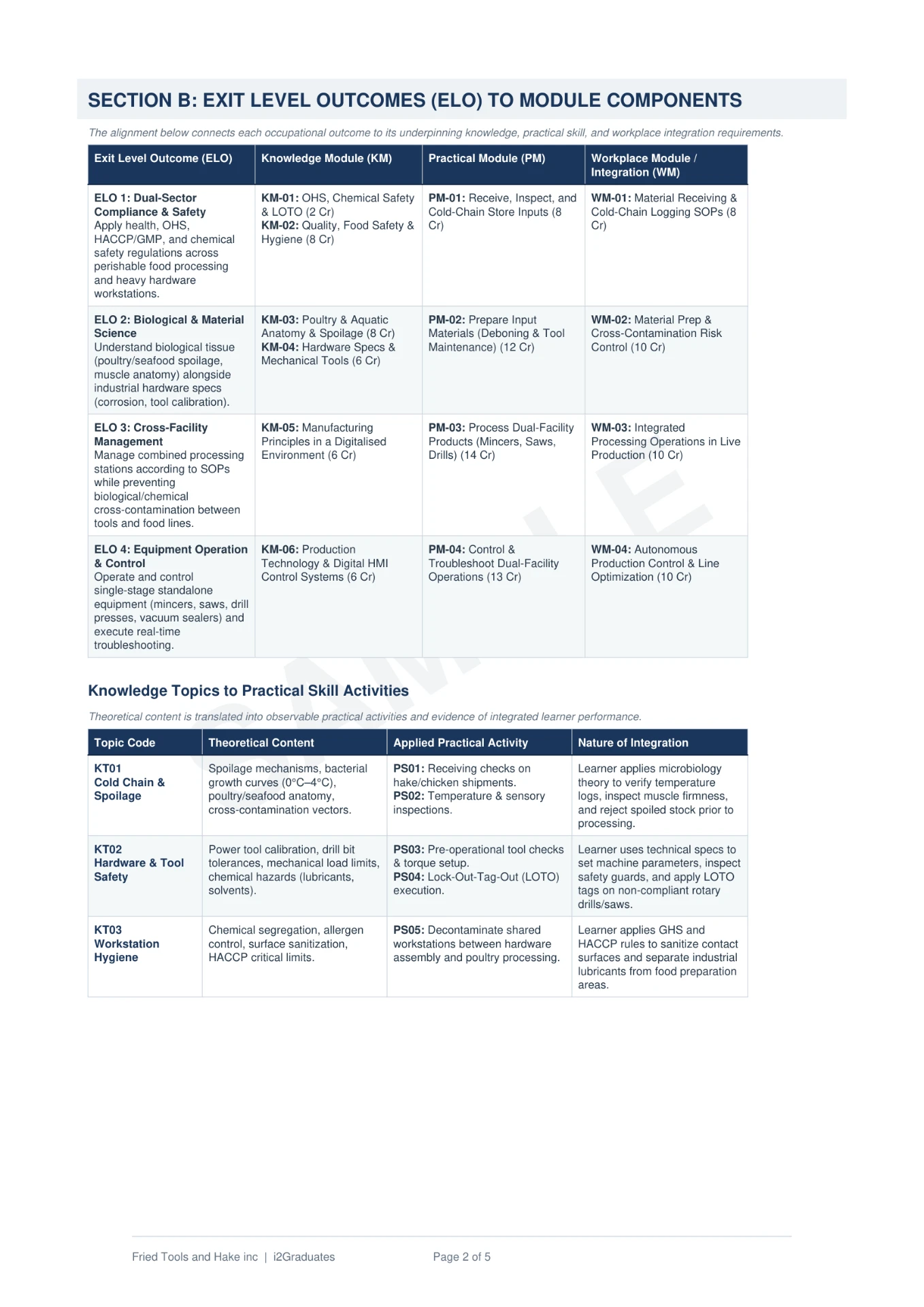
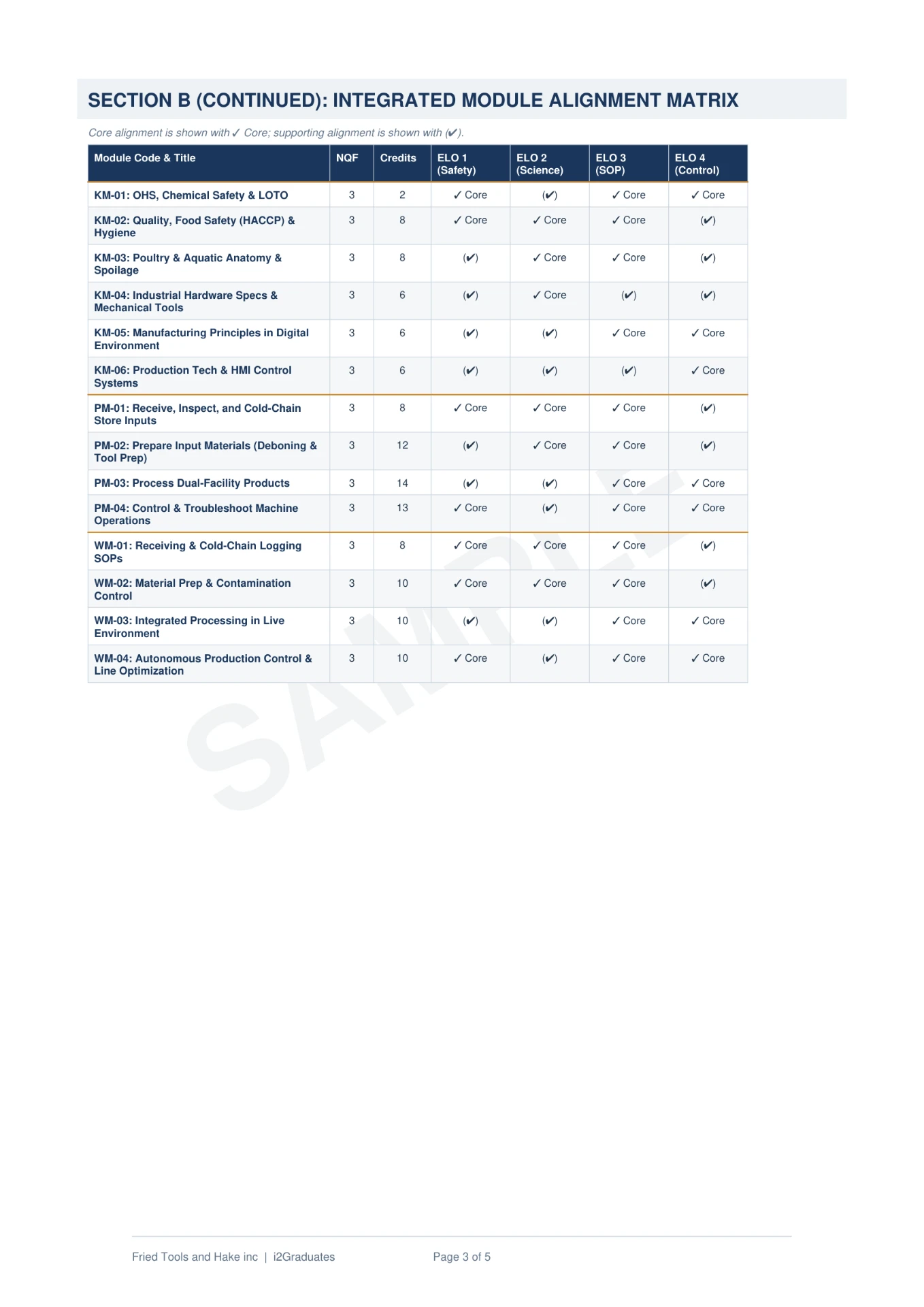
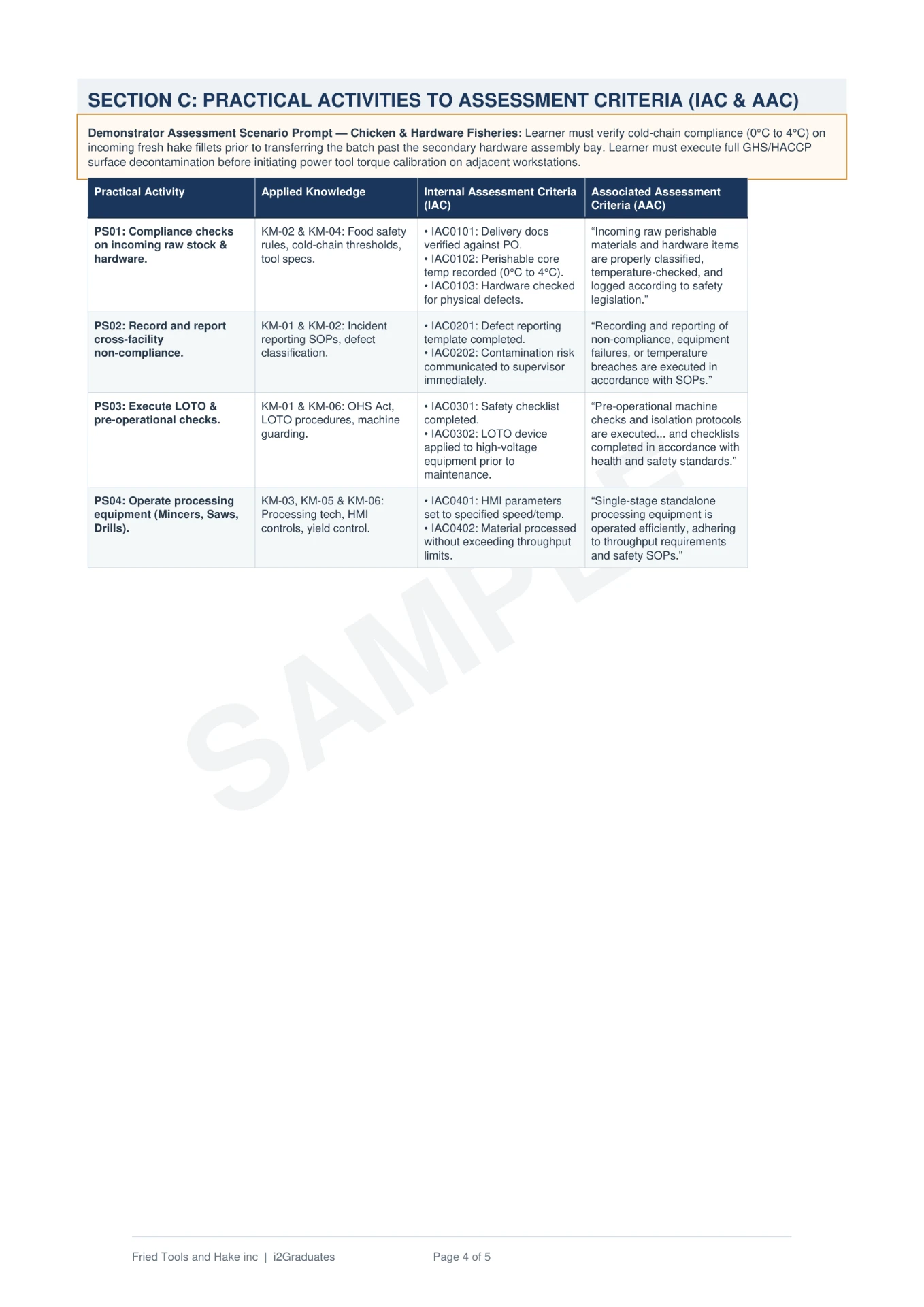
- SETA / QCTO Alignment Matrix
- Administrative & Onboarding Pack
- Implementation Plan
Moderator-Ready Curriculum Breakdown
9 modules · 102 creditsTheory, regulatory and safety knowledge. Each row carries the registered module code, NQF level and credit weight used for formative assessment rubric mapping.
- 715501001-KM-018 cr
Leather Lime Yard Processes Technology
NQF Level 2
- 715501001-KM-024 cr
Leather Fleshing Technology
NQF Level 2
- 715501001-KM-034 cr
Leather Splitting Processes Technology
NQF Level 2
- 715501001-KM-046 cr
Basic Leather Production and Manufacturing Concepts
NQF Level 2
- 715501001-KM-054 cr
Applied Numerical Literacy in the Leather Industry
NQF Level 2
- 715501001-KM-064 cr
Applied English Literacy for the Leather Industry
NQF Level 2
Qualification 101551 · Curriculum Architecture
Occupational Certificate: Beam House Machine Operator · NQF Level 2 (134 Credits)
Three Curriculum Pillars
Knowledge Modules
Classroom & E-Learning
- Facilitated lectures & self-study
- Written question banks
- Formative comprehension checks
Practical Skill Modules
Simulated Line Tasks
- Simulated line tasks
- Observation rubrics
- Structured task sheets
Work Experience Modules
On-the-Job Production
- On-the-job rotation
- Mentor logbooks
- Workplace sign-offs
Evidence & Audit Pipeline
Learner Portfolio of Evidence (PoE)Owner · Candidate▾
Admin & Registration
ID, learner contract, induction pack, POPIA consent.
Knowledge Evidence
Written assessments & question banks — KM-01 to KM-07.
Practical Evidence
Task sheets, observation rubrics, assessor photos.
Workplace Evidence
Logbooks, mentor sign-offs, supervisor letters.
Assessor Master FileOwner · Registered Assessor▾
Assessment Reports
Judgements, learner feedback, remediation agreements, appeals log.
Internal Moderation & Quality FileOwner · Moderator / SDP▾
Moderation Evidence
10% sampling matrix, HACCP/LOTO compliance sheets, SDP sign-off.
Final Accreditation Gateway
Issued by the accredited Skills Development Provider once internal moderation is signed off.
Provider submits declaration + PoE to the Assessment Quality Partner (AQP).
QCTO awards the SAQA-registered certificate on successful EISA outcome.
Audit & Compliance
Evidence & Audit Pipeline
From portfolio assembly to external sign-off — the exact route your evidence travels.
- Step 1
PoE Assembly
Learner evidence, formative records and logbook entries filed against the alignment matrix.
- Step 2
Internal Assessment
Registered assessor judges each KM/PM/WM outcome using the supplied instruments.
- Step 3
Internal Moderation
Sampling and verification of assessor decisions, with remediation loop before submission.
- Step 4
External Moderation
SETA/QCTO desktop audit and certification upload against registered credits.
Broken Standard vs i2Graduates Standard
The measurable delta between improvised material and an audit-ready suite.
Broken Standard
i2Graduates Standard
Curriculum Mapping
Photocopied guides with mismatched outcomes
6 KM + 3 PM + 0 WM modules mapped to NQF Level 2
Assessment Bank
Missing formative and summative assessments
Pre-validated assessment bank per module
Alignment Evidence
No alignment matrix — audit fails
FP&M SETA alignment matrix included
Facilitation
Facilitators improvise Beam House Machine Operator delivery
Facilitator scripts + learner activities per credit
Portfolio of Evidence
PoE gaps flagged in moderation
PoE templates that survive external moderation
Pricing & Delivery Tiers
Base licence from R46 700
Digital Master Suite
Editable master files, licensed to your SDP
- Learner Guide, Facilitator Guide & Assessment Suite
- Workplace logbook + alignment matrix (editable)
- Instant digital delivery under institutional licence
- Free minor corrections for 12 months
Turnkey Print & Bound Package
Printed, bound and couriered per learner
- Everything in the Digital Master Suite
- Full-colour print, wire-bound learner packs
- Per-learner PoE folders and dividers
- Nationwide courier with tracked delivery
Full Enterprise Accreditation Bundle
Assets plus accreditation support end-to-end
- Everything in the Print & Bound Package
- Bespoke QMS build mapped to your scope
- Moderation dry-run + written remediation report
- Brand & metadata integration across the suite
Complementary Services
Optional add-ons that harden your accreditation scope before an external audit.
Bespoke QMS Build
We author your Quality Management System — policies, procedures, records, matrices — mapped to your accreditation scope. From R18,500.
Request QuoteModeration Consultation
External moderation dry-run on your PoE + delivery pack. Written report with fixes before your real audit. From R4,900.
Book Moderation SessionThe i2Graduates Quality Guarantee
Every page of this bundle is checked for sequence and structural accuracy — no missing pages, no shortcuts. You get pre-validated assessment instruments ready to survive rigorous compliance moderation, wrapped in a curriculum your facilitators will enjoy teaching.