
Occupational Qualification · A32
Discretionary Grant · UpcomingAnimation Artist
- NQF Level
- NQF Level 5
- Credits
- 229
- Duration
- —
- SAQA ID
- 122662
Official QCTO Registry Profile
Source: SAQA / QCTO registry- SAQA ID
- 122662
- Min Credits
- 229
- Registered
- 2024-08-22
- Re-registration
- 2029-08-22
- Field
- Field 10 - Physical, Mathematical, Computer and Life Sciences
- Sub-field
- Information Technology and Computer Sciences
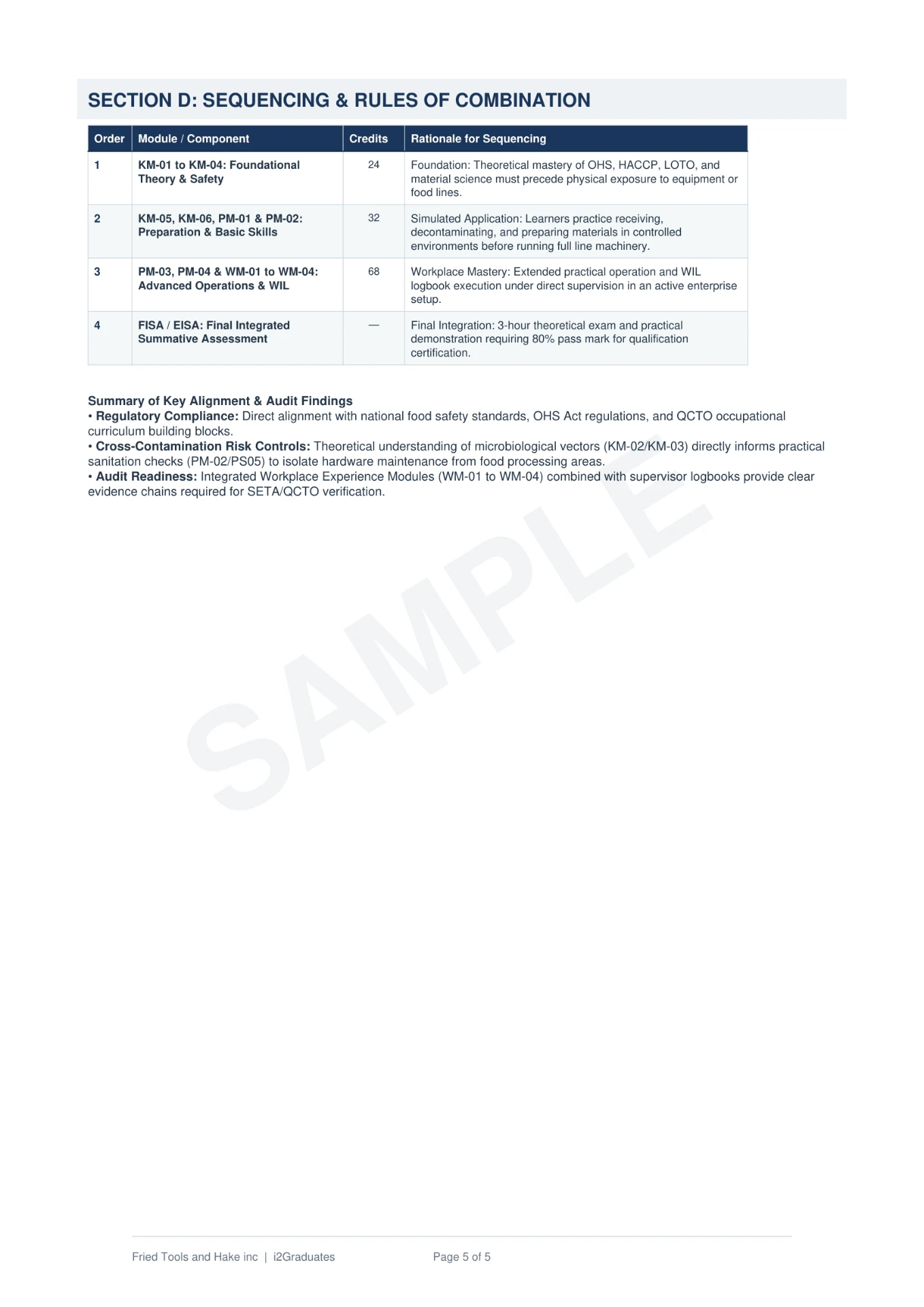
Sample Asset Preview
Overview & Scope
Programme Profile
- Target Designation
- Certified Animation Artist Practitioner
- Competency Focus
- Master specialised practical applications, safety criteria, and regulatory mandates required of a qualified Animation Artist.
- Academic Weight
- Full national recognition at NQF Level 5 yielding 229 credits upon successful PoE verification.
- Work Opportunities
- Deployment across As a qualified animation artist, you can find employment opportunities in Information Technology, Media, Communications. Your skills will be in demand across both public and private sectors, and you may also choose to work as an independent contractor or start your own business in this field. operations under MICT SETA scope.
- Audit Objective
- Bridges operational skills deficits under the governing MICT SETA quality matrix.
- Value Proposition
- Measurable, legally compliant skills that optimise productivity, satisfy Workplace Skills Plans (WSP), and unlock B-BBEE scorecard weight.
Introduction▾
The Animation Artist is a Higher Occupational Certificate set at NQF Level 5, comprising 229 credits. This qualification has been carefully developed to provide you with the essential knowledge, practical skills, and workplace experience needed to excel in your chosen field. Whether you are starting your career or looking to formalise your existing expertise, this programme offers a structured pathway to competence and recognition.
Purpose▾
The purpose of this qualification is to prepare a learner to function as an Animation Artist. Animation artists create a range of visual content in varying animation, art, and design styles for different purposes. These include cartoons, artistic shorts, music videos, educational videos, narrative features or TV series, title sequences, explainer videos, commercials, and marketing materials. They may use traditional or digital tools or a mix of the two to create digital, traditional or tradigital visual content. A qualified learner will be able to: • Determine target market for animated visual content and style preferences. • Prepare for production of animated visual content. • Create and produce animated visual content in preferred style for specific purposes, clients, and audiences. • Conduct business processes related animated visual creation.
Entry Requirements▾
Recognition of Prior Learning (RPL): RPL for Access to Training: Learners may use the RPL process to gain access to training opportunities for a programme of learning, qualification, part-qualification, or skills programme if they do not meet the formal, minimum entry requirements for admission. RPL assessment provides an alternative access route into a programme of learning, qualification, part-qualification, or skills programme. Such an RPL assessment may be developed, moderated, and conducted by the accredited Skills Development Provider which offers that specific qualification/part qualification/skills programme. Such an assessment must ensure that the learner is able to display the equivalent level of competencies required for access, based on the NQF level descriptors. RPL for exemption For exemption from modules through RPL, learners who have gained the stipulated competencies of the modules of a programme of learning, qualification, part-qualification, or skills programme through any means of formal, informal, or non-formal learning and/or work experience, may be awarded credits towards relevant modules, and gaps identified for training, which is then concluded. Entry Requirements: An NQF Level 4 qualification.
SAQA Rationale▾
The Graphic Media and Animation Sector in South Africa is a growing sector of the media industry. Though there is an overlap in the basic skills to create graphic media, animation artists require very specific skills. The Higher Occupational Certificate: Animation Artist is developed to include the generic skills required by graphic media developers, and also address the specialised skills required by animation artists. Animation plays a critical role in the media industry for advertising, educational and entertainment purposes. Animation artists bring creative and innovative ideas to the sector, pushing the boundaries of visual storytelling and graphic design. The qualification is focused on honing the skills required by animation artists to further diversify the offerings of the graphic media sector. This will add to the industry's capacity to create high-quality animations, raising the overall standard of productions in the sector which, promote the South African industry. The qualification will provide companies in the sector employing qualified animation artists with a competitive edge by offering cutting-edge visual solutions, attracting more clients and projects. This competitive edge is further enhanced by the qualification's focus on developing animation artists to collaborate with professionals from other fields, fostering a multidisciplinary approach within the sector. The South African society will benefit from the emphasis the qualification places on sensitivity to culture, traditions, and stories, fostering a sense of identity and pride among citizens. Animated content such as films, series, and advertisements provide entertainment, catering for diverse audience preferences and enhancing overall societal well-being. The economy benefits from the contribution made by the South African Animation sector. As the animation sector grows, it creates employment opportunities for animators, scriptwriters, voice actors, and various supporting roles, reducing unemployment rates. Trained animation artists often become entrepreneurs, starting animation studios and related businesses, contributing to economic diversification. Typical learners include people who are already working within the graphic media and animation environment and those who wish to enter the field. The qualifying learner will operate in occupations such as Animation Artist. Qualified learners may access employment and or establish their studios to earn a living. Representatives working in all spheres of the graphic media and animation sector were consulted in the realignment of the qualification. There is no similar qualification registered on the National Qualifications Framework.
Learning Assumed to be in Place & RPL▾
Recognition of Prior Learning (RPL): RPL for Access to Training: Learners may use the RPL process to gain access to training opportunities for a programme of learning, qualification, part-qualification, or skills programme if they do not meet the formal, minimum entry requirements for admission. RPL assessment provides an alternative access route into a programme of learning, qualification, part-qualification, or skills programme. Such an RPL assessment may be developed, moderated, and conducted by the accredited Skills Development Provider which offers that specific qualification/part qualification/skills programme. Such an assessment must ensure that the learner is able to display the equivalent level of competencies required for access, based on the NQF level descriptors. RPL for exemption For exemption from modules through RPL, learners who have gained the stipulated competencies of the modules of a programme of learning, qualification, part-qualification, or skills programme through any means of formal, informal, or non-formal learning and/or work experience, may be awarded credits towards relevant modules, and gaps identified for training, which is then concluded. Entry Requirements: An NQF Level 4 qualification.
Exit Level Outcomes▾
- Apply procedures to determine target market for animated visual content preferences by applying industry related processes of analysis, synthesis, and evaluation.
- Conduct pre-production processes for creating animated visual content by selecting and applying industry specific pre-production processes, methods, procedures, or techniques.
- Create and produce animation art content applying animation production methods, processes, procedures, and techniques.
- Apply business processes related to creating animation art applying key terms, rules, concepts, established principles, and theories.
Learning Material Included
- Learner Guide (Theory and Knowledge Modules)
- Facilitator Guide
- Workplace Logbook
- Formative and Summative Assessment
- Assessor Guide & Marking Memorandum
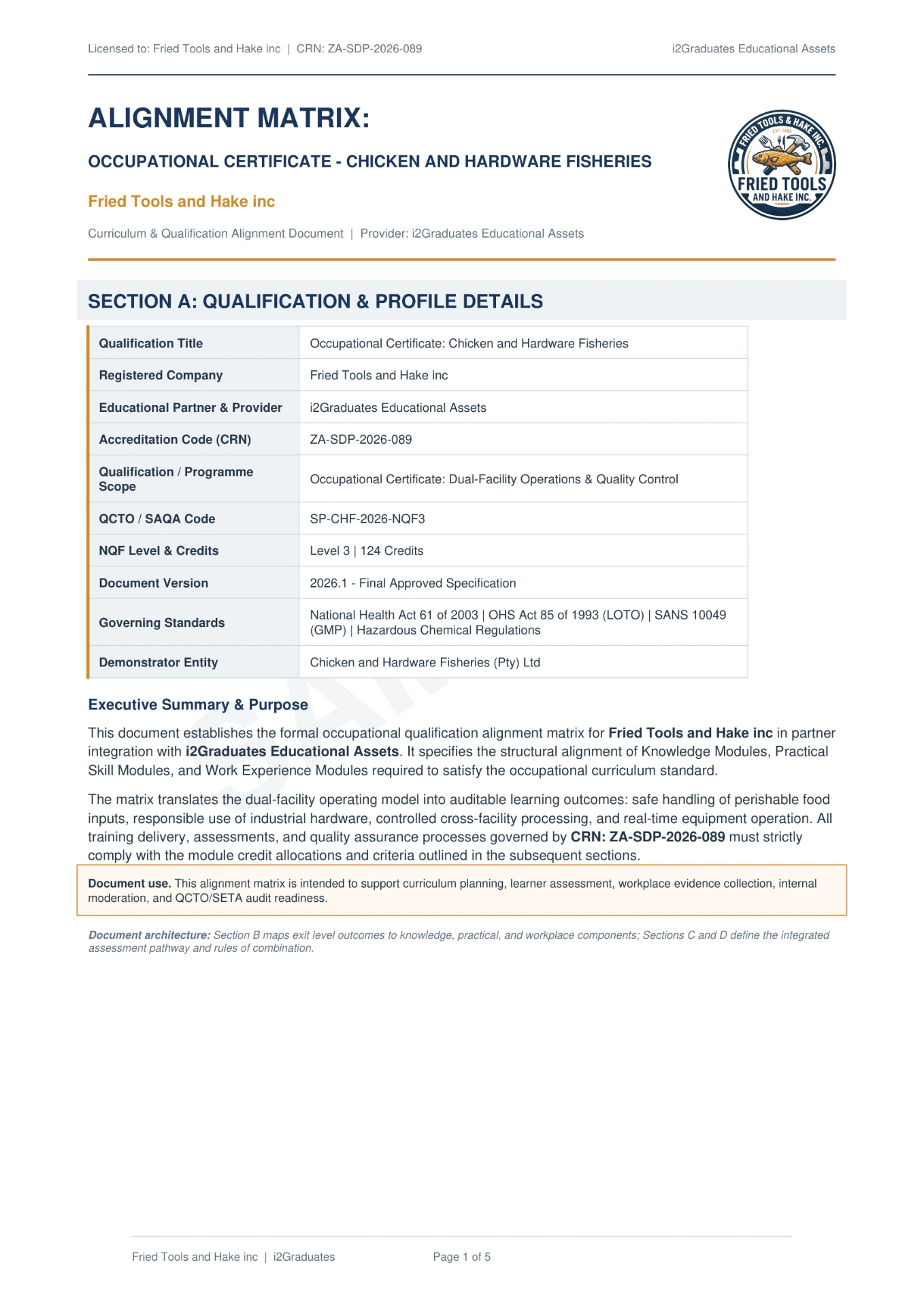
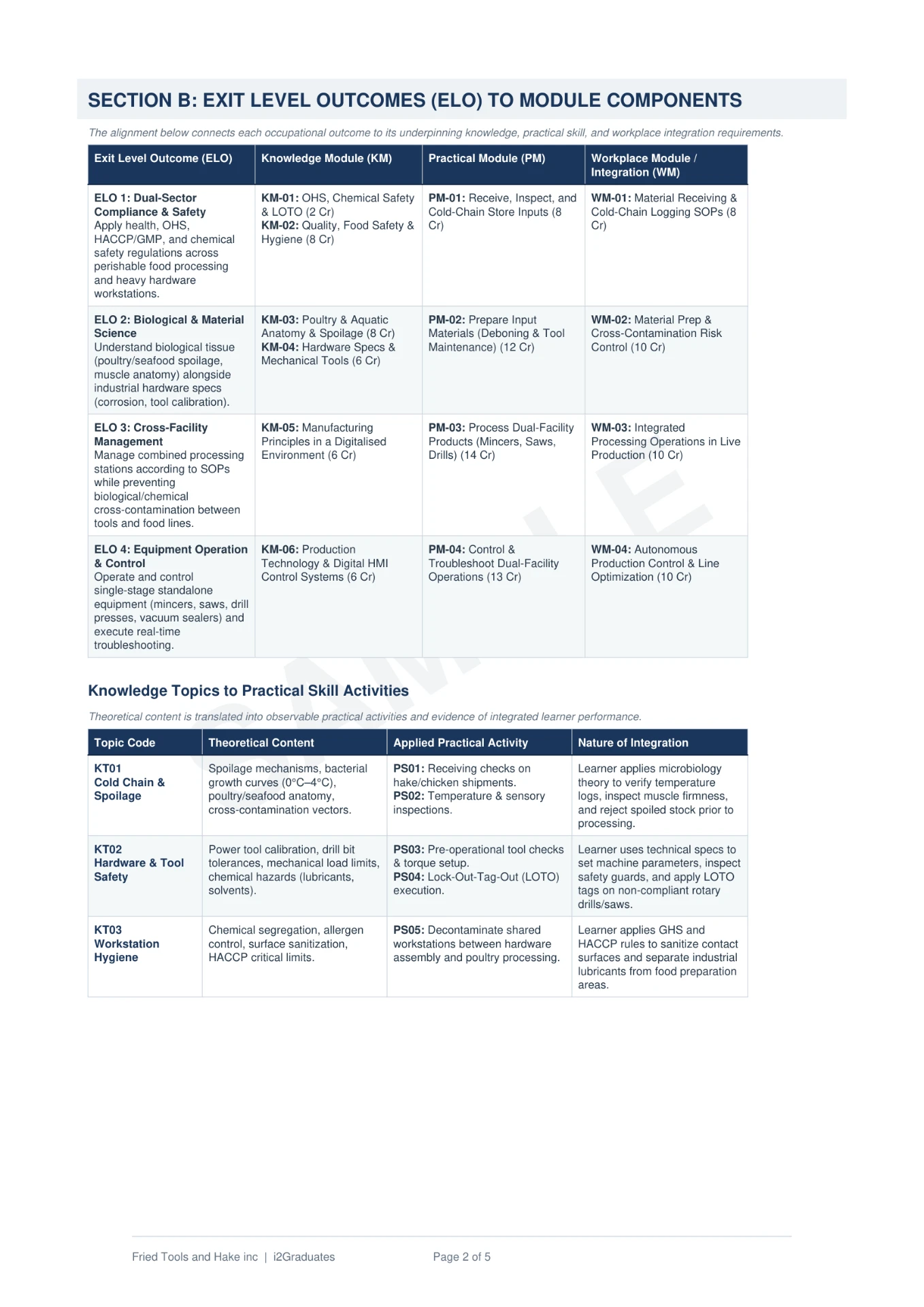
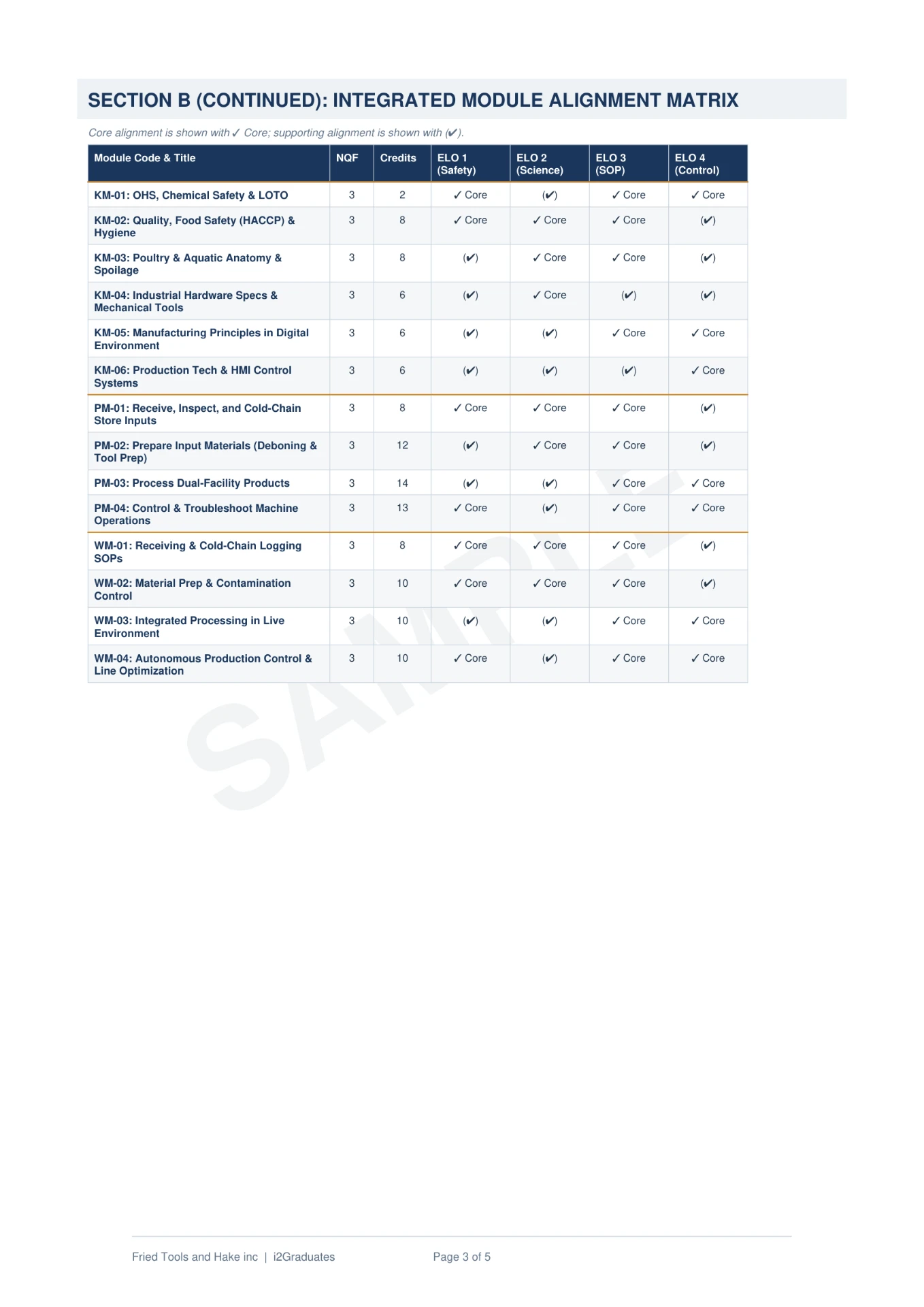
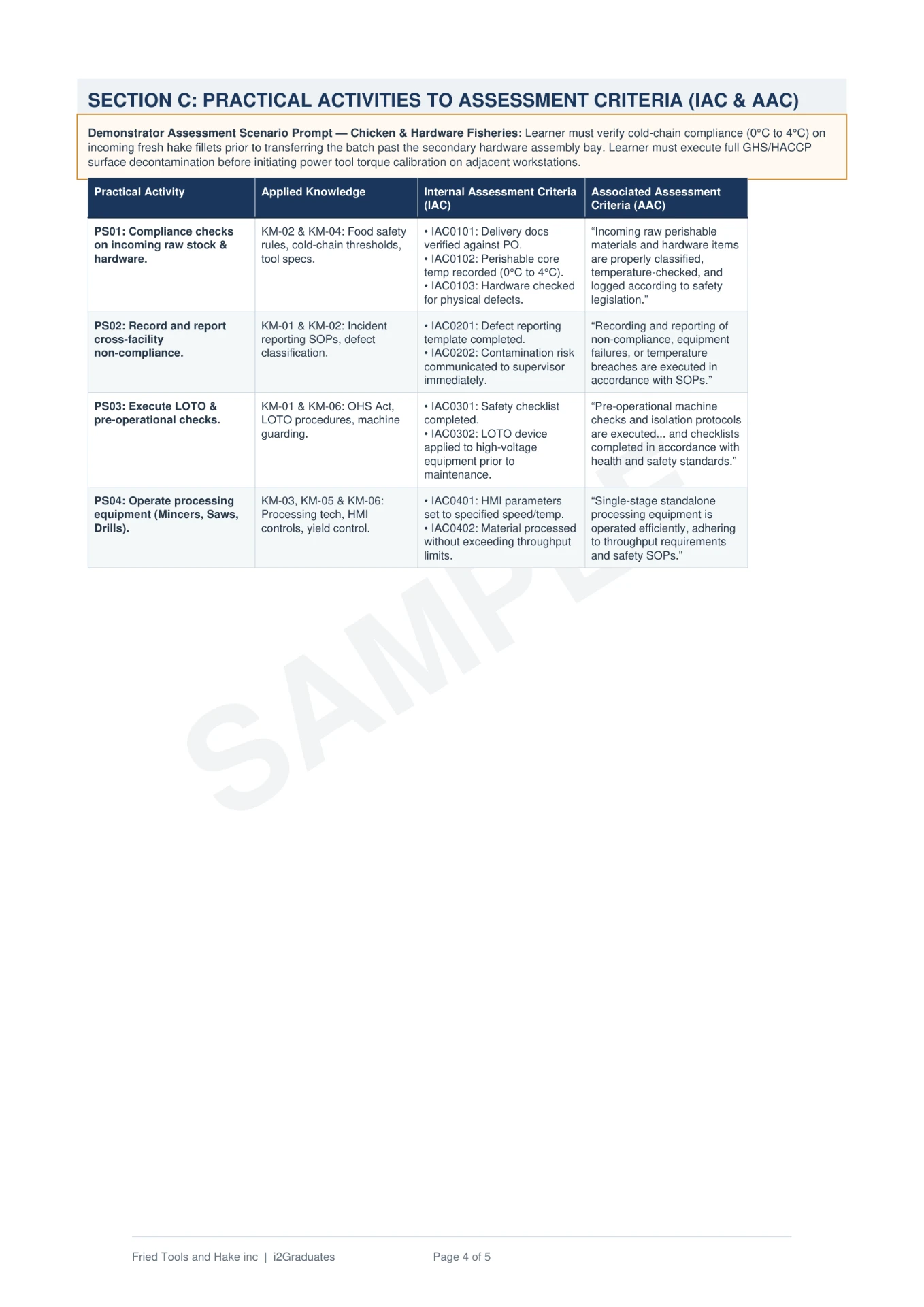
- SETA / QCTO Alignment Matrix
- Administrative & Onboarding Pack
- Implementation Plan
Moderator-Ready Curriculum Breakdown
14 modules · 229 creditsTheory, regulatory and safety knowledge. Each row carries the registered module code, NQF level and credit weight used for formative assessment rubric mapping.
- 216601-001-00-KM-0110 cr
Basic Elements and Principles of Design
NQF Level 4
- 216601-001-00-KM-0225 cr
Principles of Visual Content Development
NQF Level 4
- 216601-001-00-KM-0315 cr
Principles of Photography & Videography for Visual Content Developers
NQF Level 4
- 216601-001-00-KM-0425 cr
Principles of Design Technology Used by Visual Content Developers
NQF Level 5
- 216601-001-00-KM-0510 cr
Business Communication and Administration
NQF Level 4
- 216601-001-00-KM-0630 cr
Principles Underpinning the Animation Pipeline
NQF Level 5
Qualification 122662 · Curriculum Architecture
Higher Occupational Certificate: Animation Artist · NQF Level 5 (229 Credits)
Three Curriculum Pillars
Knowledge Modules
Classroom & E-Learning
- Facilitated lectures & self-study
- Written question banks
- Formative comprehension checks
Practical Skill Modules
Simulated Line Tasks
- Simulated line tasks
- Observation rubrics
- Structured task sheets
Work Experience Modules
On-the-Job Production
- On-the-job rotation
- Mentor logbooks
- Workplace sign-offs
Evidence & Audit Pipeline
Learner Portfolio of Evidence (PoE)Owner · Candidate▾
Admin & Registration
ID, learner contract, induction pack, POPIA consent.
Knowledge Evidence
Written assessments & question banks — KM-01 to KM-07.
Practical Evidence
Task sheets, observation rubrics, assessor photos.
Workplace Evidence
Logbooks, mentor sign-offs, supervisor letters.
Assessor Master FileOwner · Registered Assessor▾
Assessment Reports
Judgements, learner feedback, remediation agreements, appeals log.
Internal Moderation & Quality FileOwner · Moderator / SDP▾
Moderation Evidence
10% sampling matrix, HACCP/LOTO compliance sheets, SDP sign-off.
Final Accreditation Gateway
Issued by the accredited Skills Development Provider once internal moderation is signed off.
Provider submits declaration + PoE to the Assessment Quality Partner (AQP).
QCTO awards the SAQA-registered certificate on successful EISA outcome.
Audit & Compliance
Evidence & Audit Pipeline
From portfolio assembly to external sign-off — the exact route your evidence travels.
- Step 1
PoE Assembly
Learner evidence, formative records and logbook entries filed against the alignment matrix.
- Step 2
Internal Assessment
Registered assessor judges each KM/PM/WM outcome using the supplied instruments.
- Step 3
Internal Moderation
Sampling and verification of assessor decisions, with remediation loop before submission.
- Step 4
External Moderation
SETA/QCTO desktop audit and certification upload against registered credits.
Broken Standard vs i2Graduates Standard
The measurable delta between improvised material and an audit-ready suite.
Broken Standard
i2Graduates Standard
Curriculum Mapping
Photocopied guides with mismatched outcomes
6 KM + 4 PM + 4 WM modules mapped to NQF Level 5
Assessment Bank
Missing formative and summative assessments
Pre-validated assessment bank per module
Alignment Evidence
No alignment matrix — audit fails
MICT SETA alignment matrix included
Facilitation
Facilitators improvise Animation Artist delivery
Facilitator scripts + learner activities per credit
Portfolio of Evidence
PoE gaps flagged in moderation
PoE templates that survive external moderation
Pricing & Delivery Tiers
Base licence from R66 450
Digital Master Suite
Editable master files, licensed to your SDP
- Learner Guide, Facilitator Guide & Assessment Suite
- Workplace logbook + alignment matrix (editable)
- Instant digital delivery under institutional licence
- Free minor corrections for 12 months
Turnkey Print & Bound Package
Printed, bound and couriered per learner
- Everything in the Digital Master Suite
- Full-colour print, wire-bound learner packs
- Per-learner PoE folders and dividers
- Nationwide courier with tracked delivery
Full Enterprise Accreditation Bundle
Assets plus accreditation support end-to-end
- Everything in the Print & Bound Package
- Bespoke QMS build mapped to your scope
- Moderation dry-run + written remediation report
- Brand & metadata integration across the suite
Complementary Services
Optional add-ons that harden your accreditation scope before an external audit.
Bespoke QMS Build
We author your Quality Management System — policies, procedures, records, matrices — mapped to your accreditation scope. From R18,500.
Request QuoteModeration Consultation
External moderation dry-run on your PoE + delivery pack. Written report with fixes before your real audit. From R4,900.
Book Moderation SessionThe i2Graduates Quality Guarantee
Every page of this bundle is checked for sequence and structural accuracy — no missing pages, no shortcuts. You get pre-validated assessment instruments ready to survive rigorous compliance moderation, wrapped in a curriculum your facilitators will enjoy teaching.